
Bystrzyca Kłodzka
Accommodation in Bystrzyca Kłodzka
Historic fortifications, an unusual Gothic church building, and a museum dedicated to the history of making fire give Bystrzyca Kłodzka a distinct cultural profile. Several routes through the town and from its center also offer different ways to get to know the place.
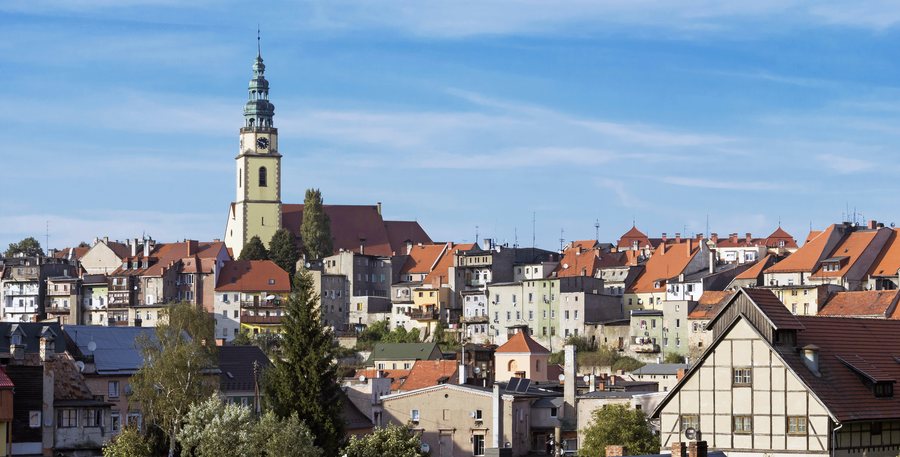 File:2014 Bystrzyca Kłodzka, stare miasto 11.jpg
Photo: Jacek Halicki via Wikimedia Commons, CC BY-SA 3.0 pl
File:2014 Bystrzyca Kłodzka, stare miasto 11.jpg
Photo: Jacek Halicki via Wikimedia Commons, CC BY-SA 3.0 pl
Quick facts about Bystrzyca Kłodzka
The historic center has historical and cultural value as a testament to the history of the Kłodzko Land, its civilizational development, and urban planning. The signposted Miejska Trasa Turystyczna runs through Bystrzyca Kłodzka. The Miejska Trasa Spacerowa also follows the historic town walls, stretching from ul. Międzyleśna to ul. Podmiejska. Key cultural sites include the Church of St. Michael the Archangel, the Baszta Kłodzka, the Brama Wodna, and the Muzeum Filumenistyczne.
Which routes are useful for getting oriented?
The two town routes have different focuses. The Miejska Trasa Turystyczna passes through the town and is signposted. The Miejska Trasa Spacerowa, by contrast, specifically follows the historic town walls and has named endpoints at ul. Międzyleśna and ul. Podmiejska. Those interested in the town’s history and fortifications will find clear reference points for getting oriented; the two routes are described here as separate offerings.
Another option leads out of the town center: a 1.5 km section of the yellow hiking trail runs from there to the Chapel of St. Florian. The stated distance can help you factor this route into your day’s plans. The routes through the town and the section leading to the chapel can be considered according to your interests, without assuming that they form a single continuous route.
What do the Old Town and fortifications tell us?
The historic center is defined not only by individual buildings, but also by its urban planning, which bears witness to the development of the Kłodzko Land. The Baszta Kłodzka is part of the town’s fortifications dating from the early 14th century and has a viewing platform. The stone Brama Wodna fortification also dates from the early 14th century. The two names refer to different parts of the town’s defenses.
The Church of St. Michael the Archangel has existed since the 13th century. It is a rare Gothic example of a two-nave hall church; its tower is integrated into the town’s fortifications. Inside are a 15th-century statue of the Madonna and Child and a stone baptismal font from 1577. The church thus brings together several distinct features: its long history, its unusual architectural form, and furnishings from different centuries.
What makes the Muzeum Filumenistyczne special?
The Muzeum Filumenistyczne is housed in a former Protestant church and a former parish school. The complex was designed by Karl Friedrich Schinkel. In 1964, the former church and school were remodeled inside, connected, and adapted for exhibition purposes. The museum’s current address is therefore in a historic building complex whose former use and subsequent transformation are part of its story. The Muzeum Filumenistyczne focuses on the history of making fire; it is the only institution in Poland devoted to this subject.
Which historic routes lead beneath the town?
The Podziemna Trasa Turystyczna is another of the town’s cultural and historical attractions. It was intended to preserve for posterity part of the original and characteristic underground mining passages beneath the historic Old Town. In 2002, a 350 m² section of the route was opened to visitors. This figure refers to the section made accessible and to that year; it does not describe the total area of the underground passages. Those interested in the development of the Old Town can also explore its underground history.
For a look at more destination pages, you can also visit Bad Reinerz, Jodlow, Wójtowice, Młynowiec, Raszków, Domaszków, Sienna, and Glatz.
FAQ
How long is the hiking trail to the Chapel of St. Florian?
A 1.5 km section of the yellow hiking trail leads from the town center to the Chapel of St. Florian.
Which buildings are part of the historic fortifications?
The Baszta Kłodzka is part of the town’s fortifications dating from the early 14th century. The Brama Wodna is a stone fortification from the same period.
What was opened to visitors at the Podziemna Trasa Turystyczna in 2002?
In 2002, a 350 m² section of the Podziemna Trasa Turystyczna was opened to visitors.
For the broader travel overview: Kłodzki.

