
Discover Kłodzko
Accommodation in Kłodzko
Kłodzko combines the history of its fortress and underground walks with museums, churches and family activities. Which aspects of the city you choose to explore further depends on whether you are more interested in historic buildings, collections or a themed walk.
Kłodzko at a glance
- The upper visitor route at Twierdza Kłodzko presents the history of the complex from the 10th to the 20th century.
- A roughly seven-kilometre underground defence system stretches beneath the fortress’s Stok bojowy.
- Muzeum Ziemi Kłodzkiej is housed in a Baroque building that was once a Jesuit college.
- Minieuroland features miniature landmarks from Poland, Europe and around the world; a city route invites children to solve puzzles.
What underground experiences does Kłodzko offer?
At Twierdza Kłodzko, the upper visitor route explores the history of the fortress complex, spanning the 10th to the 20th century. Beneath the entire Stok bojowy lies a roughly seven-kilometre underground defence system. This description refers to the historic fortifications; the tourist route through the Kłodzko Underground Labyrinth is a separate experience.
The “1000 Years of Poland Underground Tourist Route” was created in the 1960s. It runs for about 600 metres, from ul. Czeska at the foot of the fortress to ul. Zawiszy Czarnego. Along the walk, city music, the sounds of tavern visitors and fairground noises evoke the atmosphere of Kłodzko in the past. Kłodzko therefore offers two distinct underground themes: the fortress’s defensive role and an immersive evocation of the city’s former life.
Events from the Napoleonic campaign are also reenacted on the Stok bojowy. A visit to the fortress can therefore appeal to those interested in military history, while the walk through the labyrinth offers other insights into the city’s past.
What do the museums and buildings reveal about the city?
Muzeum Ziemi Kłodzkiej is housed in a Baroque building that was once a Jesuit college. Its most important collections include pewter, numismatics, Silesian clocks from the period of industrialisation in Lower Silesia, and fine glassware. These include works by artists who were active in the Ziemia Kłodzka region after 1945. In medieval underground rooms more than six metres deep, the museum also presents the everyday life of Kłodzko’s former residents.
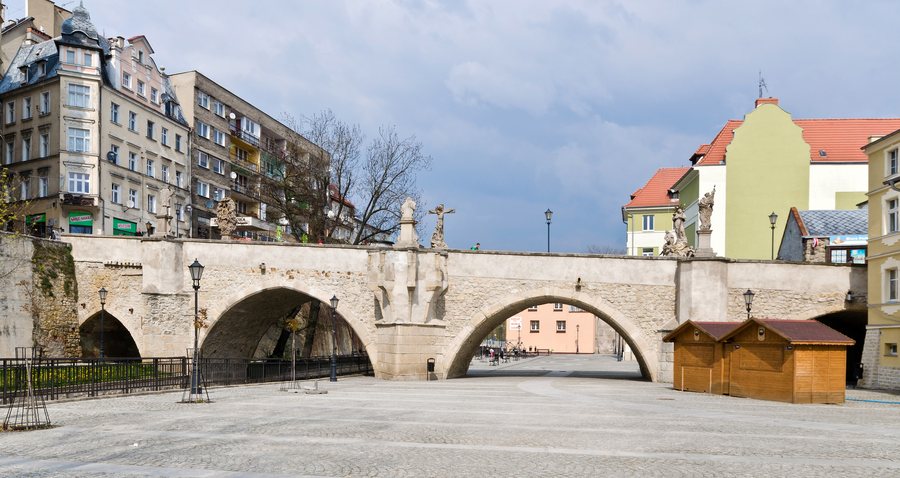
The city’s buildings offer a range of different highlights. The Parish Church of the Assumption of the Blessed Virgin Mary is the oldest surviving church in Kłodzko; its architecture and interior are primarily Late Gothic, with particularly strong Baroque influences. The Gothic bridge is dated uncertainly to between 1281 and 1390 and replaced an earlier wooden bridge. It is adorned with six votive figures. The Rynek is an integral part of the historic old town.
The Baroque Marian Column is a votive monument commemorating the city’s deliverance from plague and fire, and recalls two tragic events that struck Kłodzko. A 17th-century palace belonging to the Wallis family, originally from Ireland and Wales, also survives on ul. Czeska. The church, bridge, column and palace each offer a different reason to explore the city’s architecture and history.
What activities appeal to families and young visitors?
Minieuroland combines leisure and entertainment for the whole family with miniature models of well-known buildings from Poland, Europe and around the world. The models offer a different focus from the city’s historic sites: here, scaled-down landmarks take centre stage. The selection of miniatures may be of particular interest if you want to discover buildings and regions from different parts of the world in one park.
Young visitors can also follow the “Szlakiem kłodzkich zabytków: dla dzieci” route. It invites them to take a walk through Kłodzko, with puzzles, secrets and surprises along the way. This makes it different from the underground walks: instead of the history of the fortress or the sounds of city life, the focus is on a puzzle-filled walk for children.
Discover more destinations: Bielice, Raszków, Bad Langenau, Szczytna, Wójtowice, Domaszków, Idzików and Młynowiec.
FAQ
What can you learn on the upper route at Twierdza Kłodzko?
It presents the history of the fortress complex from the 10th to the 20th century. Beneath the Stok bojowy there is also a roughly seven-kilometre underground defence system.
How do the underground walks in Kłodzko differ?
The fortress’s underground defence system is distinct from the roughly 600-metre tourist route through the Kłodzko Labyrinth. Along this route, sounds evoke the atmosphere of the city’s former life.
Which activities are especially suited to children and families?
Minieuroland is a leisure and entertainment destination for the whole family. The “Szlakiem kłodzkich zabytków: dla dzieci” route invites children on a walk filled with puzzles, secrets and surprises.
Go to the regional travel overview: Kłodzki.

