
Discover Czerńczyce: Palace, Manor Farm and Park History
Accommodation in Czerńczyce
Czerńczyce brings together a Neoclassical palace complex, a rural manor farm and a historically designed park. To understand the site, it is worth considering the building date and the park’s history separately: the palace was built around 1815, while the naturalistic landscape park was not laid out until 1870–1880. The former park also featured different design styles and underwent changes.
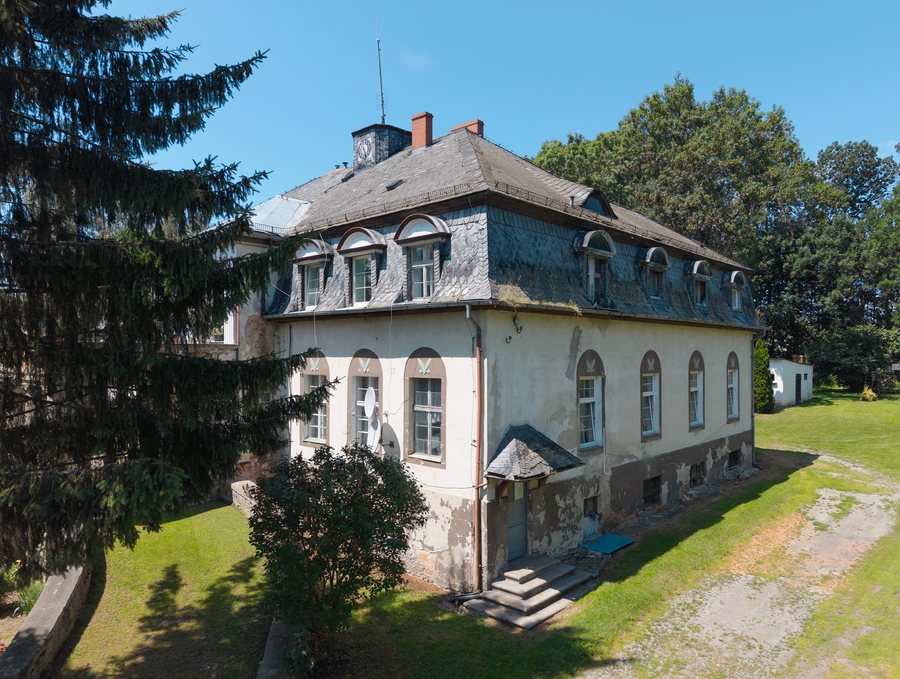
Czerńczyce at a glance
- The Neoclassical palace complex was built around 1815.
- The naturalistic landscape park beside the palace was created in 1870–1880.
- A small oval pond lay in front of the palace and was later converted into a fire-water reservoir.
- Behind the palace was a rectangular lawn with symmetrically planted oaks.
- The estate’s surviving tree stock includes more than 40 individual trees; the former park paths are now only faintly discernible.
- The manor farm includes a granary and a stable. The municipal monument register, published in May 2026, lists the stable as a currently used storage building.
Which historic features define the site?
The palace is part of a palace-and-park complex with a manor farm. The granary and stable extend the ensemble beyond the main building; the municipal monument register from May 2026 records that the stable is currently used for storage. The term “Neoclassical” generally describes an architectural style inspired by ancient forms. Together with its construction date of around 1815, this places the palace among buildings of the early 19th century.
The history of the village extends beyond the estate: Czerńczyce also has a historic rural settlement layout. Two scales therefore sit side by side—the palace and manor complex on the one hand, and the village’s historic settlement form on the other. Visitors interested in cultural history can consider the palace in the context of the settlement’s rural character.
How is the park laid out?
The park’s different areas follow different design principles. The section in front of the palace was created as a screen and designed in a naturalistic landscape style. Behind the building, by contrast, there was a rectangular lawn planted symmetrically with oaks. The contrast between landscape design and clear geometric order helps explain the layout of the grounds: in front of the palace, screening was the priority, while the lawn was defined by its rectangular shape and symmetrical planting.
The estate’s surviving tree stock includes more than 40 individual trees. This figure adds another aspect to the description of the park’s design. Depending on your interests, both the architecture and the historic garden and landscape design may be of interest.
What has changed in the remains of the former park?
The small oval pond was located in front of the palace and was later converted into a fire-water reservoir. The former layout of the park paths is also now only faintly discernible. These changes affected different elements: the pond became a fire-water reservoir, while the former path network is now difficult to trace. The park’s history therefore encompasses not only its original design but also changes to individual features.
Which road route can help you find your way?
According to the 2023 municipal spatial planning study, municipal road 100942D runs from the municipal boundary through Pęcław, Czerńczyce, Bucze and Szymocin. This sequence of places locates Czerńczyce along a specific road route. Use it as a geographic reference and check current route information for the actual journey. When planning a visit, you can also check in advance which parts of the palace and park are accessible.
Discover more destinations: Radwanice, Stara Rzeka, Polkowice, Buczyna and Chocianow.
FAQ
When were the palace and park created?
The Neoclassical palace complex was built around 1815. The naturalistic landscape park was laid out in 1870–1880.
What happened to the pond in front of the palace?
The small oval pond was later converted into a fire-water reservoir.
Which buildings are part of the palace and manor complex?
The complex includes a granary and a stable. The municipal monument register from May 2026 lists the stable as a currently used storage building.
Go to the main travel overview: Polkwitz.

