
Discover Krasnystaw
Accommodation in Krasnystaw
Get to know Krasnystaw through three specific points of interest: the city’s history in an exhibition, a named tree in the market square, and the historical beginnings of Chmielaki Krasnostawskie. These topics offer a first orientation for planning your trip and help you understand the character of the destination.
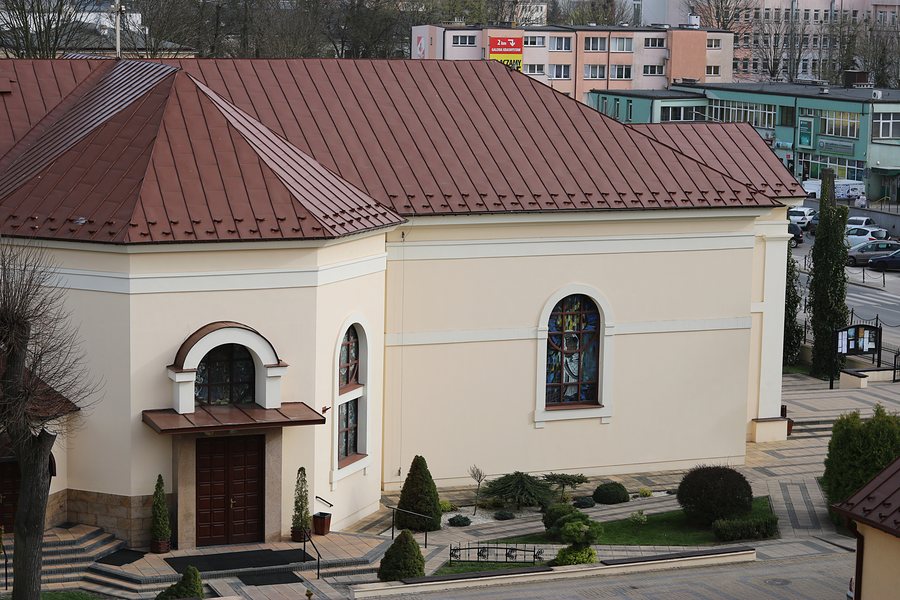 Krasnystaw, Kościół Trójcy Przenajświętszej w Krasnymstawie
Photo: Micewiczmartyna via Source, CC BY-SA 4.0
Krasnystaw facts at a glance
- The exhibition at Muzeum Regionalne w Krasnymstawie covers the city’s history from the granting of Magdeburg town rights to Szczekarzów in 1394 through to 1989.
- An ash-leaved maple grows in the market square and is known as the “klęczące drzewo,” or “kneeling tree.”
- Chmielaki Krasnostawskie began in September 1971 as a local hop harvest festival; the festival’s name is still in use.
What history of the city does the museum present?
The exhibition at Muzeum Regionalne w Krasnymstawie spans a clearly defined period. It starts with the granting of Magdeburg town rights to Szczekarzów in 1394; the period covered extends through to 1989. These two dates mark the beginning and end of the exhibition’s scope without pre-empting specific events in between.
This gives visitors a different way to explore Krasnystaw than focusing on a single landmark: the exhibition centers on the city’s history over a long period. If you are interested in how a place has developed, these dates can help you put the subject in context. Together with the tree in the market square and the festival’s history, they offer a picture made up of distinct, clearly differentiated topics.
What does “klęczące drzewo” mean?
An ash-leaved maple grows in Krasnystaw’s market square and is known by the Polish name “klęczące drzewo.” The English translation, “kneeling tree,” explains the name, while the Polish expression remains its name. This links an individual tree to a specific place, rather than speaking only in general terms about greenery or nature in the city.
The tree offers a different perspective from the museum exhibition: rather than a historical period, the focus here is a named natural feature in the market square. For travelers who also pay attention to local names and individual features of a place, this point of interest adds another perspective on Krasnystaw.
How should you place Chmielaki in context?
To understand the timeline, it is helpful to distinguish between when the festival began and the official name it was given later. Chmielaki Krasnostawskie began in September 1971 as a local hop harvest festival. In the wider destination of Krasnystaw, the hop and brewing festival has been held for several decades. Since 1977, its official name has been “Ogólnopolskie Święto Chmielarzy i Piwowarów Chmielaki Krasnostawskie.”
The year 1971 marks the beginning, while 1977 marks the adoption of the official name. The festival thus combines a local hop harvest tradition with an official name established later; the name Chmielaki Krasnostawskie is still in use. If the festival is a deciding factor in planning your trip, check the current event dates before booking a hotel.
What other topics are covered by the wider destination of Krasnystaw?
The wider destination of Krasnystaw also offers topics relating to church history and equestrian sports. The Church of St. Francis Xavier in the Jesuit complex in Krasnystaw served as a cathedral from 1773 to 1826. Stadnina Koni w Białce is a breeding center for Arabian thoroughbreds and a venue for equestrian events.
These topics differ from the exhibition on the city’s history and the named tree: the church represents a historical function with clearly defined dates, while the stud farm focuses on breeding Arabian thoroughbreds and equestrian sports. Together with the history of Chmielaki, they offer a range of points of interest within the wider destination of Krasnystaw. You can plan your trip around whichever of these topics interests you most.
Compare other destinations
If you would like to compare Krasnystaw with other destinations, you can find additional destinations here: Czysta Dębina, Izbica, Olchowiec, Ostrzyca, Tarnogóra-Kolonia and Tarnogóra.
FAQ
What period does the exhibition at Muzeum Regionalne cover?
It covers the city’s history from the granting of Magdeburg town rights to Szczekarzów in 1394 through to 1989.
Where does the “kneeling tree” grow?
The ash-leaved maple known as “klęczące drzewo” grows in the market square in Krasnystaw.
When did Chmielaki Krasnostawskie begin?
It began in September 1971 as a local hop harvest festival. Since 1977, its official name has been “Ogólnopolskie Święto Chmielarzy i Piwowarów Chmielaki Krasnostawskie.”
For the overview of the wider destination: Krasnystaw.

