
Discover Łęczna: Old Town, nature and culture
Accommodation in Łęczna
Łęczna combines an Old Town with three market squares and historic buildings with landscapes along the Wieprz and Świnka rivers. When planning your trip, you may also be interested in the visiting hours for the observation tower in Podzamcze and Łęczna’s role as a base for exploring the Łęczyńsko-Włodawskie Lake District.
Łęczna at a glance
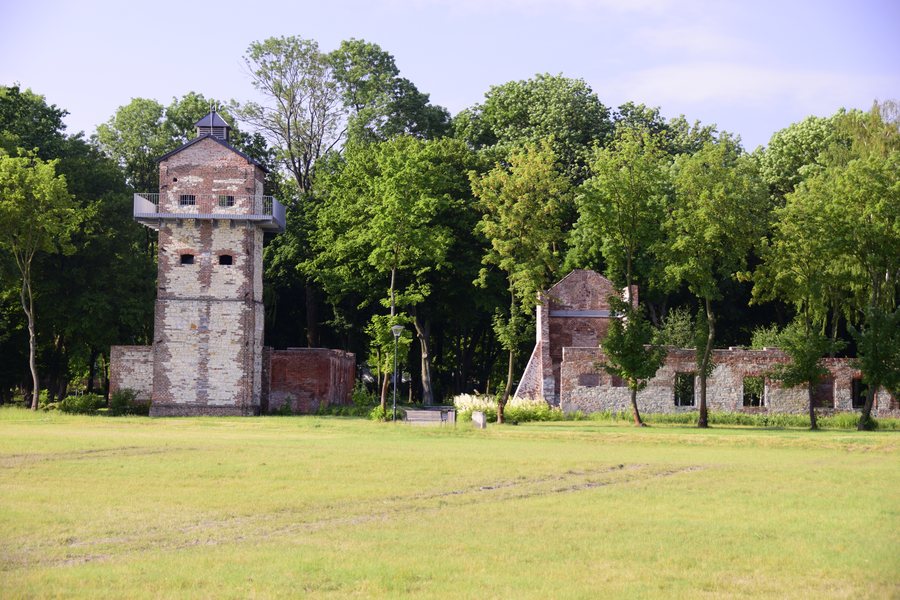
The older part of the town lies on a high terrace between the Wieprz and Świnka rivers. The Old Town has an unusual layout with three market squares. The Podzamcze park and manor complex includes an observation tower, covers an area of about 8 hectares and has nearly 2,000 trees. The tower can be visited free of charge every day from 8:00 to 21:00. In the wider region, the Łęczyńsko-Włodawskie Lake District comprises 68 lakes, each larger than 1 hectare; together, they cover 2,726 hectares.
How do the rivers and landscape shape Łęczna?
The location between the Wieprz and Świnka rivers is a useful reference point in Łęczna: the older part of town lies on a high terrace between the two rivers. The Podzamcze complex is also elevated, on a hill at the confluence of the Świnka and Wieprz. The town’s setting and its river landscape are both part of its description, without implying any particular route.
Twenty percent of the area of the associated municipality lies within the Nadwieprzański Landscape Park. The northwestern part of this landscape park is also within the municipality; it includes the protected Łęczyński przełom Wieprza gorge. These figures refer to the municipal area, not just the Old Town. The wider region has a distinct natural area in the lake district: its 68 lakes, each larger than 1 hectare, cover a combined area of 2,726 hectares.
A single natural monument stands at ul. Marszałka Piłsudskiego in Łęczna: a common ash (Fraxinus excelsior L.) that has stood there since around 1780 and is protected as a natural monument. Its trunk circumference is 470 cm at a height of 130 cm. In Podzamcze, the nearly 2,000 trees are another notable feature of the park complex.
Which historic buildings define the town?
The Old Town stands out for its three market squares. The town hall is a Neoclassical brick building from the late 19th century with a four-column portico. The Church of St. Mary Magdalene is another building with a long history: it was built between 1618 and 1631 in the Late Renaissance style.
The Synagoga Duża was built in the mid-17th century. After being largely destroyed during the war, it was rebuilt in the post-war period, between 1953 and 1964. Its interior is currently not open to visitors. The Synagoga Mała was built from stone and brick in the early 19th century. It retains a stone basin for ritual handwashing.
Other buildings reflect different periods and functions: the late Baroque brick Mansjonaria was founded around 1639 by Adam Noskowski. The former parish residence is a wooden building with Swiss-style decoration, dating to around 1858. The Domy zajezdne at ul. 3 Maja 26 and 37 and pl. Kanałowy 18 and 26 are remnants of 19th-century architecture from Łęczna’s heyday as a fairground town.
What can you discover in Podzamcze and on the Ośrodek grounds?
At the Podzamcze park and manor complex, you can visit the observation tower free of charge every day between 8:00 and 21:00. Its location on a hill at the confluence of the Świnka and Wieprz rivers, and the size of the complex, give the place its own character. The tower’s stated daily opening hours are a helpful reference when planning a visit.
At the Ośrodek Rewalidacyjno-Wychowawczy in Łęczna, the graduation tower is open daily from 11:00 to 19:00. The grounds also have sensory gardens, two sensory paths and a playground for younger visitors. These features are specific to these grounds. If they are of interest, you can take them into account when considering the town’s various attractions.
How can you think of Łęczna as a base?
Łęczna is considered a good base for exploring the entire Łęczyńsko-Włodawskie Lake District. If you want to include the lake region as well as the town in your trip, this described role is a useful reference when choosing where to stay. For travel by train, note that the nearest station on the Lublin–Chełm railway line is in Minkowice.
For more information, you can also visit the pages for Stara Wieś, Cyców, Nadrybie-Wieś, Rozpłucie, Czarny Las, Łęczna, Krzczeń, Spiczyn, Bogdanka and Zaróbka.
FAQ
When can you visit the observation tower in Podzamcze?
The observation tower is open daily from 8:00 to 21:00 and can be visited free of charge.
Is the interior of the Synagoga Duża accessible?
The interior of the Synagoga Duża is currently not open to visitors.
How large is the Łęczyńsko-Włodawskie Lake District?
It comprises 68 lakes, each larger than 1 hectare. Their combined area is 2,726 hectares.
For the broader travel overview: Lublin.

