
Discover Kock
Accommodation in Kock
You can plan your trip to Kock around its architectural history, memorial sites and routes. The Neoclassical palace renovation, parish church and historic cemeteries offer specific themes to explore in the town. There are also described routes of different lengths.
Kock at a glance
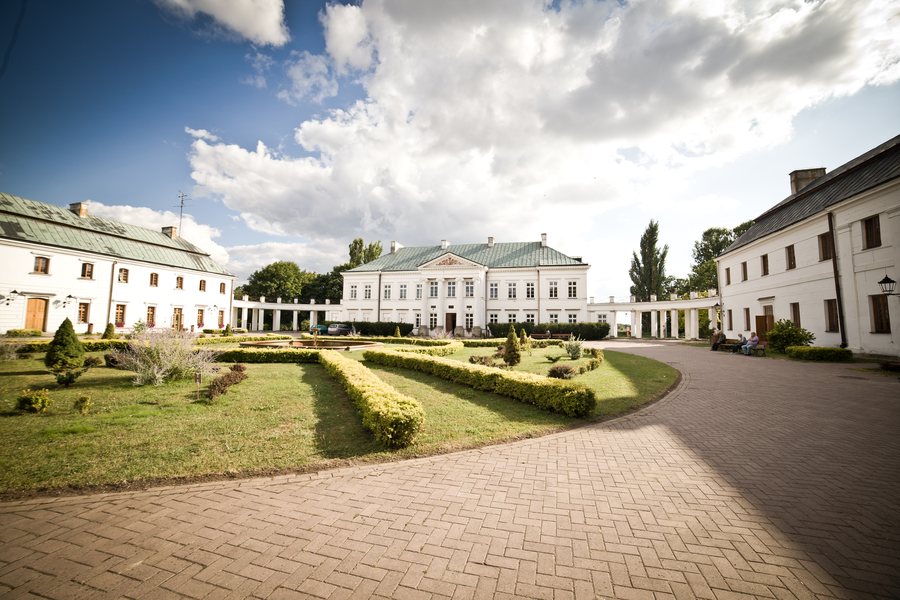
- Princess Anna Jabłonowska had the palace renovated in the Neoclassical style by Szymon Bogumił Zug in the 1770s.
- Construction of the parish church was completed in 1782; Zug also designed it.
- Menachem Mendel of Kock is buried in the ohel at the Jewish cemetery.
- Brigadier General Franciszek Kleeberg and 81 soldiers who fell on October 2 and 3, 1939, are buried at the war cemetery.
- One route description lists a 22 km red route and a 35 km black route.
What architectural history shapes Kock?
The palace renovation and the construction of the parish church were two separate projects, both associated with Szymon Bogumił Zug. In the 1770s, Princess Anna Jabłonowska had him renovate the palace in the Neoclassical style. Construction of the parish church was completed in 1782; Zug designed it. The dates therefore refer to different events: the palace renovation and the completion of the church.
The palace garden is also part of the history of this renovation. Jabłonowska had it laid out as an early English landscape garden while work on the palace was underway. This places the garden within the scope of her commission, while Zug as designer and the year 1782 are the main historical reference points for the parish church. Visitors interested in architecture can thus distinguish the chronology and the different roles of the patron and architect.
Which historic sites recall Kock’s past?
The Jewish cemetery and the war cemetery represent different historical contexts. A description from 2013 records about 40 surviving matzevot at the Jewish cemetery. Menachem Mendel of Kock (1787–1859), regarded as the founder of the Kock dynasty of tzaddikim, is buried in the ohel. These details connect a specific burial site with the history of this religious dynasty.
Brigadier General Franciszek Kleeberg and 81 of his soldiers, who fell on October 2 and 3, 1939, are buried at the war cemetery. The number of people buried there and the precise dates of their deaths give the site a clearly defined historical context. Together with the Jewish cemetery, it offers different perspectives on Kock’s history: religious heritage as well as remembrance of those who fell in 1939.
Which routes can you compare?
The route description lists a 22 km red route from Kock through Ruska Wieś, Bożniewice, Zakalew, Poizdów and Białobrzegi, returning to Kock. The black route is listed as 35 km and runs via Talczyn, Annopol, Wygnanka, Białobrzegi, Poizdów, Zakalew, Bożniewice and Ruska Wieś, returning to Kock. It is therefore 13 km longer and additionally passes through Talczyn, Annopol and Wygnanka. The comparison is based on the stated distances and named places.
A green route is listed at “KOCK – Rynek PKS” and at the war cemetery. The route description dates from 2013; check conditions locally before planning to take any of the routes.
Discover more destinations: Wincentów, Firlej, Rokitno, Lubartów.
FAQ
Who designed the parish church in Kock?
Szymon Bogumił Zug designed it; construction was completed in 1782.
How long are the red and black routes?
The route description lists the red route as 22 km and the black route as 35 km.
Who is buried in the ohel at the Jewish cemetery?
Menachem Mendel of Kock (1787–1859), founder of the Kock dynasty of tzaddikim, is buried there.
For the broader travel overview: Lubartów.

