
Laski: Cycling Routes, Nature Trail and Historical Traces
Accommodation in Laski
Explore Laski via its cycling routes, a nature trail in the surrounding area and historical traces in the village. When planning your visit, it is worth distinguishing these local features from the attractions in the wider destination of Parczew.
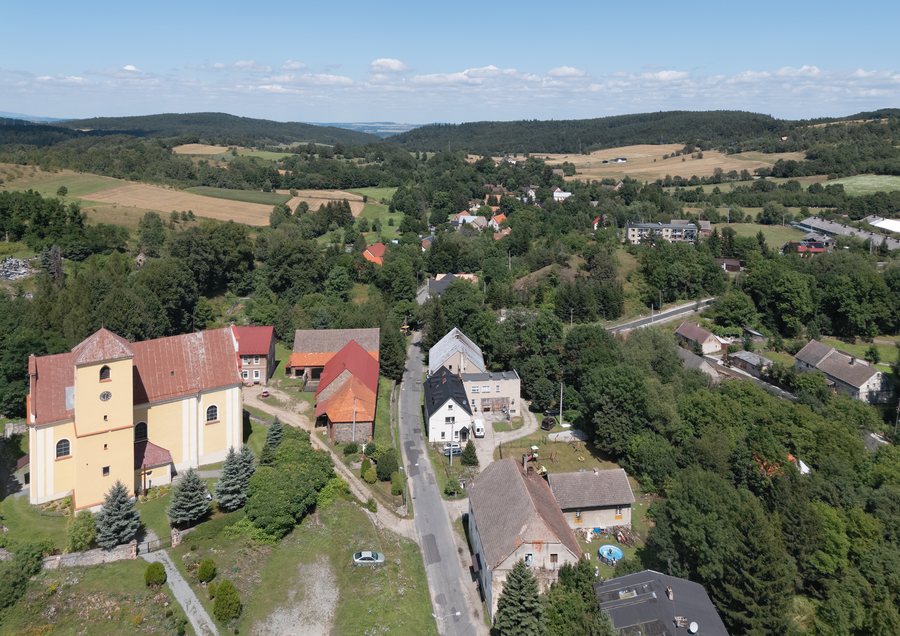 Church of the Assumption in Laski and panorama
Photo: Jacek Halicki via Wikimedia Commons, CC BY-SA 4.0
Key facts about Laski
- The granary at Laski No. 229 and the former school at No. 49 date from the first quarter of the 20th century and are listed in the Voivodeship Heritage Register.
- Wayside cross No. 12 dates from the second quarter of the 20th century; the roadside shrine opposite house number 2 dates from the first quarter. Both are also listed in the register.
- Cycling Route No. 2 is about 25 km long and No. 5 about 35 km. Both pass through Laski and then reach the edge of the Parczew forests.
- The “Jezioro Obradowskie” nature trail is about 3 km south of Laski. It is 800 m long, with around 700 m running along a wooden boardwalk through woodland and marshland.
What historical traces can you find in Laski?
The dated sites reflect different connections to the village: the granary and former school date from the first quarter of the 20th century, as does the roadside shrine opposite house number 2. Wayside cross No. 12 dates from the following quarter-century. Together, the listed traces represent buildings and small monuments from two consecutive periods. The buildings and religious markers give Laski’s historical story specific addresses and distinct forms.
For a quick orientation, you can distinguish the sites by location: the granary and former school are identified by house numbers, the wayside cross has the address No. 12, and the roadside shrine is opposite house number 2. This also helps match the similar dates to their respective locations.
Which cycling routes pass through Laski?
Two pairs of routes are useful for comparing distances. Cycling Route No. 2, at about 25 km, is shorter than No. 5, at about 35 km; both pass through Laski and continue to the edge of the Parczew forests. Route No. 3 is about 30 km long and No. 6 about 50 km; both also run through Laski. This makes it possible to compare the two pairs of routes by their approximate length.
A longer connection is the 104.7 km red Partisan Trail LU-5515. In the section near Parczew, it passes through Laski towards the Parczew forests. The trail was intended to make nature and sites associated with Second World War partisan fighting accessible to visitors. In the wider destination of Parczew, the red Partyzancki Trail starts at the railway station and also runs through Laski and the Parczew forests, passing the Jezioro Obradowskie, Królowa Droga and Lasy Parczewskie nature reserves. Check the local trail markings before setting out.
Which nature trails complement route planning?
At 800 m, the “Jezioro Obradowskie” nature trail is much shorter than the cycling and hiking routes that cover several kilometres. About 700 m of it follows a wooden boardwalk through woodland and marshland. These distances help distinguish the type of nature trail from the longer connections through Laski. As local conditions can change, check them before your visit.
The 42 km red Szlak Dzikiej Przyrody nature trail connects Parczew, Laski, the Parczew forests and Białka Sosnowica. It starts at the car park by the Minor Basilica in Parczew, heads towards Laski and reaches the Parczew forests near Pohulanka. This also allows you to consider local route planning as part of a connection spanning several named places.
What does the wider destination of Parczew offer?
In the wider destination of Parczew stands the Minor Basilica, the Sanctuary of Our Lady Queen of Families in the Roman Catholic Parish of St. John the Baptist. The Neo-Gothic church has two distinctive towers and five wooden altars; Pope John Paul II granted it the status of a minor basilica in 1989. Polychrome decoration and stained-glass windows adorn the interior. The windows include depictions of St. Anthony from 1939 and the Assumption of Mary from 1937.
Further architectural and urban history adds to this picture of Parczew: the market hall on Plac Wolności was built in 1938 to a design by Artur Bernhardt; the wooden bell tower, dating from 1675, is considered the city’s oldest surviving historic building. Parczew is documented as early as the 13th century, when it was known as Parczów, and received its town charter in 1401. In 1413, Parczew was designated as a venue for Polish-Lithuanian meetings and Sejms. A medieval town plan based on Magdeburg law, along with traces of underground settlements and archaeological layers, adds to the historical perspective.
Jewish history is also part of the wider destination: the synagogue was a Jewish house of prayer, built after 1873 in the eclectic style. The mikveh was a Jewish ritual bath built at the beginning of the 20th century with features of modernist architecture. The former Jewish cemetery was destroyed during the Second World War; today, the site is a park with a monument to the victims of the Second World War. The 27th Parczewska Jesień Kulturalna is listed in the Parczewski Dom Kultury calendar for September to November 2026. Check the specific event dates before travelling.
FAQ
How far is the “Jezioro Obradowskie” nature trail from Laski?
The nature trail is about 3 km south of Laski. It is 800 m long, with around 700 m running along a wooden boardwalk.
Where does the Szlak Dzikiej Przyrody start?
The 42 km red nature trail starts at the car park by the Minor Basilica in Parczew. From there, it heads towards Laski and reaches the Parczew forests near Pohulanka.
Which cycling route is shorter: No. 2 or No. 5?
Cycling Route No. 2 is about 25 km long and No. 5 about 35 km. Both pass through Laski and then reach the edge of the Parczew forests.
Is there a railway line through Parczew?
The Lublin–Łuków railway line runs through Parczew. Check separately whether and when passenger services operate on this line.
Go to the wider travel overview: Babianka.

