
Parczew
Accommodation in Parczew
Parczew combines a long urban history with church art and routes through forests and protected areas.
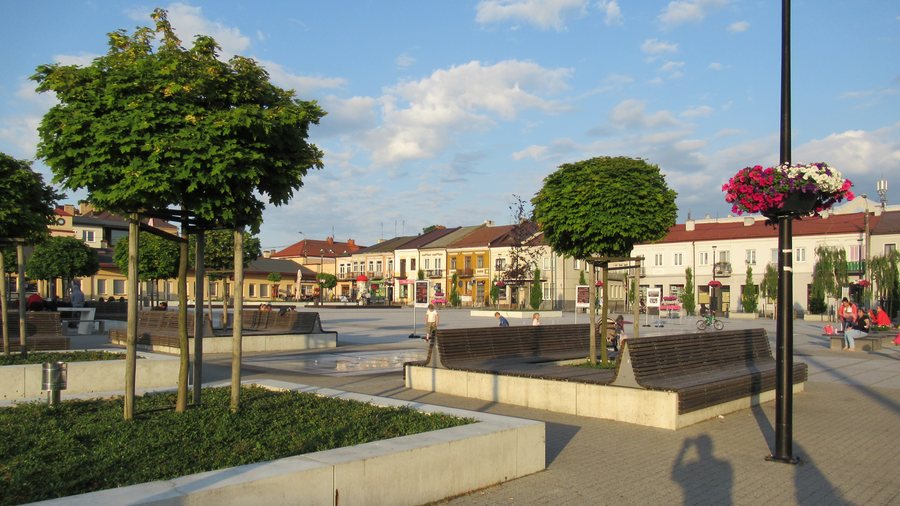
Parczew at a glance
The settlement of Parczew, formerly called Parczów, is documented as early as the 13th century; Parczew was granted town rights in 1401. The Lublin–Łuków railway line runs through the town. Routes include short and longer walks and cycle rides, as well as routes that start in Parczew.
What does Parczew’s townscape reveal about its history?
A prominent landmark is the Minor Basilica, the Sanctuary of Our Lady Queen of Families in the Roman Catholic Parish of St John the Baptist. The Neo-Gothic church has two distinctive towers and five wooden altars. Its interior is defined by polychrome decoration and stained-glass windows, including a window depicting St Anthony from 1939 and one depicting the Assumption of Mary from 1937. Pope John Paul II elevated the church to the status of a Minor Basilica in 1989. The church complex is listed in the heritage register and heritage inventory.
The medieval town plan, laid out under Magdeburg rights, also points to Parczew’s development. Traces of underground settlements and archaeological layers add to this picture. In 1413, Parczew was designated at Horodło as a venue for Polish-Lithuanian meetings and Sejms. The wooden bell tower, built in 1675, is considered the town’s oldest surviving historic building. The market hall at Plac Wolności was built in 1938 to a design by Artur Bernhardt.
The history of the Jewish community includes the synagogue, a Jewish prayer house built after 1873 in the Eclectic style, and the mikveh, a ritual bath with features of early 20th-century Modernist architecture. The former Jewish cemetery was destroyed during the Second World War. Today, the site is a park with a monument to the victims of the Second World War.
Which routes explore nature and the surrounding area?
Several routes vary in length and course. The combined Parczew–Siemień walking and cycling route is 6.9 kilometres long and ends at the Tyśmienica River, by a rest area. The black route from Milanów to Parczew is 8.9 kilometres long. The yellow LU-5514-y route runs for 73.7 kilometres between Sobieszyn PKS and Parczew PKP.
The red Partyzancki Trail starts at Parczew railway station and passes through Laski and the Parczew Forests. Along the way, it passes the Jezioro Obradowskie, Królowa Droga and Lasy Parczewskie nature reserves. The green Leśny Trail starts at the bus station, passes through the town, then follows the Gościniec and the Parczew Forests to Białka. A longer option is the 42-kilometre Szlak Dzikiej Przyrody, which runs from Parczew via Laski and the Parczew Forests to Białka Sosnowica; it starts at the car park by the Minor Basilica. The route passes through or near four nature reserves: Jezioro Obradowskie, Torfowisko przy Jeziorze Czarnym, Królowa Droga and Lasy Parczewskie.
What nature experiences complement the routes?
In Parczew Municipality, an educational trail runs through the Jezioro Obradowskie water and peat bog reserve. It includes the 12-hectare lake and a boardwalk across the bog, offering views of the reserve’s landscape and nature. The Dolina Tyśmienicy nature trail follows a section of the Tyśmienica Valley. The valley is part of the European Natura 2000 ecological network and is valued by ornithologists for its many bird species. The Parczew Forests in the municipality are also considered suitable for walks and cycling tours.
How do you choose a convenient location for your accommodation?
When choosing a hotel in Parczew, you can use your travel plans and intended routes as a guide. The Lublin–Łuków railway line runs through Parczew; the red Partyzancki Trail starts at the railway station, while the green Leśny Trail starts at the bus station. Consider which of these starting points matters for your own route and compare accommodation locations accordingly. These trailheads are different access points, not part of a single route.
To compare other town pages in this section, see Dębowa Kłoda, Leitnie, Babianka, Opole and Parczew. Other pages at the same level include Chełmski, Bialski and Łuków.
What other activities and cultural events are there?
In Parczew Municipality, the Jelonek Sports and Recreation Complex has a covered six-lane sports pool, a leisure pool with water attractions, a Finnish dry sauna, a fitness room and a weight room. The Municipal Sports and Recreation Centre in the municipality also includes a skatepark, a pump track, sports fields, weight rooms and a tennis court.
The annual Jarmark Jagielloński celebrates the history and traditions of the Jagiellonian dynasty. The programme includes historical reenactments, sculpture and painting, as well as traditional ceramics, pottery and embroidery. The 27th Parczewska Jesień Kulturalna is also listed in the Parczew Cultural Centre calendar for September to November 2026.
FAQ
How long is the Parczew–Siemień walking and cycling route?
The combined route is 6.9 kilometres long and ends at the Tyśmienica River, by a rest area.
Which routes pass by nature reserves?
The red Partyzancki Trail passes three nature reserves. The Szlak Dzikiej Przyrody passes through or near four protected areas.
For what period is the 2026 Parczewska Jesień Kulturalna listed?
The 27th edition is listed in the Parczew Cultural Centre calendar for September to November 2026.
For the regional travel overview: Lublin.

