
Discover Brójce
Accommodation in Brójce
Brójce can be explored through a range of themes: Blue Cycling Route II passes through the town, its preserved town layout tells the story of its past, and nearby are traces of Jewish life as well as the Czarna Droga nature reserve. Which of these aspects draws you in depends on whether you are considering the town primarily for cycling, its history or its memorial sites.
Brójce at a glance
- Blue Cycling Route II passes through Brójce and continues to Łagowiec and Panowice.
- The original town layout, with two main streets and a large rectangular market square, has been preserved.
- The parish church of the Name of the Most Holy Virgin Mary dates from 1860.
What should you plan for when following the cycling route?
Route II passes through Brójce and continues to Łagowiec and Panowice. These are the places that follow Brójce on the route. If you would like to plan your trip around this route, check local route information before setting off. This lets you base your plans on the information available there, rather than judging the demands of a stage solely from the route itself.
The cycling route can be a specific reason to consider Brójce as a destination. The town’s history offers another focus: historical information ranges from its founding and town layout to its former economic foundations. These topics can be explored whether or not the cycling route is the main focus of your trip.
How can you explore the town’s history?
The medieval town of Brójce was founded in 1428 by King Władysław Jagiełło under Magdeburg Law. Its original town layout has been preserved: two main streets and a large rectangular market square at their center define the historic plan. The parish church of the Name of the Most Holy Virgin Mary dates from 1860. Together, these details offer different starting points for exploring the town’s development.
The town’s former economy is also part of this picture. Agriculture, crafts, markets and fairs formed the economic foundation of Brójce. Clothmaking developed in the 17th century and remained the local population’s main occupation until the Partitions of Poland.
What traces of Jewish life are there?
For centuries, Poles, Germans and Jews lived alongside one another in Brójce. Historical traces include remains of a Protestant cemetery and a Jewish cemetery, as well as a surviving synagogue building that has lost its former features. These traces reveal the different religious and community histories of the town.
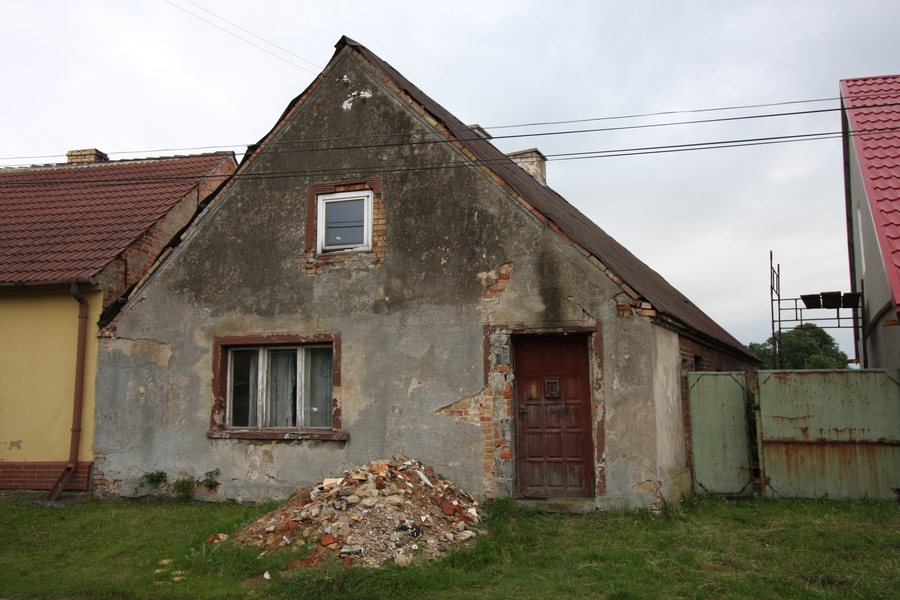
At 64 Poznańska Street, the Jewish community built a single-storey, brick mikveh with a gabled roof. After 1945, the building was used as a residential house; it is now vacant. This may change. The Jewish cemetery lies north of Brójce, outside the town. At its entrance, the Foundation for the Preservation of Jewish Heritage unveiled a memorial plaque in 2014 for the Jews buried there. Its inscriptions are in Polish, Hebrew and German. One relocated matzevah has been preserved in the cemetery; fragments of several other tombstones remain. This, too, may change.
What is there to discover nearby?
The Czarna Droga nature reserve lies northwest of Brójce. A 2011 article describes a large oak there with a trunk circumference of more than seven metres. The oak offers a specific point of interest for anyone interested in natural monuments.
A road runs through the middle of the reserve. Long ago, it was surfaced with black gravel, giving the area its name. The oak and the story behind the name add a distinct perspective on the area around Brójce to the town’s history.
Discover more destinations: Porabka, Wiejce, Murzynowo, Chycina, Pszczew, Skwierzyna, Miedzyrzecz, Przytoczna.
FAQ
Where does Blue Cycling Route II go from Brójce?
The route passes through Brójce and continues to Łagowiec and Panowice. Check local route information before setting off.
What is known about the historic town layout?
The original layout, with two main streets and a large rectangular market square at their center, has been preserved. Brójce was founded under Magdeburg Law in 1428.
What memorials are there at the Jewish cemetery?
A memorial plaque was unveiled in 2014 at the entrance to the cemetery north of Brójce. Its inscriptions are in Polish, Hebrew and German.
To the higher-level travel overview: Międzyrzecki.

