
Bobrówko: Palace, Park and Hiking Trail
Accommodation in Bobrówko
Bobrówko offers several specific points of interest to help you plan your trip: the palace’s architectural history, a preserved manor complex, a Mannerist altar dating from 1627, a landscape park, a large erratic boulder and a marked hiking trail. This gives you a sense of the area’s culture, landscape and hiking opportunities, and helps you consider which of these themes best suits your trip.
Bobrówko at a glance
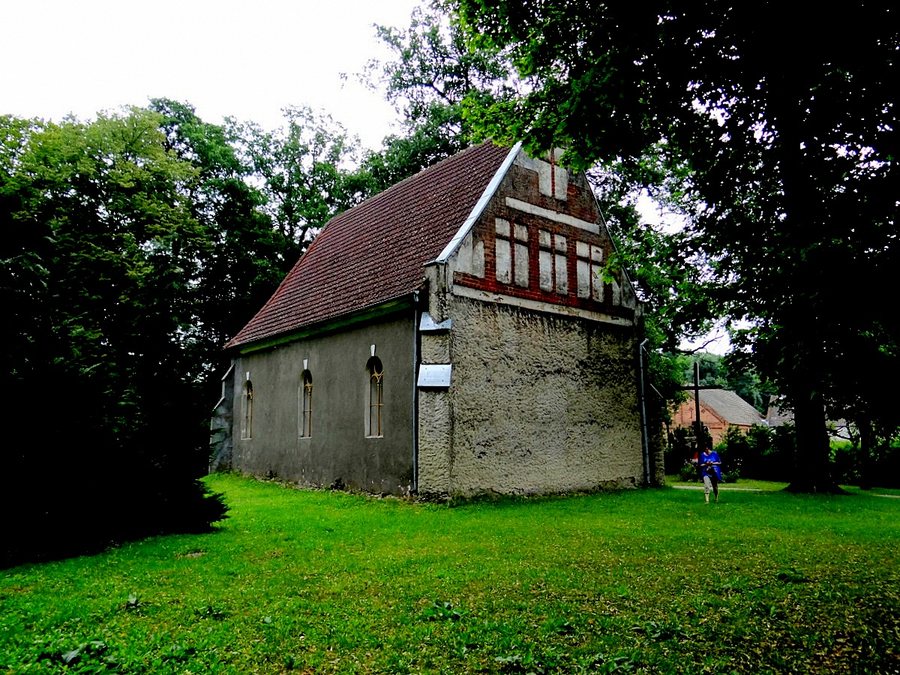
- The Church of St. Anthony of Padua contains a Mannerist altar dating from 1627.
- The palace was built at the end of the 18th century as a modest manor house belonging to the von der Osten family, and was remodeled in the Neo-Renaissance style about a hundred years later.
- The preserved manor complex includes farm buildings, including a substantial 19th-century barn and servants’ houses.
- The landscape park borders the palace to the east and south and covers about 6 ha.
- An erratic boulder in a cultivated field on the road to Machary measures up to 7.9 m long and 3.9 m wide.
- A yellow-marked hiking trail runs for 29 km from Jezioro Ogardzka Odnoga (Spalony Most), through several places including Bobrówko, to Danków.
What architectural history shapes Bobrówko?
The palace’s development can be divided into two phases. A modest manor house belonging to the von der Osten family, initially covered by a gabled roof, was built at the end of the 18th century. About a century later, it was remodeled in the Neo-Renaissance style and a two-storey wing with a mansard roof and dormer windows was added. Its architectural history therefore encompasses both the original manor house and a later extension.
The roof forms provide a specific architectural focus: the gabled roof belongs to the original building, while the added wing received a mansard roof and dormer windows. A mansard roof has a roofline with a change in pitch; dormers project from the roof surface with their window structures. The preserved manor complex is also described through its individual components: the farm buildings include a substantial 19th-century barn and servants’ houses.
What cultural and green spaces are described?
The Church of St. Anthony of Padua, with its Mannerist altar, offers a different point of interest from the palace: the altar is dated to 1627, while the palace’s development is described through two construction phases. Bobrówko’s cultural history can thus be explored through a dated work of art and architecture that was later altered.
The location of the landscape park is also described precisely. It borders the palace to the east and south and covers approximately 6 ha. The area figure gives an indication of its size, while the compass directions locate the park in relation to the building. The palace is compositionally linked to the green space, so the two appear in the description as connected elements of the area’s layout.
Where is the erratic boulder, and what are its stated dimensions?
The erratic boulder lies in a cultivated field on the road to Machary. It is stated to measure up to 7.9 m long and up to 3.9 m wide. These dimensions make it a distinctive feature of the Bobrówko landscape, setting it apart from the historic buildings and the park. It adds another point of interest to the area: alongside architectural and cultural history, there is also a natural feature in the field landscape.
What is the route of the hiking trail through Bobrówko?
The yellow-marked trail is 29 km long in total. Its route starts at Jezioro Ogardzka Odnoga (Spalony Most), passes through Pielice, Ogardy and Tuczno to Bobrówko, and ends in Danków. Bobrówko is therefore one section of a route connecting several named places; the stated length refers to the entire trail described.
The 2014 tourism guide also mentions giant hogweed along a section of road toward Bobrówko. It is therefore a good idea to check current route information before setting out today. If you would like to combine accommodation planning with a hike, you can weigh the area’s attractions according to your interests: architectural history and the altar, the park and erratic boulder, or the described trail through several places.
Discover more destinations: Mierzęcin, Przyleg, Zagórze, Drezdenko, Dobiegniew, Osów, Głęboczek, Strzelce Krajenskie.
FAQ
Which altar is in the church in Bobrówko?
The Church of St. Anthony of Padua contains a Mannerist altar dating from 1627.
How did the palace develop?
It was initially built at the end of the 18th century as a modest manor house belonging to the von der Osten family. About a hundred years later, it was remodeled in the Neo-Renaissance style and extended with a two-storey wing featuring a mansard roof and dormer windows.
Which route passes through Bobrówko?
The yellow-marked hiking trail, 29 km long, runs from Jezioro Ogardzka Odnoga (Spalony Most) through Pielice, Ogardy, Tuczno and Bobrówko to Danków. The 2014 tourism guide notes giant hogweed along a section of road toward Bobrówko.
To the broader travel overview: Strzelecko-Drezdenecki.

