
Zaręby Kościelne: Local History and Churches
Accommodation in Zaręby Kościelne
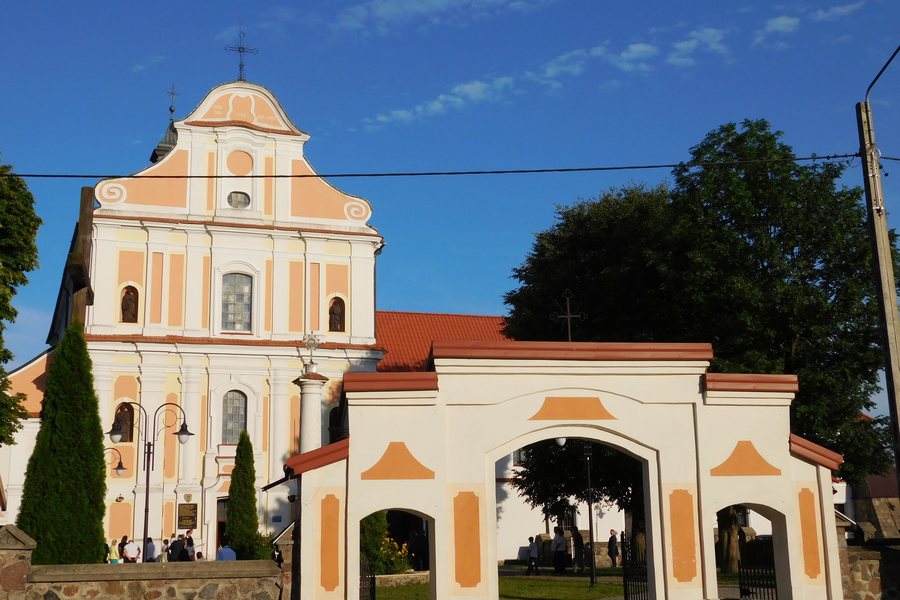
Until the January Uprising, Zaręby Kościelne was a town. Surviving buildings on ul. Rynek, the former Reformati monastery, and the parish church of St. Stanislaus the Bishop point to several clearly datable periods in the town’s history. These structures connect its former town history with ecclesiastical architecture from various centuries.
Quick facts about Zaręby Kościelne
- Until the January Uprising, Zaręby Kościelne had town rights; surviving buildings, especially on ul. Rynek, bear witness to this former status.
- The church and former Reformati monastery were built between 1765 and 1774, thanks to a foundation by Szymon Zaręba, castellan and land judge of Sieradz.
- The parish church of St. Stanislaus the Bishop is a Neo-Gothic structure made of fieldstone and brick; it was built between 1882 and 1900.
- In the walled, quadrangular monastery courtyard are a Tuscan column from 1805 and a statue of the Immaculate Conception erected in 1862. A charnel house built in 1961 is also located there.
- The church complex includes a burial chapel of the Detyniecki family from 1861 and a Sarmatian portrait of Szymon Zaremba, the only one of its kind in Ostrów County.
- There is a railway station named Zaręby Kościelne in Zaręby Kościelne.
What does the surviving architecture tell us about the town?
The town’s earlier history has a concrete connection to its built environment: the surviving buildings along ul. Rynek, in particular, bear witness to the fact that Zaręby Kościelne was a town until the January Uprising. Alongside its ecclesiastical buildings, the townscape itself therefore reflects its historical development. Those interested in a place’s history will find two distinct points of reference here: traces of its former town status and the dated construction phases of the church complex.
How do the church’s building phases differ?
The church and former Reformati monastery are dated to the period from 1765 to 1774. They were built thanks to a foundation by Szymon Zaręba, who was castellan and land judge of Sieradz. The parish church of St. Stanislaus the Bishop was built later, from 1882 to 1900. It is described as a Neo-Gothic structure made of fieldstone and brick. Their dates and recorded features make it possible to distinguish the earlier construction phase of the church and monastery complex from the later parish church.
What details add to the church complex?
The individual elements in the monastery courtyard also date from different periods. The Tuscan column was erected in 1805, the statue of the Immaculate Conception was installed in 1862, and the charnel house dates from 1961. These dates make the sequence of periods within the courtyard clear. A burial chapel of the Detyniecki family was built in 1861, linking the earlier and present-day church complex.
Other points of interest are found in different parts of the complex: a Sarmatian portrait of Szymon Zaremba hangs in the side aisle of the parish church; it is the only one of its kind in Ostrów County. The mummified remains of the founder, Szymon Zaremba, are in the monastery’s underground rooms. A monument to Maria Curie-Skłodowska stands next to the community library building.
What is known about travelling by train?
There is a railway station in Zaręby Kościelne. For specific travel plans, check current departures on the official rail portal: the station listing alone does not provide information about a particular timetable or current connections.
Discover more destinations: Nagoszewo, Brok and Ostrów Mazowiecka.
FAQ
When was the parish church of St. Stanislaus the Bishop built?
The Neo-Gothic parish church, made of fieldstone and brick, was built between 1882 and 1900.
Which dated features are there in the former monastery courtyard?
The courtyard contains a Tuscan column erected in 1805 and a statue of the Immaculate Conception installed in 1862. A charnel house built in 1961 is also located there.
Is there a railway station in Zaręby Kościelne?
Yes. There is a railway station of that name in Zaręby Kościelne. For specific departures, check the current information on the official rail portal.
Return to the main travel overview: Ostrów.

