
Discover Baniocha
Accommodation in Baniocha
Baniocha combines a local history with clearly recorded dates and a landscape shaped by former brickworks; there is also a cycling route in the surrounding area. If you are looking for a hotel, you can first consider whether local history or cycling will be the focus of your stay.
Baniocha at a glance
- The parish of Najświętszej Maryi Panny Królowej Pokoju was established on 20 September 1952.
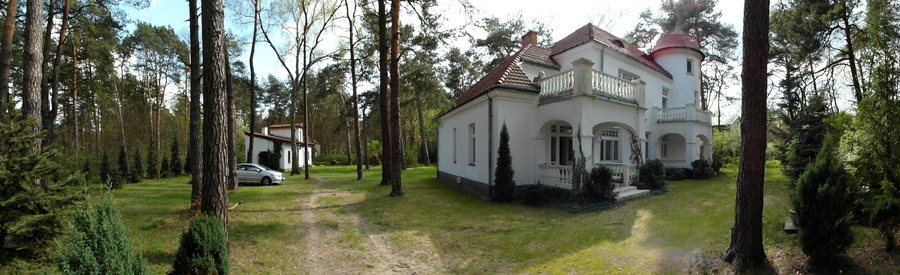
- The villa and its grounds date from 1895–1896; they were listed under A-1498 in 1991.
- The many clay pits were created by the operation of three brickworks.
- The Chojnowski Cycling Route is 24 km long and runs in the Baniocha area.
Which historical events have shaped the town?
On 20 September 1952, Stefan Wyszyński established the parish of Najświętszej Maryi Panny Królowej Pokoju and sent its first parish priest, Stanisław Kowalski, to Baniocha. The date, parish and first parish priest give this chapter of local history a clear temporal and personal context.
Another historical memory is the “Weller 12” air operation. On the night of 16–17 April 1944, four Polish Cichociemni parachuted into Baniocha. The monument on Wiejska Street commemorates the operation; Major Aleksander Tarnawski unveiled it in 2017.
What do the historic buildings and sites tell us?
The villa and its grounds date from 1895–1896. On 21 October 1991, they were entered in the register of monuments under number A-1498. The construction period and the date of registration are two different historical reference points: one dates the villa, while the other marks its inclusion in the register.
A manor house in Baniocha dates from the 1920s and is now used as a kindergarten. A park is also listed in the voivodeship’s register of monuments. The Roman Catholic parish cemetery is likewise part of the regional heritage inventory. These details offer insight into different historic places and uses without reducing them to the same period or function.
How did the landscape with its clay pits come about?
The many clay pits in Baniocha were created by the operation of the Feniks, Rozalin and Marki Grójeckie brickworks. At the turn of the 20th century, these brickworks were among the most important suppliers of bricks to Warsaw and its southern outskirts. The origins of the clay pits therefore point both to local production and to sales extending beyond Baniocha.
What should you know before a cycling trip?
The 24 km Chojnowski Cycling Route runs in the Baniocha area. It is a main cycling route through the Chojnów Forests and part of the cycling routes of Kraina Jeziorki. Before setting off, it is advisable to check the current route conditions.
The route can be viewed in more than one regional context: it belongs both to the cycling network of the Chojnów Forests and to the cycling routes of Kraina Jeziorki. Alongside Baniocha’s historical attractions, it offers a specific cycling route in the area as a separate aspect to consider when planning.
Discover more destinations: Łęg, Tomice, Mysiadło, Józefosław, Mroków, Zalesie Górne, Bobrowiec and Biały Ług.
FAQ
When was the parish in Baniocha established?
Stefan Wyszyński established the parish of Najświętszej Maryi Panny Królowej Pokoju on 20 September 1952 and sent Stanisław Kowalski to Baniocha as its first parish priest.
What role did the brickworks play in the formation of the clay pits?
The clay pits were created by the operation of the Feniks, Rozalin and Marki Grójeckie brickworks, which at the turn of the 20th century were among the most important suppliers of bricks to Warsaw and its southern outskirts.
How long is the Chojnowski Cycling Route?
The Chojnowski Cycling Route is 24 km long and runs in the Baniocha area. Check the current route conditions before setting off.
Go to the broader travel guide: Piaseczyński.

