
Przasnysz: City Park, Sacred Architecture and City History
Accommodation in Przasnysz
Przasnysz can be explored through clearly distinct highlights: the market square and sacred architecture tell the story of the city, the city park adds a green touch, and the Węgierka offers a walking and kayaking route.
Przasnysz at a glance
- The Neoclassical town hall stands in the middle of the market square.
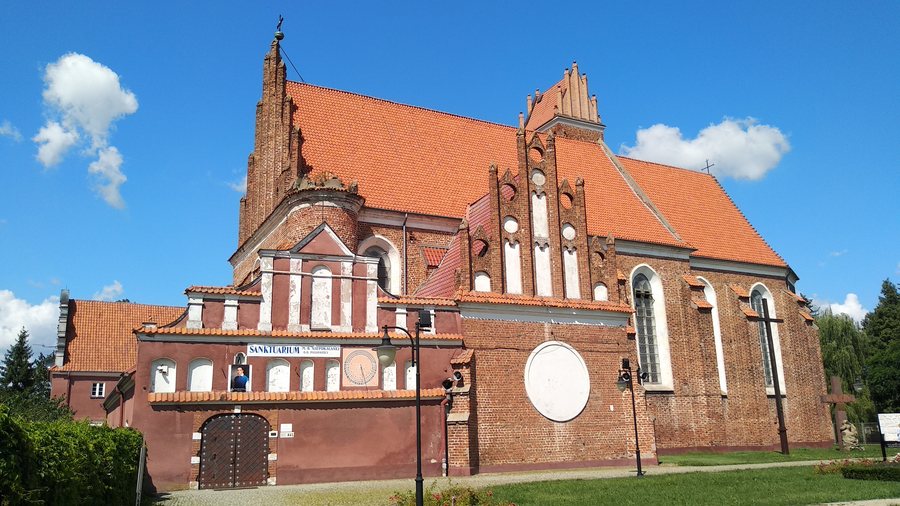
- The Assumption of the Blessed Virgin Mary parish church complex is a Late Gothic building dating from 1474 to 1485.
- The city park was laid out in the first half of the 19th century as a former promenade garden. It is also home to the Monument to the Millennium of the Polish State.
- The walking and kayaking route along the Węgierka offers opportunities for walking, running, Nordic walking, cycling and kayaking. It is currently undergoing extensive modernization; be aware of individual restrictions on walking paths.
Which buildings tell the story of the city?
The town hall provides an architectural focal point for the market square: it is Neoclassical and stands in the middle of the square. In the wider destination of Przasnysz, restoration of the town hall was completed in 2012. The building thus brings together historic architecture and a later restoration that has since been completed.
The sacred buildings also differ in age. The Assumption of the Blessed Virgin Mary parish church complex dates from 1474 to 1485. The monastery complex has been owned by the Passionists, who were brought from Rome, since 1923.
The wider destination of Przasnysz has an even longer church history: Saint Stanislaus Kostka was baptized in 1550 in the so-called Kostka Chapel at the Church of the Assumption of the Blessed Virgin Mary; his parents and brothers are buried there. The church complex also includes a completely freestanding 15th-century Gothic bell tower. It is built of masonry and was raised around the turn of the 16th and 17th centuries. The church of the Bernardine Sisters’ monastery complex dates from 1609 to 1616, and the monastery building was completed in 1615. The church of the Bernardine monastery complex was built from 1585 to 1588 on the initiative of Paweł Kostka.
What sets the city park apart from the riverside route?
The city park combines a historic layout with the Monument to the Millennium of the Polish State. The park was laid out in the first half of the 19th century as a former promenade garden. The monument stands in Tadeusz Kościuszko City Park. This distinguishes the area’s landscape and commemorative highlights.
In the wider destination of Przasnysz, the city park also includes an island in the Węgierka. Five oak trees there, about 300 years old, are protected as natural monuments. New walking paths made of natural stone chippings have also been laid out in Tadeusz Kościuszko City Park. These park paths should be distinguished from the restrictions on the walking and kayaking route along the Węgierka.
The riverside route offers different ways to get active: in addition to walking, it includes running, Nordic walking, cycling and kayaking. At the same time, the route is currently undergoing extensive modernization. On the section from the bridge near ul. Szpitalna to the sports complex, walking is difficult because of the condition of the terrain. At ul. Szosa Ciechanowska, it is currently not possible to cross the river on foot. Take these locations into account when planning, and check the route before choosing a walking route.
What cultural and leisure activities are available in the wider destination of Przasnysz?
Przasnysz serves as a service and tourism center for the Przasnysz region, thanks to its historic urban layout and sacred architecture. The Historical Museum has a permanent multimedia exhibition, “Złoty wiek Przasnysza,” which is aimed mainly at children. If you are comparing cultural activities for a trip with children, this focus is a specific distinction from the architectural and historical highlights in the cityscape.
The sports and recreation center in Przasnysz offers a fitness room, aerobics rooms with exercise equipment and an infrared sauna. So, alongside the park, cultural attractions and the route along the Węgierka, the wider destination also offers sports activities.
How can you use these highlights to guide your hotel search?
Before you search, decide what matters for your trip: sacred architecture and city history, parkland, activities by the river or attractions in the wider destination of Przasnysz.
Discover more destinations: Krasne, Rycice, Romany-Sebory.
FAQ
Where is the Monument to the Millennium of the Polish State?
It stands in Tadeusz Kościuszko City Park in Przasnysz.
What restrictions apply to the walking and kayaking route?
The route is currently undergoing extensive modernization. Between the bridge near ul. Szpitalna and the sports complex, walking is difficult because of the condition of the terrain. At ul. Szosa Ciechanowska, it is currently not possible to cross the Węgierka on foot.
Which exhibition is aimed mainly at children?
The Historical Museum in Przasnysz has a permanent multimedia exhibition, “Złoty wiek Przasnysza,” which is aimed mainly at children.
Back to the main travel overview: Przasnysz.

