
Trześcianka: Churches, Village Layout and Routes
Accommodation in Trześcianka
Trześcianka combines wooden religious buildings with a traditional village layout and several named routes. Their distinct architectural histories and routes offer concrete ways to explore the village and its surroundings according to your interests.
Quick facts about Trześcianka
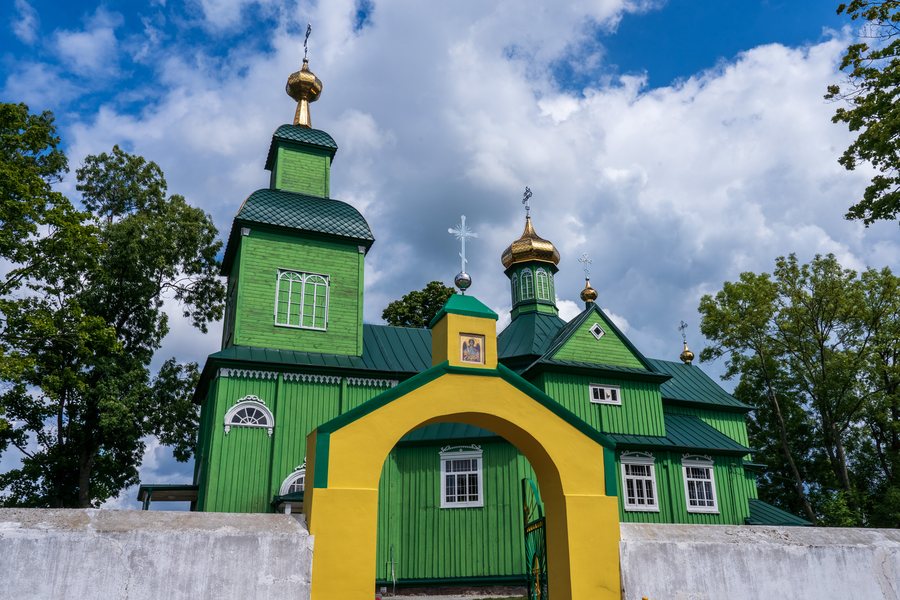
- The Orthodox parish church of St. Michael the Archangel is wooden, rectangular and clad; it was built between 1864 and 1867.
- A second wooden church, dating from the early 19th century, stands in the parish cemetery; it was moved here from Białowieża toward the end of the 19th century.
- The village layout dates from the 16th century and is associated with włóczna land measurement; it includes a street built up on both sides.
- Several hiking, cultural and cycling routes pass through Trześcianka.
What histories do the churches tell?
The parish church of St. Michael the Archangel was built between 1864 and 1867 on the site of a church that burned down in 1835. The wooden building has a rectangular floor plan and is clad. Its materials, form and date of construction can therefore be considered together; its history also includes the earlier church on the same site.
The Church of the Presentation of the Blessed Virgin Mary tells a different story. It stands in the parish cemetery, dates from the early 19th century and was moved to its present location from Białowieża toward the end of that century. The two churches thus represent different building histories: for St. Michael’s, the key event is the new construction after the previous church burned down; for the cemetery church, it is its move from Białowieża.
What is distinctive about the historic village layout?
Trześcianka has preserved its spatial layout from the 16th century, which is associated with włóczna land measurement. A street with buildings on both sides is characteristic of the layout. This describes the structure of the village, not a single building: the arrangement of the village is one of its notable historic features, alongside its churches. Those interested in the village’s history can consider this spatial dimension as well as its individual religious buildings.
Which routes pass through Trześcianka?
The green-marked Szlak Krainy Otwartych Okiennic (Trail of the Land of Open Shutters) passes through the village on the Narew–Ancuty–Trześcianka–Soce–Puchły route. The Podlaski Szlak Bociani (Podlasie Stork Trail) is a cycling route that also passes through Trześcianka. Along this cycling route, visitors can experience the landscapes around the Narew; the white stork is a defining feature of the local landscape.
The Szlak Świątyń Prawosławnych (Orthodox Churches Trail) also passes through Trześcianka. The Podlaski Szlak Kulturowy „Drzewo i Sacrum“ (Podlasie Cultural Trail “Tree and the Sacred”) also runs through the village. It was created to showcase the beauty of wooden architecture and places of particular interest and value to visitors in Powiat bielski and Powiat hajnowski. The routes therefore have different focuses: a named sequence of places, a cycling route connected with the landscape, and routes whose themes include Orthodox churches and wooden architecture.
Conditions on the routes mentioned may change. Before your visit, check the markings of the green-marked Szlak Krainy Otwartych Okiennic on site in particular. Discover more destinations: Nowoberezowo, Bialowieza, Kruhlik, Janowo, Leśna, Pogorzelce, Kleszczele and Łuka.
FAQ
When was the parish church of St. Michael the Archangel built?
It was built between 1864 and 1867, after the previous church on this site burned down in 1835.
Which church was moved from Białowieża?
The wooden Church of the Presentation of the Blessed Virgin Mary was moved from Białowieża to the parish cemetery in Trześcianka toward the end of the 19th century.
What characterizes the historic village layout?
Trześcianka has preserved its 16th-century layout, which is associated with włóczna land measurement. It includes a street built up on both sides.
What are the themes of the routes through Trześcianka?
These include a route through Narew, Ancuty, Trześcianka, Soce and Puchły; a cycling route connected with the landscape around the Narew; and routes focusing on Orthodox churches and wooden architecture.
For the broader travel overview: Hajnowski.

