
Piątnica Poduchowna: Forts and Nature Trail
Accommodation in Piątnica Poduchowna
For a cultural trip to Piątnica Poduchowna, the history of its fortifications is an obvious starting point: three forts are connected by ramparts and ditches to form an ensemble. A nature trail in the surrounding area adds a different, scenic perspective.
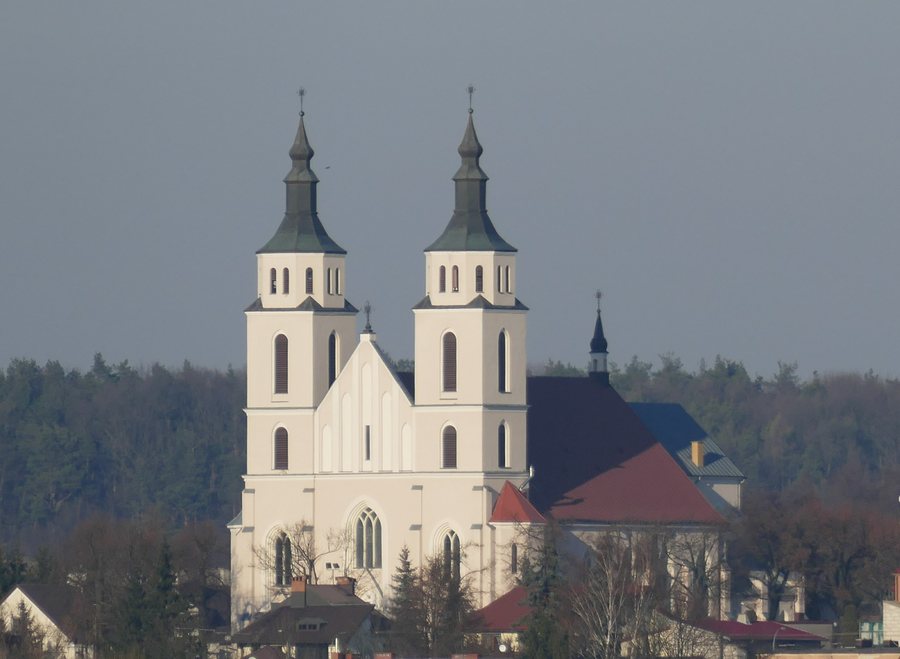 Church of the Transfiguration in Piątnica
Photo: Patryk Korzeniecki via Wikimedia Commons, CC BY 4.0
Key facts about Piątnica Poduchowna
- Construction of the five forts of the Łomża Fortress began in 1887 as a ring fortress.
- Forts I, II, and III were located on the right bank of the Narew around Piątnica.
- Three forts in Piątnica form the “Główna Osłona” ensemble, with ramparts and ditches.
- The Nadnarwiańskie Górki Nature Trail is 3.3 kilometres long. It starts at the bus stop in Kalinowo and ends beyond rampart No. 1 in Piątnica Włościańska.
How is Piątnica connected to the Łomża Fortress?
Construction of the five forts of the Łomża Fortress began in 1887 as a ring fortress. The location specifies where some of its parts stood: Forts I, II, and III were on the right bank of the Narew around Piątnica. This brings two scales into view: the fortress system with five forts and the three numbered forts associated with Piątnica.
The “Główna Osłona” ensemble is important for understanding the local area. Three forts in Piątnica are connected by ramparts and ditches and form part of the 19th-century fortifications of the Łomża Fortress. The name refers to the group as a whole; ramparts and ditches are the connecting elements described.
What do the names and numbers mean for understanding the site?
The terms refer to different levels: a fort is part of a fortress, while “Łomża Fortress” refers to the larger context. “Główna Osłona” is the name of the ensemble of three forts in Piątnica. The numbers also answer different questions: five forts belong to the fortress project, while Forts I, II, and III are located around Piątnica on the right bank of the Narew. This distinction helps differentiate the overall complex, individual forts, and local group, rather than treating the terms as interchangeable.
What perspective does the nature trail offer?
The Nadnarwiańskie Górki Nature Trail complements the fortress perspective with a different subject. It is in the area around the destination and runs for 3.3 kilometres from the bus stop in Kalinowo to a point beyond rampart No. 1 in Piątnica Włościańska. Its length and the two named locations provide concrete points of reference for including the trail in your trip plans.
The information can be compared directly when choosing a focus: the fortress offers a focus on construction history and its classification as a ring fortress, while the trail offers its length and named endpoints. This lets you weigh a cultural and historical subject against a nature route with specific distance details.
Discover more destinations: Kisielnica, Koziki, Nowosiedliny, Łomża, Wizna, Nowogród, Giełczyn, Drozdowo.
FAQ
How many forts are part of the Łomża Fortress?
Construction of the five forts began in 1887 as a ring fortress. Forts I, II, and III were located on the right bank of the Narew around Piątnica.
What does “Główna Osłona” refer to?
This is the name of the ensemble of three forts in Piątnica, connected by ramparts and ditches. It is part of the 19th-century fortifications of the Łomża Fortress.
Where does the Nadnarwiańskie Górki Nature Trail start and end?
The 3.3-kilometre trail starts at the bus stop in Kalinowo and ends beyond rampart No. 1 in Piątnica Włościańska.
For the higher-level travel overview: Łomżyński.

