
Krynki – Historic Town Plan and Cultural Heritage
Accommodation in Krynki
A hexagonal market square, with twelve streets radiating out from its corners, defines Krynki’s historic town plan. The town also has churches and synagogues with different architectural histories, as well as a cycling route that starts and ends in Krynki. The town can therefore be explored particularly through its layout and cultural heritage.
Krynki at a glance
The historic town plan dates from the 18th century and is considered unique in the country. Its hexagonal market square is now laid out as a park; twelve straight streets radiate out from its corners. Streets used for centuries include Sokólska, Kościelna, Cerkiewna, and Garbarska.
Krynki has a tourist information office at the Gminny Ośrodek Kultury. A bus route connects Szudziałowo, Krynki, Supraśl, Nowodworce, and Białystok. The connection between Sokółka and Kruszyniany runs via Szudziałowo and Krynki.
What defines the historic town plan?
The market square and the streets radiating from its corners give the town layout a clear geometric form. Today, the hexagonal square is a park. Anyone exploring Krynki can therefore take in both its historic layout and its present-day design as a park. Sokólska, Kościelna, Cerkiewna, and Garbarska have been part of the town’s streetscape for centuries.
For those interested in culture, the town’s religious buildings and historic traces are also significant. The buildings differ in their materials, functions, and dates of origin. Rather than telling a single architectural story, they offer insights into different chapters of the town’s history.
Which churches and historic traces can you find?
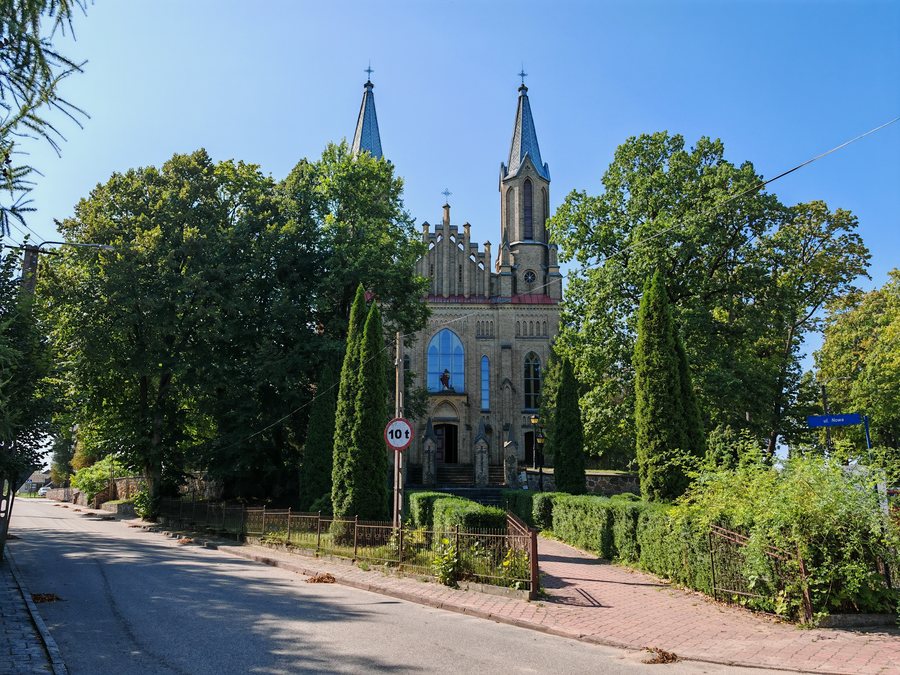
The brick parish church of St. Anne on Kościelna Street was built between 1907 and 1913 to a design by Stefan Szyller. The church complex includes a gate-bell tower from the second half of the 18th century; the churchyard also dates from the 18th century. It contains the tombstones of the de Virion family, former owners of Krynki and several estates in the surrounding area. A wooden church of St. Anne is associated with its foundation by King Sigismund I in 1521 and its construction in 1522.
At 5 Cerkiewna Street stands the brick Orthodox parish church of the Nativity of the Mother of God, built in 1864. The Orthodox cemetery chapel of St. Anthony is also part of the town’s religious history: originally a Greek Catholic wooden church from the first half of the 18th century, it was reconstructed between 1989 and 1991.
Jewish architectural history and heritage are also present in Krynki. The brick synagogue ruins on Garbarska Street date from the 17th century, were altered in the 19th century, and were destroyed by fire in 1944. They were built on the site of an earlier wooden synagogue. Another brick synagogue at 5 Piłsudskiego Street dates from 1850; after being partially damaged by fire during the Second World War, it was rebuilt in 1955. The brick Hasidic synagogue at 10a Czysta Street dates from the second half of the 19th century. The Jewish cemetery, dating from the 18th century, is in the northern part of town.
How can you combine culture and outdoor activities?
The “Kresowe Wędrówki” cycling route starts and ends in Krynki. This circular route runs between the eastern and western edges of the Knyszyńska Forest. If you want to include cycling in your trip, you can also treat Krynki as the starting and finishing point of a circular tour; no route distance is specified here.
For those exploring the town’s cultural diversity, the Public Library in Krynki offers the outdoor game “In the Footsteps of Many Cultures” as downloadable archive material for educational and promotional purposes. It was created as part of a joint project involving a school, a foundation, and local partners. The manor park also contains the ruins of an 18th-century barn.
FAQ
What is special about Krynki’s town plan?
The historic town plan, dating from the 18th century, is laid out around a hexagonal market square that is now a park. Twelve straight streets radiate out from its corners.
Which bus routes pass through Krynki?
A bus route connects Szudziałowo, Krynki, Supraśl, Nowodworce, and Białystok. The connection between Sokółka and Kruszyniany also runs via Krynki and Szudziałowo.
Where does the “Kresowe Wędrówki” cycling route start?
The route starts and ends in Krynki. It forms a loop between the eastern and western edges of the Knyszyńska Forest.
To the main travel overview: Sokółka.

