
Kołczygłowy: Hiking Trails and Churches
Accommodation in Kołczygłowy
Kołczygłowy offers a tangible connection to nature and culture: a hiking trail reaches the Dolina Słupi Landscape Park near the town, and the half-timbered church houses sculptures made of white marble. The municipality also has other churches and a manor house with documented construction dates. This lets you compare your interests in hiking and architecture in a targeted way.
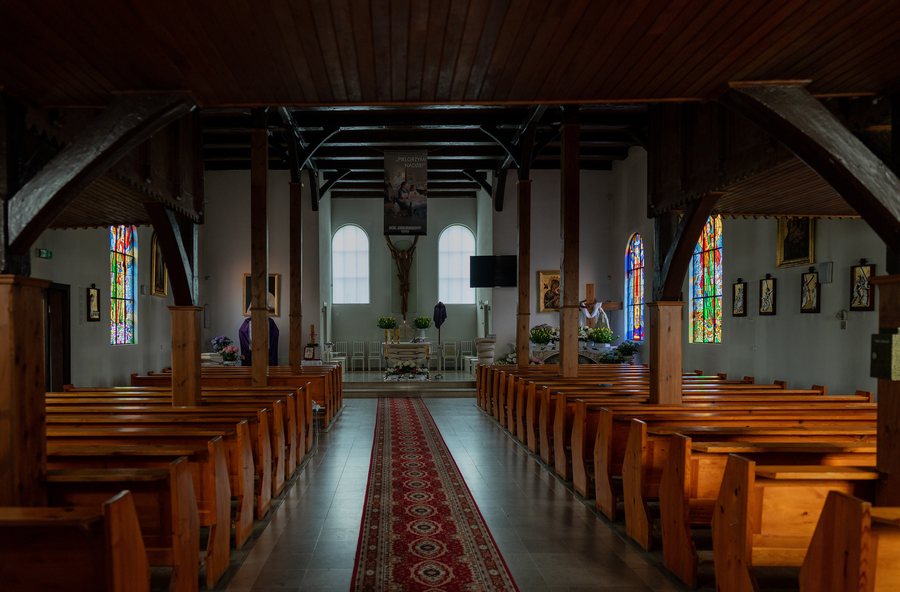 File:Kołczygłowy pomorskie kościół Chrystusa Króla A 228 (3).jpg
Photo: Januszk57 via Wikimedia Commons, CC BY-SA 4.0
Kołczygłowy at a glance
- A hiking trail reaches the Dolina Słupi Landscape Park near Kołczygłowy; check the current trail markings before setting out.
- In the southern part of the park, a hiking trail runs for about 40 kilometers within the protected area.
- The half-timbered church in Kołczygłowy houses sculptures made of white marble by the Italian artist Pasquale Galbusera.
- The municipality has a half-timbered church built in Łubno in 1633, a Neo-Romanesque church built in Gałąźnia Mała in 1857, and a manor house built in Barnowo in 1786.
How can you factor the landscape park into your hiking plans?
A hiking trail reaches the Dolina Słupi Landscape Park near Kołczygłowy. You should check the current trail markings before setting out. This keeps your navigation focused on the specific route and its markings.
In the southern part of the park, a hiking trail runs for about 40 kilometers within the protected area. Two scales are useful when planning: a trail's proximity to Kołczygłowy and the roughly 40-kilometer route in the southern part of the park. The approximate length refers to the trail within the protected area. This helps you distinguish local orientation from the broader context of the landscape park when weighing your hiking interests.
What makes the half-timbered church in Kołczygłowy distinctive?
The half-timbered church in Kołczygłowy houses sculptures by the Italian artist Pasquale Galbusera. They are made of white marble. Two distinct features therefore come together in one named building: the church's half-timbered construction and its stone sculptures. The artist is also specifically identified: the works are by Pasquale Galbusera. The church thus offers both an architectural and an artistic point of reference for cultural context, without requiring a general overview of art or churches.
What other buildings are located in the municipality?
Several other buildings in the municipality have clearly defined features. In Łubno there is a half-timbered church built in 1633. In Gałąźnia Mała there is a church in the Neo-Romanesque style, built in 1857. The manor house in Barnowo dates from 1786. The dates place these examples in chronological order: the church in Łubno came first, followed by the manor house in Barnowo and then the church in Gałąźnia Mała. The latter also has the distinct architectural designation of Neo-Romanesque. If you are choosing cultural points of interest for your trip, these buildings can be distinguished by location, architectural style, and year of construction. The examples in Łubno, Gałąźnia Mała, and Barnowo are in the municipality; the half-timbered church with the marble sculptures, by contrast, is in Kołczygłowy.
Discover more destinations: Skwierawy, Przewoz, Studzienice, Łupawsko, Osieki, Świelubie, Czarna Dąbrówka, Trzebiatkowa.
FAQ
Which hiking trail reaches the Dolina Słupi Landscape Park near Kołczygłowy?
A hiking trail reaches the park near Kołczygłowy. Check the current trail markings before setting out.
What art does the half-timbered church in Kołczygłowy house?
It houses sculptures made of white marble by the Italian artist Pasquale Galbusera.
What other buildings are located in the municipality?
In Łubno there is a half-timbered church built in 1633, in Gałąźnia Mała a Neo-Romanesque church built in 1857, and in Barnowo a manor house built in 1786.
For the overview of the wider area: Bytów.

