
Discover Pawłowo
Accommodation in Pawłowo
Pawłowo offers different starting points for planning a trip: a voivodeship road runs through the village, while its architectural and local history give the destination a distinct cultural profile. This lets you consider its transport links and historical themes separately.
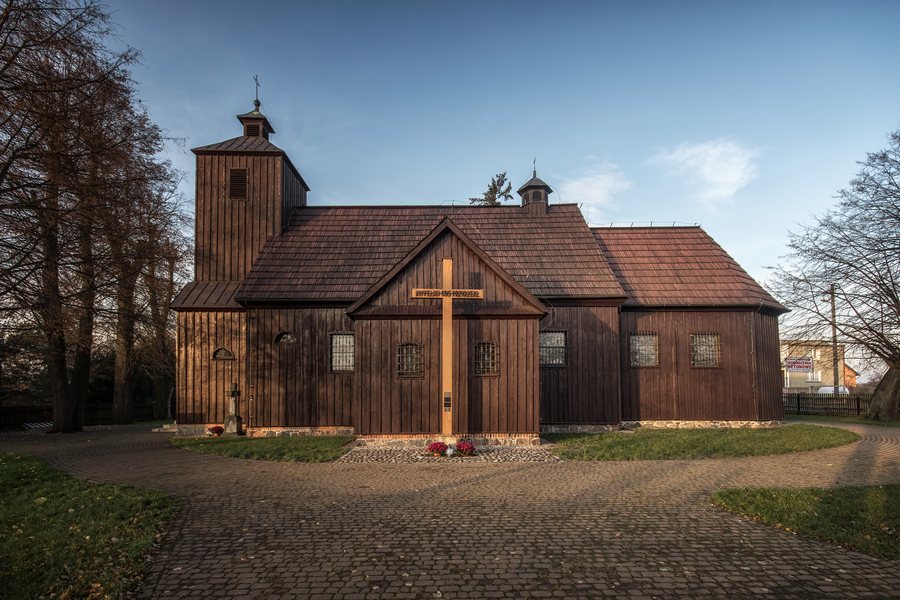 File:SM Pawłowo Kościół św Marcina 2019 (6).jpg
Photo: Sławomir Milejski via Wikimedia Commons, CC BY-SA 4.0
Quick facts about Pawłowo
- Voivodeship Road 240 runs through Pawłowo.
- At 15 Tucholska Street, there is a brick Neoclassical manor house listed in the registers of historic monuments.
- The half-timbered church of the Pawłowo parish burned down in 1945 during wartime hostilities.
Where is Pawłowo located?
The fact that Voivodeship Road 240 runs through Pawłowo places the road within the village itself. This is a different point of reference from the cultural themes associated with the manor house and the history of the parish church. For your initial selection, you can consider these aspects separately: the road’s location describes Pawłowo geographically, while the two buildings offer a way into its local history. The distinction between a road running through a village and a mere reference to the surrounding area makes the description specific, without requiring you to infer a particular route.
What makes the manor house distinctive?
The manor house at 15 Tucholska Street can be understood through three distinct details. “Brick” describes its construction, “Neoclassical” identifies its architectural style, and its entry in the registers of historic monuments classifies the building as a monument. These are not interchangeable descriptions: each answers a different question about the building. The address locates it within Pawłowo; the material and style describe its architectural form. Those interested in architecture and cultural history therefore have a clearly defined starting point for considering the manor house as a distinct subject when learning about the village.
What is the history of the parish church?
The Pawłowo parish church is also part of the village’s history, through a historical event: it was built using half-timbered construction and burned down in 1945 during wartime hostilities. The construction method and the date represent different aspects. Half-timbering describes the church’s construction; 1945 places the fire in time. Together, they provide a historical point of reference distinct from the architectural classification of the manor house. Both architecture and the watershed events of the war years are therefore relevant to a cultural-historical view of Pawłowo.
What themes can guide your selection?
The local features described here appeal to different interests: the road’s location provides a geographical reference, the manor house offers an architectural point of interest, and the church’s history opens up a historical perspective. So if you are comparing Pawłowo as a travel destination, you can first consider which of these perspectives matters most to your plans. The themes complement one another, while providing different kinds of orientation. This lets you assess the village by its specific features rather than relying only on a general description of cultural attractions.
Discover more destinations: Konarzyny, Męcikał, Czersk, Swornegacie, Brusy, Krzyż, Charzykowy, Olszyny.
FAQ
Which road runs through Pawłowo?
Voivodeship Road 240 runs through the village.
Where is the manor house located?
It is located at 15 Tucholska Street and is made of brick, Neoclassical, and listed in the registers of historic monuments.
What happened to the parish church in 1945?
The half-timbered church of the Pawłowo parish burned down during wartime hostilities.
For the broader travel overview: Chojnice.

