
Żuławki: Arcaded Houses and Cultural History
Accommodation in Żuławki
In Żuławki, historic village architecture and the Szkarpawa are two themes to consider when planning your trip. Preserved arcaded houses, religious traces and a walk to notable sites give you concrete points of reference to help decide whether you want to discover the village mainly for its history or its waterside setting.
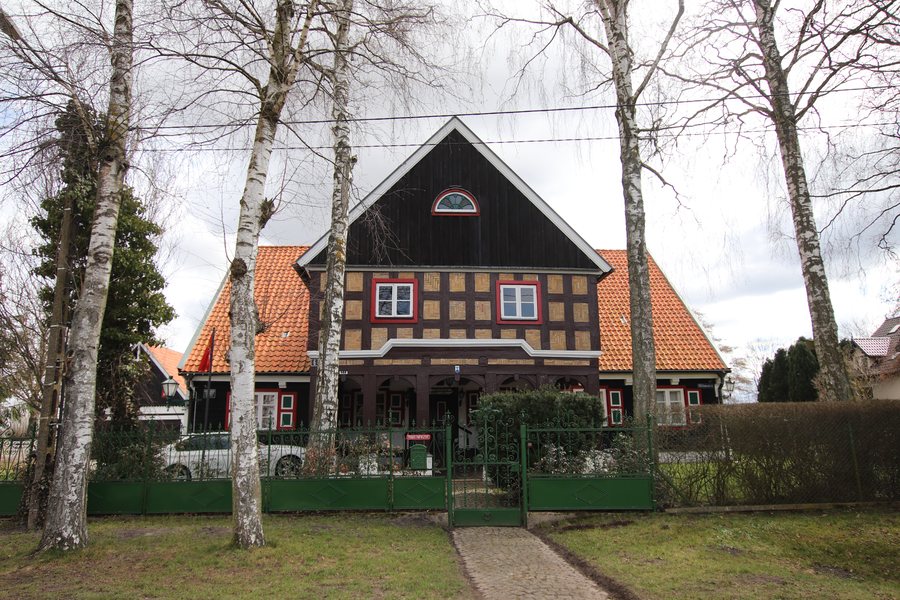
Quick Facts About Żuławki
- Żuławki and Drewnica are former Mennonite villages, separated by the Szkarpawa.
- Żuławki and Drewnica have unique ensembles of historic buildings from the 18th and 19th centuries.
- An eight-site walk can be taken along a two-kilometre road running parallel to the riverbank.
- The Gdańska Głowa lock connects the Vistula with the Szkarpawa nearby; the latter flows into the Vistula Lagoon.
- The village has a grocery store and a sailing marina.
What History Shapes the Village’s Character?
Żuławki’s former Mennonite character is an important part of the village’s history, as well as that of Drewnica, which is separated from it by the Szkarpawa. The village’s religious heritage also reflects several traditions: in the 16th century, Żuławki had three places of worship—a Catholic, a Lutheran and a Mennonite one. This historical context helps distinguish the different traces of the past.
Local landmarks include a Neo-Gothic Catholic church dedicated to the Nativity of the Blessed Virgin Mary, as well as a chapel and a Protestant cemetery. Together with the arcaded houses, these buildings give the village a layered cultural and historical character. Those interested in village history can explore its different religious and architectural traces.
What Is Notable About the Architecture?
Żuławki and Drewnica are home to unique ensembles of historic buildings from the 18th and 19th centuries. Several arcaded houses have been preserved in Żuławki, including two restored houses. The village’s arcaded house has Baroque and Neoclassical features, dates from the 18th century and underwent extensive alterations in 1825. The original date and later renovation provide two different points of reference for the building’s history.
Drewnica also has a historic building: a grain windmill of the “koźlak” type, known in English as a post mill, built in 1718. It complements the arcaded houses as another specific point of reference for exploring the architectural history of the two villages. These buildings can be seen as distinct examples of rural architecture, rather than being reduced to a single period.
How Can You Explore Żuławki on Foot?
A two-kilometre walk along a road parallel to the riverbank offers a way to take in the village’s rural layout. Along the way, you can see eight notable sites. These sites are not described as monuments; rather, the route provides clear guidance for a walk that brings the village structure and individual points of interest into view together.
The route’s length is also useful for planning your day: you can make the walk a separate activity and set aside time for it. If you are particularly interested in historic architecture, you can also look out for the arcaded houses and the village’s other cultural features. The walk offers a way to experience Żuławki in the context of its rural surroundings.
What Role Do the Szkarpawa and the Lock Play?
The Szkarpawa separates Żuławki and Drewnica. Near Żuławki, the Gdańska Głowa lock connects the Vistula with the Szkarpawa, which flows into the Vistula Lagoon. Together, these geographical features place the river within the surrounding waterscape, without requiring a boat trip or assuming anything about the lock’s current operating status.
Travellers on the Szkarpawa are advised to moor at Marina Żuławki and explore the surrounding area. The sailing marina is one of the facilities in the village, which also has a grocery store. These details complement the cultural and historical perspective with practical guidance for those travelling by water.
How Does Żuławki Fit into Your Accommodation Search?
Consider which of these themes matters most to your trip, and compare Żuławki with other destinations before choosing accommodation.
Discover more destinations: Stegna, Kobyla Kępa, Myszewko, Krynica Morska, Jazowa, Nowa Cerkiew, Drewnica and Nowy Dwór Gdański.
FAQ
Which places does the Szkarpawa separate?
The Szkarpawa separates the former Mennonite villages of Żuławki and Drewnica.
What can you see on a walk in Żuławki?
You can see eight notable sites on a two-kilometre walk along a road running parallel to the riverbank.
What does the Gdańska Głowa lock connect?
Near Żuławki, the lock connects the Vistula with the Szkarpawa, which flows into the Vistula Lagoon.
Back to the main travel overview: Tiegenhof.

