
Wierzchucino
Accommodation in Wierzchucino
Wierzchucino combines a traditional rural settlement layout with a connection to the water and several historic sites.
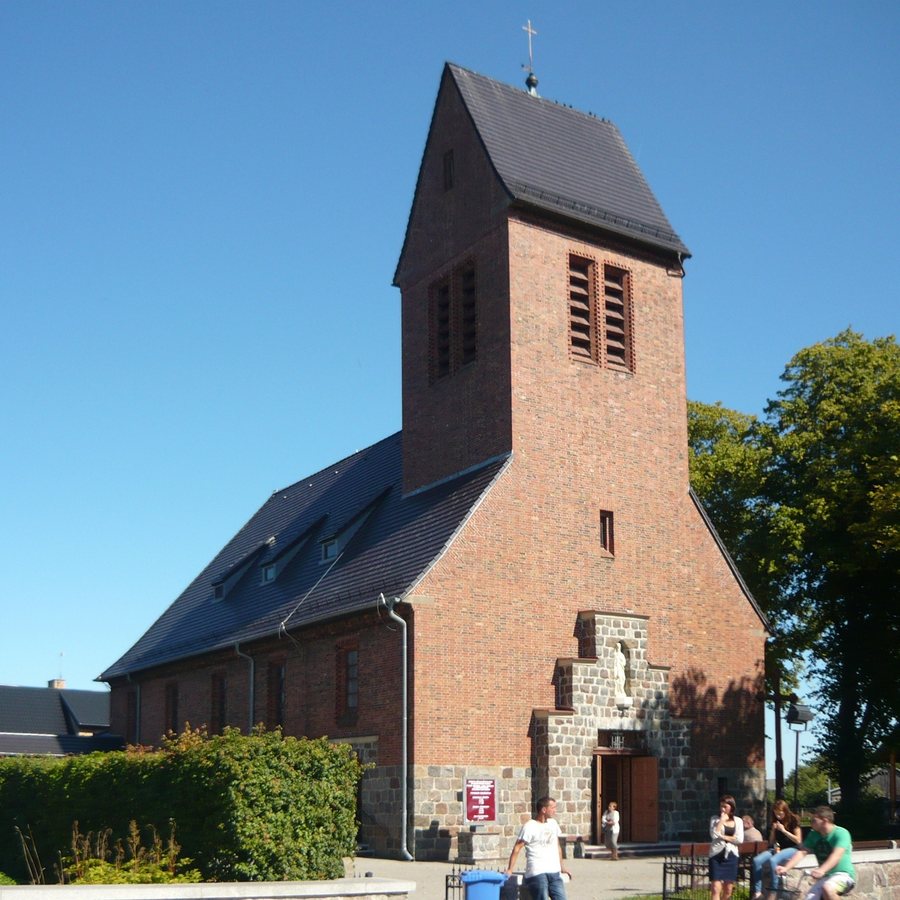 Kościół Najświętszego Serca Pana Jezusa i św. Rozalii z Palermo w Wierzchucinie
Photo: Ulrich Jahr via Source, Public Domain
Key facts about Wierzchucino
Wierzchucino lies on the Bychowska Struga and at the northwestern edge of Lake Żarnowieckie. The village has preserved its traditional, multi-street layout, typical of historic rural settlements. Historic buildings and sites in the village include a Neo-Gothic former Protestant church dating from 1882 with a historic cemetery, a manor house from the early 20th century surrounded by a park, a historic watermill on the Bychowska Struga, and buildings belonging to a former folwark. The Northern Kashubian Trail also runs through Wierzchucino.
What defines its rural character and connection to the water?
The multi-street layout is an important feature if you want to understand Wierzchucino as a rural village shaped by history. Together with its location on the Bychowska Struga, it gives the village a focus different from a trip based solely on individual buildings. It is also situated at the northwestern edge of Lake Żarnowieckie. The village can therefore be considered in terms of both its settlement pattern and history, and its relationship to the stream and lake.
The watermill stands on the Bychowska Struga in Wierzchucino. It is another historic landmark directly connected to the watercourse. When weighing up your interests, you can distinguish these features of the village from the nature and waterside destinations in the wider area: the lake lies at the northwestern edge of the village, while other destinations described here have their own directions and distances.
Which historic sites and traces can you find in the village?
The two churches are distinct historic landmarks. The Neo-Gothic former Protestant church dates from 1882 and is associated with a historic cemetery. The parish church in Wierzchucino is separate: it was consecrated on September 6, 1931. Each date belongs to its respective church and marks a different moment in the village’s history.
A manor house from the early 20th century is surrounded by a park. Wierzchucino also preserves remains of a German center for Olympic Games training from the 1930s. Buildings belonging to a former folwark add to the historic traces. Together, these do not represent a single theme, but form a village landscape where ecclesiastical architectural history, a manor house and park, and surviving sites from different historical contexts stand side by side. If you are particularly interested in historic architecture or rural history, these varied features can help guide your choice of trip.
Which destinations are nearby?
About 1 km west of Wierzchucino’s present-day built-up area, directly on Voivodeship Road 213 toward Choczewo, is a restored Protestant cemetery. A monument there commemorates local residents who fell in the First World War. It bears the names of 44 residents of Wierzchucino and the surrounding area who fell between 1914 and 1918. The site’s location west of the village and the monument’s connection to the years 1914–1918 give this destination a different historical context from the buildings in the village.
The Długosz Królewski Nature Reserve lies about 3 km east of Wierzchucino, in the buffer zone of the Coastal Landscape Park. Nearby, the Piaśnica flows out of Lake Żarnowieckie between Żarnowiec and Wierzchucino. This outflow is a popular starting point for kayaking trips that end at a beach near Dębem; the Piaśnica flows directly into the Baltic Sea. If you want to include nature or waterside activities in your trip, distinguish these destinations by their respective locations and character.
First choose what draws you to Wierzchucino: do you mainly want to explore its historic features, or would you also like to visit the nature reserve and go kayaking in the surrounding area? The destinations are not all in the same place: the restored cemetery is about 1 km west of the present-day built-up area, and the nature reserve is about 3 km east. You can take these details into account when planning without combining the different places into a single stop.
The Northern Kashubian Trail runs through Wierzchucino, adding a trail connection to the options. To compare other destinations, you can also consider Jastarnia, Bialogora, Gnieżdżewo, Żelistrzewo, Puck, Pierwoszyno, Rewa and Jurata.
FAQ
Where is Wierzchucino located in relation to Lake Żarnowieckie?
Wierzchucino lies at the northwestern edge of Lake Żarnowieckie and on the Bychowska Struga.
What historic buildings are there in Wierzchucino?
The village includes, among other things, a Neo-Gothic former Protestant church dating from 1882, the parish church, a manor house from the early 20th century, and a historic watermill.
Where is the Długosz Królewski Nature Reserve?
The nature reserve is about 3 km east of Wierzchucino, in the buffer zone of the Coastal Landscape Park.
For the main travel overview: Puck.

