
Jaworze
Accommodation in Jaworze
Jaworze combines a wooded landscape with park architecture, hiking trails and unusual insights into local flora and fauna. When planning your trip, it is worth considering which of these different themes interest you most.
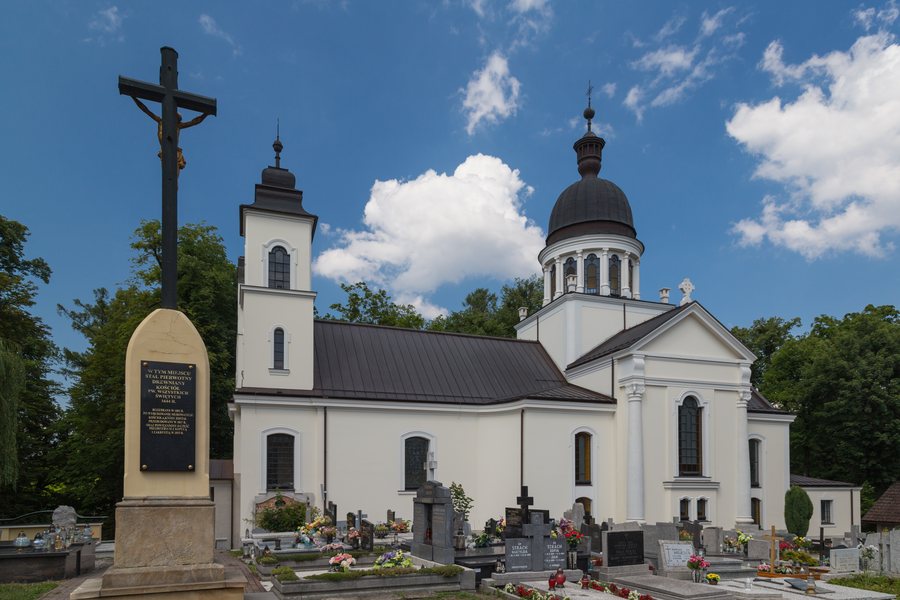 File:2021 Powiat bielski, Jaworze, Kościół Opatrzności Bożej 05.jpg
Photo: Marcin Konsek via Wikimedia Commons, CC BY-SA 4.0
File:2021 Powiat bielski, Jaworze, Kościół Opatrzności Bożej 05.jpg
Photo: Marcin Konsek via Wikimedia Commons, CC BY-SA 4.0
Jaworze at a glance
The area’s natural features include the 411 m-high, wooded Goruszka in the Cieszyn Foothills and a distinctive stand of Austrian pines. In terms of cultural history, Jaworze’s layout is shaped by a palace and park complex dating from the late 18th century. Other attractions include Zdrojowy Park, with five wooden walkways and observation points; the Museum of Marine and Freshwater Fauna and Flora; and hiking trails starting from Jaworze-Nałęże.
What makes Goruszka and its natural environment distinctive?
Goruszka is a wooded hill in the Cieszyn Foothills, reaching a height of 411 m. Austrian pines grow in its forest; they were introduced in the 19th century by Jaworze’s owners at the time, the Counts of Saint-Genois d’Anneaucourt. This is the only continuous stand of this pine species in the Silesian Beskids. The hill therefore offers a specific connection to nature and landscape for travellers interested in the distinctive local vegetation as well as the area’s cultural sites.
Another distinctive feature of Goruszka is the Glorieta, a Baroque element of the park. Its round roof is supported by six Neoclassical columns. The description brings together two different design elements in one structure: the Glorieta’s Baroque classification and the Neoclassical form of its columns. Visitors interested in park architecture will find a clearly defined example here, distinct from the hill’s natural history.
Which trails and park areas can you include in your plans?
The Szlak szklany hiking trail begins in Jaworze-Nałęże and leads to Ranczo Błatnia. Another option in the direction of Błatnia is the trail that starts in Nałęże, in Jaworze-Nałęże. This starting point is accessible by PKS bus or by car. There is a car park behind the converted church; from there, you can set off on foot for Błatnia. These descriptions refer to two routes, each with its own starting point or destination, and should not be combined into a single route.
Following its redesign, Zdrojowy Park has five wooden walkways and observation points. They offer new perspectives on the park. This is a different way to experience the landscape from hiking in the direction of Błatnia: in the park, the focus is on the walkways and observation points, while the hiking trails mentioned connect Jaworze-Nałęże with destinations outside the park. These differences can help you choose the kind of nature experience you are looking for.
What cultural sites does Jaworze offer?
The central feature of Jaworze’s layout is a palace and park complex dating from the late 18th century. Its described arrangement includes a lower manor farm in the northeastern part and an upper manor farm set further north. The complex is relatively symmetrical. Those interested in historic town layouts can look not only at individual buildings but also at how the complex is arranged.
Jaworze-Nałęże is also home to a reconstructed glassworks on the site of a former glassworks dating from the 19th century. The present-day glassworks is a reconstruction; the former glassworks is part of the site’s history. The Museum of Marine and Freshwater Fauna and Flora displays, among other things, a sea turtle, sharks including a hammerhead shark, octopuses, molluscs and sea urchins. These exhibits make the museum a distinct attraction alongside the park, architecture and hiking trails.
The Protestant cemetery in Jaworze also offers a clearly defined historical experience: an information board guides visitors through eleven important memorial points within the cemetery. If you would like to explore different sides of the area, you can consider nature, park design, the museum and these memorial points as separate interests. You can also explore Buczkowice, Świętoszówka, Rudzica, Bystra, Rybarzowice, Bestwina, Zasole Bielańskie and Międzyrzecze Górne as further destinations.
FAQ
Which animals are on display at the museum in Jaworze?
Animals on display include a sea turtle, sharks including a hammerhead shark, octopuses, molluscs and sea urchins.
Where does the Szlak szklany begin?
The hiking trail begins in Jaworze-Nałęże and leads to Ranczo Błatnia.
How do you get to the starting point of the trail to Błatnia?
The starting point in Nałęże is accessible by PKS bus or by car. There is a car park behind the converted church; from there, you continue on foot.
What is the Glorieta on Goruszka?
It is a Baroque element of the park, with a round roof supported by six Neoclassical columns.
For the broader travel overview: Bielsko-Biała.

