
Krempna: Nature Trails and Cultural Heritage
Accommodation in Krempna
Krempna brings together nature trails, the reservoir, the Magura National Park Museum and distinctive buildings. Information about the trails, the collection and cultural heritage highlights different aspects to consider when planning your trip. You can start by deciding whether you are most interested in landscapes, natural history or architecture.
Krempna at a glance
- Krempna is the seat of Magura National Park.
- The Magura National Park Museum has an extensive collection of plant and animal specimens as well as geological exhibits.
- The yellow-marked Hałbów–Kamień nature trail is 10 kilometres long and starts and ends in Krempna. Check current trail conditions before setting out.
- The “Dobry widok – Krempna” landscape trail passes five viewpoints.
- War Cemetery No. 6 is located on the summit of Łokieć Hill, southwest of Krempna.
- The reservoir is a place to relax surrounded by nature.
How do the nature spots differ?
The Hałbów–Kamień nature trail is described in specific terms: its length, marking and connection to the area. The yellow marking identifies the 10-kilometre route, which starts and ends in Krempna. Check current trail conditions before setting out. The “Dobry widok – Krempna” landscape trail is distinguished by its five viewpoints. This gives you different features to consider when making your choice: a measured route that starts and ends in Krempna, or a trail with five viewpoints.
The reservoir adds another way to experience the landscape alongside these two nature trails: it is described as a place to relax surrounded by nature. When planning your trip, you can therefore choose between a designated route, viewpoints and relaxation by the reservoir.
What role does Magura National Park play in the area?
Krempna is the seat of Magura National Park. The park pavilion houses the park administration, the Jan Szafrański Education Centre and the Magura National Park Museum. The museum has an extensive collection of plant and animal specimens as well as geological exhibits. These three areas give the collection a distinct natural history focus alongside the trails and viewpoints.
The facilities in the pavilion also represent different aspects of the national park: the park administration, the education centre and the museum. This means Krempna can be understood not only through its nature trails and landscape, but also through the park’s institutional and natural history presence.
What makes Krempna’s cultural sites distinctive?
War Cemetery No. 6 is located on the summit of Łokieć Hill, southwest of Krempna. Its central feature is a mausoleum designed by Dušan Jurkovič. The circular floor plan, six stone pillars and concrete ring give the structure its described form. The ring is decorated with oak leaves made of sheet copper. Its location and design offer two distinct points of reference for understanding the cemetery.
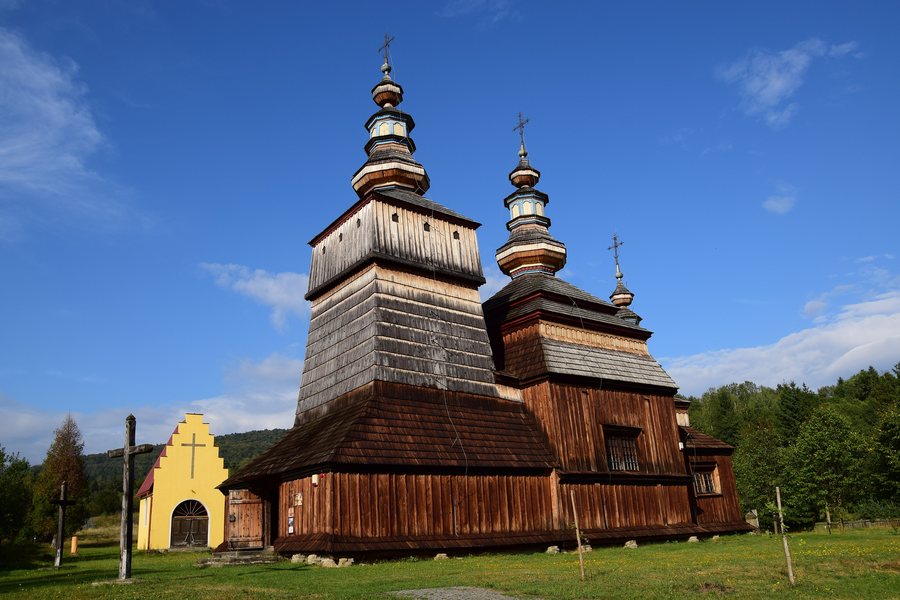
The church in Krempna is now used as a Roman Catholic church. Inside, a complete iconostasis from 1835 and a Deesis from an older 17th-century iconostasis have been preserved. This gives two distinct points of reference in time: the iconostasis from 1835 and the Deesis, which comes from an older 17th-century furnishing. Lemko farmsteads are also among Krempna’s attractions.
How can you choose a focus for your trip?
You can consider the nature and cultural themes separately when planning. Those interested in the landscape can choose between the nature trail, the landscape trail and the reservoir as different points of interest. The museum adds another perspective with its plant, animal and geological exhibits. For architecture and historic furnishings, the mausoleum and church offer specific details. You can decide how much each of these themes will shape your stay based on your own interests.
Discover more destinations: Jasło, Nawsie Kołaczyckie, Nowy Żmigród, Kołaczyce, Polany.
FAQ
What information is available about the Hałbów–Kamień nature trail?
It is 10 kilometres long, marked in yellow, and starts and ends in Krempna. Check current trail conditions before setting out.
What is the central feature of War Cemetery No. 6?
It is a mausoleum by Dušan Jurkovič with a circular floor plan, six stone pillars and a concrete ring decorated with copper oak leaves.
What historic details have been preserved in the church?
The church is now used as a Roman Catholic church. Preserved inside are a complete iconostasis from 1835 and a Deesis from an older 17th-century iconostasis.
For the main travel overview: Jasielski.

