
Kargów
Accommodation in Kargów
Kargów’s story unfolds through a long church history and religious markers at prominent locations. Historical records date back to 1326; a statue and a Pietà add different forms of religious remembrance to the picture.
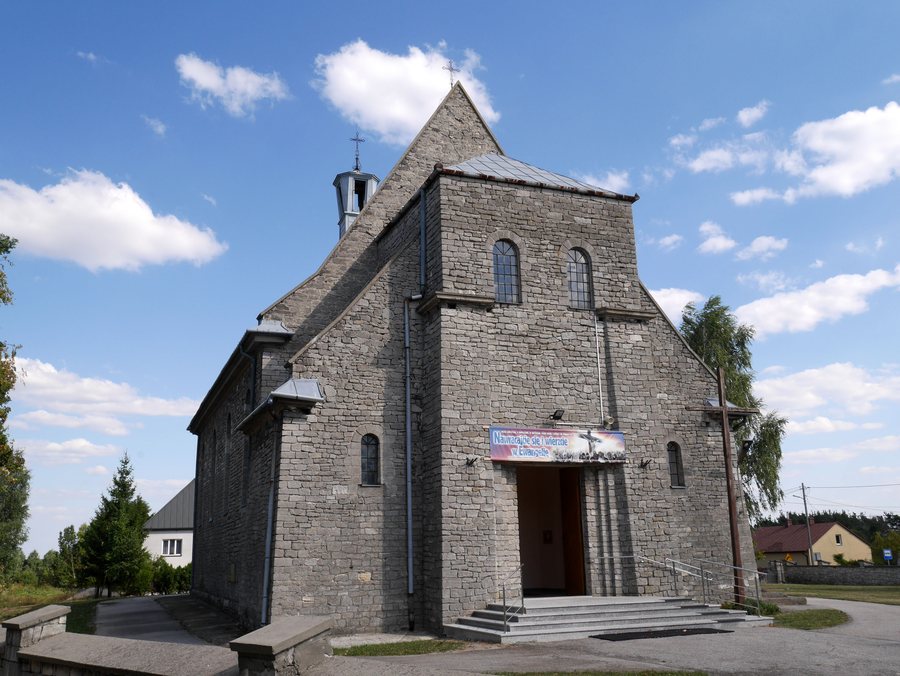 File:Kargow our lady of fatima church p1040310.jpg
Photo: WiktorN.PL via Wikimedia Commons, CC BY-SA 3.0
File:Kargow our lady of fatima church p1040310.jpg
Photo: WiktorN.PL via Wikimedia Commons, CC BY-SA 3.0
Key facts about Kargów
The first recorded mention of the church and parish dates from 1326. The church was built by King Casimir the Great and was altered during postwar reconstruction after suffering war damage. A statue of Saint Joseph stands on a hill several metres high at the junction of the roads to Tuczępy and Stopnica. There is also a stone Pietà on the road between Kargów and Bosowice.
What does the church history tell us?
The year 1326 marks the first recorded mention of the church and parish; it does not necessarily indicate when they were founded. A report by the historian Bartosz Paprocki dates the construction of a stone church to the 1360s, replacing a wooden one. According to the report, King Casimir the Great had it built as penance for the murder of the priest Baryczka. Thus, an early written mention and a later-dated account coexist, without describing the same historical event.
The later building history is also part of the picture: after the church was damaged in the war, it was altered during postwar reconstruction. Those interested in historic sites will find several points of reference here—from the first recorded mention to the medieval building history and postwar reconstruction. These details concern different periods and should be understood as such.
Where are the religious wayside shrines?
The statue of Saint Joseph holding the infant Jesus stands on a hill several metres high at the junction of the roads to Tuczępy and Stopnica. It was erected in 1921, on the 50th anniversary of Saint Joseph’s appointment as patron of the Universal Church. Its location and the occasion give the monument a specific place in local history: it is not only a religious depiction, but is also associated with a clearly specified commemorative year.
Another kind of depiction is the stone-carved Pietà on the road between Kargów and Bosowice. Locally, it is known as “Pod Męką.” While the statue of Saint Joseph stands on a hill at a road junction, the Pietà is identified by its location between two places. These differences help distinguish the two religious landmarks without combining them into a single stop or shared route.
What are Kargów’s highlights?
When planning your trip, you can distinguish between two interests: church history offers points of reference in time and a recorded account of the origins of the stone church. The religious landmarks, by contrast, draw attention to specific locations and their individual significance. Together, these topics reveal different aspects of local history. You can decide whether you are most interested in historical accounts, religious depictions, or the connection between the two.
Discover more destinations: Konary, Janina, Balice, Zielonki, Mietel, Solec-Zdrój, Stopnica, Busko-Zdrój.
FAQ
How long has the church in Kargów been documented?
The first recorded mention of the church and parish dates from 1326.
When was the statue of Saint Joseph erected?
It was erected in 1921, on the 50th anniversary of Saint Joseph’s appointment as patron of the Universal Church.
What is the Pietà between Kargów and Bosowice called?
The stone-carved Pietà is locally known as “Pod Męką.”
Return to the regional travel guide: Buski.

