
Discover Heiligkreuz: Nature, history and excursions
Accommodation in Heiligkreuz
Heiligkreuz offers a variety of reasons to plan a trip: nature experiences in Świętokrzyski National Park, a cave along a 20-kilometre hiking trail, and prehistoric and historic sites.
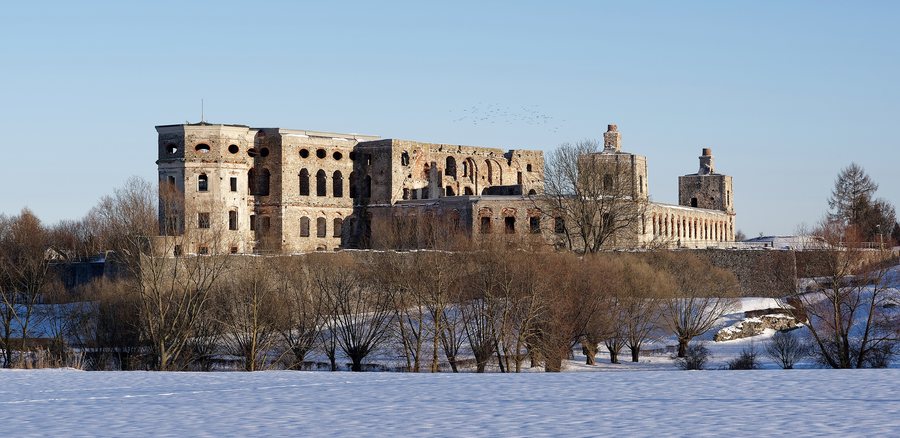 Krzyżtopór Castle in Ujazd, Świętokrzyskie Voivodeship
Photo: Jakub Hałun via Wikimedia Commons, CC BY 4.0
Krzyżtopór Castle in Ujazd, Świętokrzyskie Voivodeship
Photo: Jakub Hałun via Wikimedia Commons, CC BY 4.0
Key facts about Heiligkreuz
Świętokrzyski National Park protects the highest mountain range in the Świętokrzyskie Mountains and its surroundings. Visits are permitted only on marked hiking trails or at places designated for educational activities. Other topics in the region include the prehistoric flint mines of Krzemionki, historic buildings, an underground tourist route and attractions for a variety of interests.
What should you know about nature experiences and hiking?
There is a clear rule for excursions in Świętokrzyski National Park: stay on marked hiking trails or visit only places designated for educational activities. The park protects the highest mountain range in the Świętokrzyskie Mountains and its surroundings. If you include hikes in your travel plans, bear this visitor requirement in mind.
Another geological feature lies at the summit of Łysa Góra: there is a boulder field formed during a glaciation from quartzite sandstone around 500 million years old. In Jaskinia Raj, mineral formations shape the passages and chambers. They display white, beige, brown and rusty reddish-brown hues and cover the ceiling, floor and walls, as well as detached rock blocks.
Jaskinia Raj lies on the red hiking trail from Kielce to Chęciny. The trail is 20 kilometres long, starts at Mount Karczówka in Kielce and ends at the market square in Chęciny. This information helps you consider the route as a hiking option in its own right; no walking time is specified. If you want to browse trails and plan your own excursions using a comprehensive map feature, you can use the “Świętokrzyskie szlaki turystyczne” platform.
Which historic sites and exhibitions are there?
In Krzemionki, the region of prehistoric striped flint mining was added to the UNESCO World Heritage List in 2019. The flint mines there were in operation during the Neolithic and early Bronze Age, from around 3900 to 1600 BC. This makes the site part of a long history of flint mining with a clearly defined timeframe.
The Royal Castle in Chęciny was built at the turn of the 13th and 14th centuries as a hilltop castle on a rise 360 metres above sea level. If you are interested in historic buildings, you can make it a focus of your trip. The history of the Palace of Kurozwęki dates back to the 14th century.
At the Ethnographic Park in Tokarnia, rural and small-town buildings are presented in natural settlement groups. These include sections of villages, as well as a mill, a windmill and a smithy. The Underground Tourist Route in Sandomierz offers a different focus: it includes a multimedia exhibition about legendary figures from Sandomierz.
Which excursions suit different interests?
On the bison safari in Kurozwęki, you can observe the animals from a Western-style wagon that drives into the enclosure. Qualified guides explain the herd's history and the bison's habits. Raft trips are available on the Kamienna River in Bałtów. The Bałtów Complex lies on the Świętokrzyski Geo- and Archaeological Trail; it also includes a dinosaur park supervised by palaeontological scientists. New discoveries lead to changes to the dinosaur figures or their exhibition locations.
The Leonardo da Vinci Science Centre teaches visitors about the human body through interactive exhibits inside the building and in the garden. For a longer bike ride, the Czerwona Pętla Rowerowa is another option: the circular route is 60 kilometres long, has a stated duration of six hours, and runs through Chęciny Rynek and Podzamcze Chęcińskie, among other places, as well as through other locations in the Chęcinsko-Kielecki Landscape Park. This lets you choose an excursion based on your interests, from cycling and nature watching to culture and interactive attractions.
You can explore other regions on their own pages: Sandomierz County, Końskie, Jędrzejów, Kazimierza, Pińczów, Skarżysko, Starachowice, Opatów, Ostrowiec, Włoszczowa, Kielce, Staszów and Busko.
FAQ
What rules apply to visits to Świętokrzyski National Park?
You may visit the national park only on marked hiking trails or at places designated for educational activities.
How long is the Czerwona Pętla Rowerowa?
The circular route is 60 kilometres long, with a stated duration of six hours. It runs through Chęciny Rynek and Podzamcze Chęcińskie, among other places.
What can you see at the Ethnographic Park in Tokarnia?
You can see rural and small-town buildings in natural settlement groups, including sections of villages, a mill, a windmill and a smithy.
For the main travel overview: Poland.

