
Czarnocin: Church, Hill and Local History
Accommodation in Czarnocin
Czarnocin brings together the history of the Church of the Assumption of the Blessed Virgin Mary and a hill topped by a Baroque statue of Saint John of Nepomuk dating from 1761. A wooden bell tower and the traditions surrounding the hill also shape the character of the place.
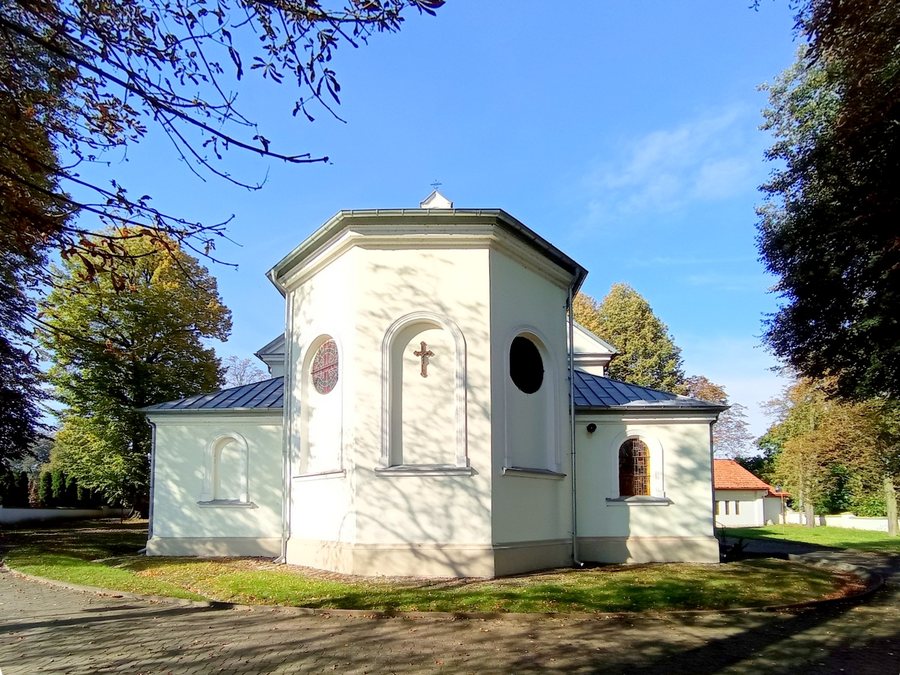
Czarnocin at a glance
- The hill near the church is truncated-conical and several metres high.
- A Baroque statue of Saint John of Nepomuk dating from 1761 stands on the hill.
- Local residents call the hill Górka Luterska.
- A wooden bell tower stands beside the church; it was built during the 19th-century renovation.
What stories are told about the hill near the church?
Its shape and the statue make the hill a distinctive feature of Czarnocin’s local history. It is truncated-conical and several metres high, with a Baroque statue of Saint John of Nepomuk standing on it. The statue dates from 1761. The name Górka Luterska refers to the same hill: that is what local residents call it.
Its origins are interpreted in different ways, and with some reservations. The hill is thought to be a pre-Slavic burial mound; historical documents may refer to it as an Arian grave. These cautious formulations leave its origins open to question. It is therefore important not to treat the possible interpretations as a confirmed identification.
A legend adds to these traditions: three sisters are said to have lived in Czarnocin. One sister is credited with building a palace, another with building a hill, and the third with building a church. The story links these three structures within the legend and offers its own oral interpretation of local history.
What is the history of the church and bell tower?
The Church of the Assumption of the Blessed Virgin Mary was founded by Otto of Mstyczów, Chancellor of Greater Poland and bearer of the Lis coat of arms. The wooden bell tower stands beside the church and was built during the 19th-century renovation. Two distinct historical references meet here: the church’s recorded foundation and a later architectural addition. Those interested in local history can view these as different periods rather than combining them into a single building history.
What remains of the former manor park?
Some of the trees from the former manor park have survived in Czarnocin. This feature of the landscape adds another aspect of local history to the stories of the church and hill. In Czarnocin, religious buildings, a traditional interpretation of the hill and a trace of the former park can all be found side by side. These points can be distinguished thematically: the hill is associated with a statue and several interpretations, the church with its foundation history, and the park with its surviving trees.
What cultural history can be found near Stradów?
Another point of interest lies in the municipality of Czarnocin near Stradów, not in the village of Czarnocin itself: there is an early medieval fortified settlement there, one of the largest in Poland. Together with its associated settlements of Waliki, Mieścisko and Barzyńskie, the site covered about 25 hectares. This municipal connection broadens the focus beyond the history of the village. For trip planning, it is useful to distinguish the locations: the church, bell tower and hill are in Czarnocin; the fortified settlement is near Stradów, within the municipality.
Discover more destinations: Kazimierza Wielka, Kraśniów, Opatowiec, Odonów, Sędziszowice.
FAQ
What is the hill by the church called?
Local residents call it Górka Luterska.
How are the hill’s origins interpreted?
It is thought to be a pre-Slavic burial mound; historical documents may refer to it as an Arian grave.
Where is the fortified settlement near Stradów?
It is in the municipality of Czarnocin near Stradów, not in the village of Czarnocin.
Who founded the Church of the Assumption of the Blessed Virgin Mary?
The founder is said to have been Otto of Mstyczów, Chancellor of Greater Poland and bearer of the Lis coat of arms.
For the broader travel overview: Kazimierza.

