
Starachowice
Accommodation in Starachowice
Starachowice combines striking architecture and industrial history with trails along Zalew Lubianka and a wooded landscape. When planning your trip, you can choose between cultural attractions, hiking trails and various road connections, depending on what you want to focus on during your stay.
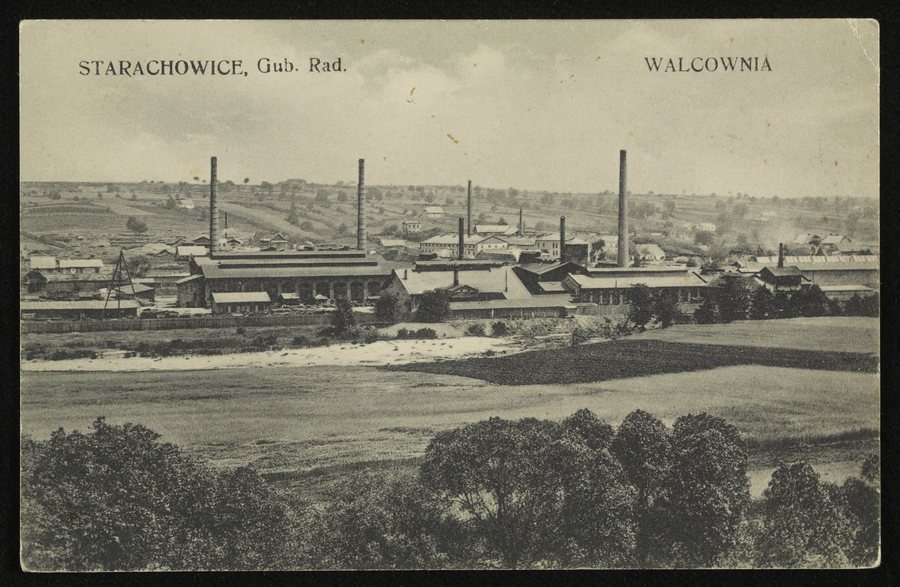 Starachowice, Gub. Rad. - walcownia. 1905-1918
Photo: Unknown author via Wikimedia Commons, Public domain
Starachowice, Gub. Rad. - walcownia. 1905-1918
Photo: Unknown author via Wikimedia Commons, Public domain
Starachowice at a glance
- Starachowice lies on the northern edge of the Świętokrzyskie Mountains, in the Kamienna River valley and surrounded by an extensive forest area.
- The Trinity Church has three naves, was built of sandstone and was founded in 1681.
- The Muzeum Przyrody i Techniki „Ekomuzeum“ im. Jana Pazdura is located on the grounds of the blast furnace works.
- The yellow walking trail is about 7.5 kilometres long and starts on the eastern side of Zalew Lubianka.
- The black hiking trail starts at Starachowice Zachodnie railway and bus station and reaches the Wykus clearing.
What defines the landscape of Starachowice?
Its location on the northern edge of the Świętokrzyskie Mountains, the Kamienna River valley and the extensive forest area give Starachowice a distinct landscape. Those interested in nature and trails when choosing a destination will find both a connection to the wooded surroundings and specific route descriptions within the town. The Kamienna River valley is part of this landscape, as are the forests surrounding Starachowice.
You can also plan your excursions around different starting points: the yellow walking trail starts at a turning loop on ul. Myśliwska, while the black hiking trail begins at Starachowice Zachodnie railway and bus station. These two trails therefore have different named starting points; no connection between them or shared route is specified.
What cultural and historical attractions are there?
The Trinity Church offers a distinctive architectural highlight. Its three naves and sandstone construction vividly describe the church, while its founding year, 1681, adds historical context to these architectural features. If you want to include culture in your travel plans, you can consider architecture and local history as separate themes.
Another perspective on history can be found at the blast furnace works. The Muzeum Przyrody i Techniki „Ekomuzeum“ im. Jana Pazdura is located on its grounds. The complex includes a late-19th-century blast furnace complex, which is the only fully preserved technological line of metallurgical installations in Europe. Alongside the church, the museum and this historic industrial complex provide Starachowice with another point of interest focused on technology.
The Jewish cemetery is also part of the town’s history. It was established towards the end of the 19th century, is one of the largest in the region and was in use until 1946. A stay focused on cultural history can therefore encompass several themes: sacred architecture, industrial history and the history of the Jewish cemetery.
Which trails and railway routes can you include in your plans?
The yellow walking trail starts at a turning loop on ul. Myśliwska, on the eastern side of Zalew Lubianka. It is about 7.5 kilometres long; keep in mind that this is an approximate distance when planning your day. The trail continues along the southern side of Zalew Lubianka and leads to Langiewicz’s camp.
The black hiking trail has a different specified starting point: it begins at Starachowice Zachodnie railway and bus station and reaches the Wykus clearing. If you choose a trail based on its named landmarks, the yellow walking trail focuses on Zalew Lubianka and Langiewicz’s camp, while the black hiking trail starts at the railway and bus station and leads to the Wykus clearing.
During the tourist season, the Starachowicka Kolej Wąskotorowa operates on two sections: Starachowice–Lipie and Iłża–Marcule. Timetabled services on the Starachowice–Lipie section are to be offered after repair work is completed. Bear this caveat in mind if you want to include a ride on this narrow-gauge railway in your trip; seasonal operation is also specified for Iłża–Marcule.
How can you plan your journey to Starachowice?
Several road designations are useful for travelling by car. Starachowice lies on national road 42 between Namysłów and Rudnik. Voivodeship roads 744, between Radom and Starachowice, and 756, between Starachowice and Stopnica, also begin there. These connections provide an overview of the named road routes.
Starachowice Zachodnie railway and bus station is another named location in the town: it serves as the starting point for the black hiking trail.
More pages about nearby places and the region: Grabków, Tarczek, Ambrożów, Jabłonna, Wielka Wieś, Starachowice, Sandomierz County and Kazimierza.
FAQ
How long is the yellow walking trail?
The yellow walking trail is about 7.5 kilometres long. It starts at a turning loop on ul. Myśliwska, on the eastern side of Zalew Lubianka, follows its southern shore and leads to Langiewicz’s camp.
Where does the black hiking trail start?
It starts at Starachowice Zachodnie railway and bus station and reaches the Wykus clearing.
Which sections does the narrow-gauge railway operate on?
During the tourist season, the Starachowicka Kolej Wąskotorowa operates on the Starachowice–Lipie and Iłża–Marcule sections. Timetabled services on Starachowice–Lipie are to be offered after repair work is completed.
For the broader travel overview: Świętokrzyskie.

.jpg)