
Discover Frombork
Accommodation in Frombork
Frombork brings together distinctive buildings and cultural history: the Archcathedral Basilica of the Assumption of the Blessed Virgin Mary and Saint Andrew the Apostle is the oldest building on Cathedral Hill. The International Organ Festival is held in the cathedral every summer. A water tower dating from 1571 offers another view of the town and the Vistula Lagoon.
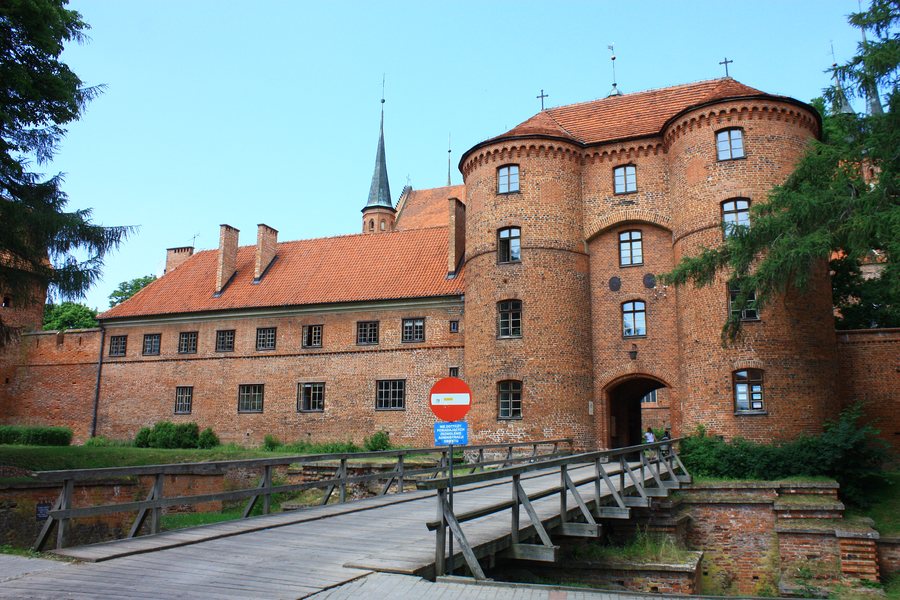
Frombork at a glance
- The Archcathedral Basilica of the Assumption of the Blessed Virgin Mary and Saint Andrew the Apostle is the oldest building on Frombork’s Cathedral Hill.
- The water tower was built in 1571 over a canal that flows through the town and today also serves as a viewpoint.
- The International Organ Festival is held in the cathedral every summer.
- Frombork commemorates Nicolaus Copernicus, including with a tower and a bronze statue in the market square.
What defines Cathedral Hill and the cathedral?
The Archcathedral Basilica of the Assumption of the Blessed Virgin Mary and Saint Andrew the Apostle is the oldest building on Cathedral Hill. This makes a specific building the focal point if you are interested in the town’s history and architecture. Cathedral Hill is also a recurring point of reference in Frombork: the water tower offers a view of it, and the Copernicus statue in the market square faces towards it.
For music lovers, the International Organ Festival is one of the special cultural events. It is held every summer in the cathedral. If you would like to plan your trip around a particular reason to visit, you can take this seasonal event into account.
What traces of Nicolaus Copernicus can you find?
The Copernicus Tower belonged to Nicolaus Copernicus from 1504 to 1543. This period makes the tower a specific point of interest for travellers interested in Copernicus and his connection with Frombork. There is also a bronze statue of him in the market square, seated on a bench designed to look like the Earth and gazing towards Cathedral Hill. This means the name Copernicus appears not only in connection with a tower, but also as part of the design of a public square.
What can you discover at the water tower?
The water tower was built in 1571 over a canal that flows through the town. At the time, its purpose was to supply water to Cathedral Hill, the Bishop’s Palace and the canons’ houses. The building therefore also tells the story of how these institutions were supplied: it was connected to a canal and had a clearly defined purpose.
Today, the water tower is also a viewpoint. From there, you can look out over Cathedral Hill, the Old Town and the Vistula Lagoon. Visitors who appreciate both historic buildings and town views will find a link here between Frombork’s architectural history and its visible surroundings. The view includes several specifically named features, including the Vistula Lagoon; the tower thus offers a different way to experience the town than the exhibitions or the cathedral.
What cultural interests suit Frombork?
The medical history section of the Nicolaus Copernicus Museum displays exhibits on the history of medicine. It also hosts temporary exhibitions on death, illness and the body. This focus differs from the cathedral, the organ festival and the links to Copernicus: here, medical subjects and changing exhibitions take centre stage.
These experiences offer different points of interest without needing to be combined into a set itinerary. If you would like to compare other destinations, you can also find Nowica, Zagaje, Maciejewo, Mikolajewo, Wilczeta, Braniewo, Pieniężno and Stegna.
FAQ
When does the International Organ Festival take place?
The festival is held every summer in Frombork Cathedral.
What can you see from the water tower?
From the water tower, you can see Cathedral Hill, the Old Town and the Vistula Lagoon.
What topics are covered in the medical history section?
It features exhibits on the history of medicine as well as temporary exhibitions on death, illness and the body.
For the broader travel overview: Braunsberg.

