
Discover Łabędzie: Church, Monument and Watermill
Accommodation in Łabędzie
Łabędzie brings together several historical landmarks in a small area: a parish church dating from around 1600, a memorial to the victims of the First World War, and a preserved watermill. If you would like to include culture and routes in the wider region in your travel plans, the broader Dramburg destination also offers a range of themes to help you find your bearings.
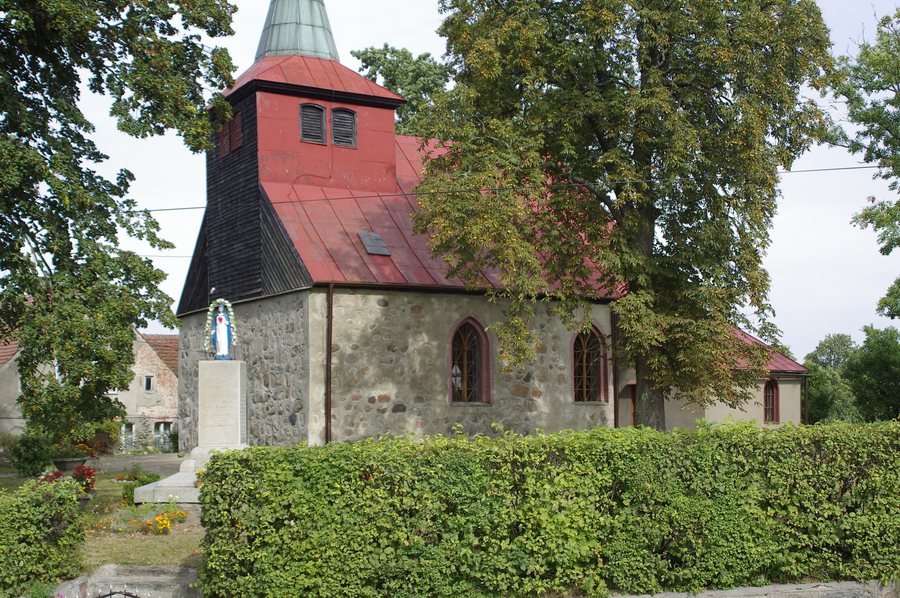 File:47 kościół św.Michała Archanioła Łabędzie areekw1.JPG
Photo: Arkadiusz Wielemborek via Source, CC BY-SA 3.0 pl
File:47 kościół św.Michała Archanioła Łabędzie areekw1.JPG
Photo: Arkadiusz Wielemborek via Source, CC BY-SA 3.0 pl
Key facts about Łabędzie
- The parish church was built at the turn of the 16th and 17th centuries.
- A statue of the Virgin Mary stands beside the Church of St Michael the Archangel, on a memorial to the victims of the First World War.
- The bell of the Church of St Michael was cast in 1564 by Jochim I (the Elder) at the Karstede family foundry.
- A watermill dating from the first decade of the 20th century has been preserved in the Neu Lanenz colony in Łabędzie.
What historical traces can you find in Łabędzie?
The church, bell, memorial and mill provide different points of reference for exploring Łabędzie through time. The parish church was built at the turn of the 16th and 17th centuries. The bell, dated precisely to 1564, offers another clue: it was cast by Jochim I (the Elder) at the Karstede family foundry. The church thus draws attention both to its period of construction and to an older, specifically dated piece of its furnishings.
Beside the Church of St Michael the Archangel stands a statue of the Virgin Mary on a memorial to the victims of the First World War. Its location brings together two distinct aspects of the village’s history: the church and remembrance of the fallen. The preserved watermill adds a building dating from the first decade of the 20th century to this picture. It is located in the Neu Lanenz colony in Łabędzie. These dates and places can be considered individually, without grouping them into a single historical period.
Which routes can you compare in Dramburg?
Two hiking trails in the broader Dramburg destination are described, with different lengths and endpoints. The 67-kilometre black trail “Drawskich grodzisk wczesnośredniowiecznych” both starts and ends in Drawsko Pomorskie. The 52-kilometre blue trail “im. I Warszawskiej Dywizji Kawalerii” follows the Wał Pomorski fortification line; it starts in Iłowiec and ends in Drawsko Pomorskie. Their names, routes and endpoints give you a concrete basis for comparing these regional trails.
Another trail, the “Szlak Jezior Drawskich” around Drawsko Pomorskie, runs through moraine hills and river valleys and along a continuous chain of lakes. It can also be cycled. At inaccessible or difficult-to-access points, use the suggested detours. The black cycle route “Rzeka Brzeźnicka Węgorza – wodospady” starts and ends at Drawsko Pomorskie railway station; its stated length is 39 kilometres, with an estimated duration of two to three hours. Route details may be revised; check them before setting out.
What does Drawsko Pomorskie offer in terms of culture and visitor information?
The cultural attractions in the broader Dramburg destination are not all in Łabędzie. Drawsko Pomorskie is home to the Late Gothic Church of the Resurrection. Built at the turn of the 14th and 15th centuries, it has a 75-metre-high tower. Bestiary decorations adorn its pointed-arch side portals. Since 2018, the salt storehouse has housed memorabilia relating to the history of Drawsko Pomorskie.
For initial information about the region, a tourist information point in Drawsko Pomorskie provides details about accommodation, dining and tourist attractions. The topics covered also include cycling, horse-riding, hiking and walking trails, cultural and sporting events, and tourist equipment rental. The services available may change; it is best to check in advance about specific needs.
How is the destination connected by transport?
National Road 20 and railway line 385 run through the town and municipality of Drawsko Pomorskie. The road connects Stargard and Szczecinek, while the railway line connects Runowo Pomorskie and Szczecinek. Szczecinek is the shared endpoint for both the road and the railway line.
Fryderyk Chopin City Park in Drawsko Pomorskie is another distinct regional landmark: it was laid out in 1875 on a right-hand bend of the Drawa River. Together with the landscape descriptions of the “Szlak Jezior Drawskich”, it offers two different perspectives on the region: a named park on the Drawa and a route through hills and valleys and along a chain of lakes.
Discover more destinations: Broczyno, Czaplinek, Bobrowo, Siemczyno, Wierzchowo, Złocieniec, Zabin, Kalisz Pomorski.
FAQ
How old is the parish church in Łabędzie?
It was built at the turn of the 16th and 17th centuries. The bell of the Church of St Michael the Archangel has a more precise date: it was cast in 1564.
Where is the statue of the Virgin Mary on the war memorial?
It stands beside the Church of St Michael the Archangel in Łabędzie, on a memorial to the victims of the First World War.
Which hiking trails are described for Dramburg?
The 67-kilometre black trail “Drawskich grodzisk wczesnośredniowiecznych” starts and ends in Drawsko Pomorskie. The 52-kilometre blue trail along the Wał Pomorski fortification line starts in Iłowiec and ends in Drawsko Pomorskie.
Can you cycle the “Szlak Jezior Drawskich”?
Yes. At inaccessible or difficult-to-access points, use the detours suggested in the route description.
For the broader travel overview: Dramburg.

