
Rekowo
Accommodation in Rekowo
Rekowo combines a rural settlement pattern with archaeological traces from different periods. A cycling route and a stage of the Way of St. James offer further concrete starting points for planning your trip.
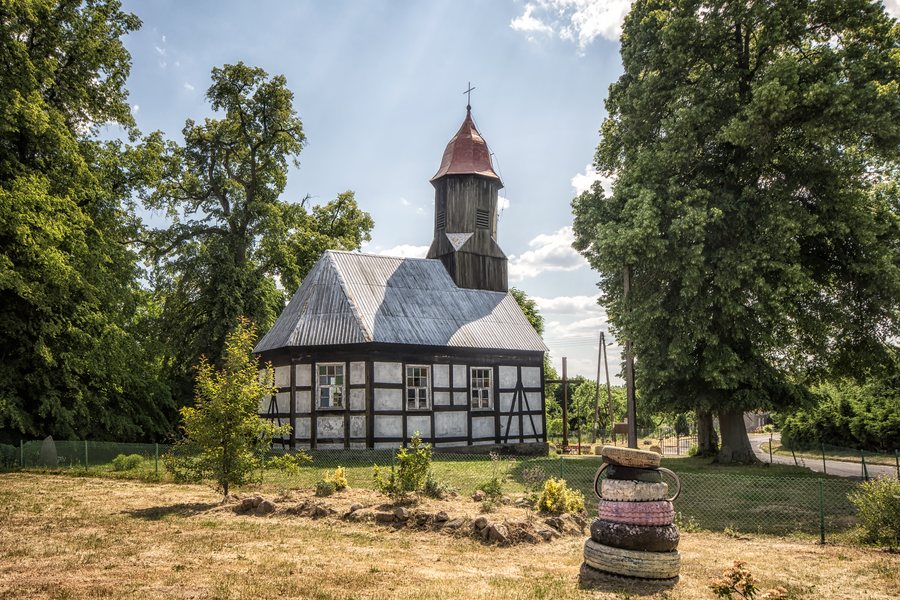 File:SM Rekowo Kościół Apostołów Piotra i Pawła 2023 (9).jpg
Photo: Sławomir Milejski via Wikimedia Commons, CC BY-SA 4.0
File:SM Rekowo Kościół Apostołów Piotra i Pawła 2023 (9).jpg
Photo: Sławomir Milejski via Wikimedia Commons, CC BY-SA 4.0
Key facts about Rekowo
- Rekowo is home to an archaeologically investigated barrow cemetery.
- The earliest discovered traces of settlement date from the Stone Age and Early Bronze Age.
- A cycling route runs via Kolonia Mrówek to Kościernica.
- Stage 28a of the Way of St. James passes through Rekowo.
- On the edge of the village is a former German cemetery with graves dating from the 19th century still preserved.
What travel interests does Rekowo suit?
Rekowo is best discovered through its archaeological remains, cycling route, and the Way of St. James. Its rural settlement pattern is another part of the village’s character. A chapel dedicated to Saint John Paul II adds another cultural point of interest.
What do the archaeological traces tell us?
The earliest traces of settlement discovered at the archaeological site date back to the Stone Age and Early Bronze Age. The barrow reveals a different, clearly dated history of use: after an earlier phase with cremation burials of the Lusatian culture, dated to approximately 1200 to 700 BC, the mound was used again as a burial site during the Roman Imperial period. This later use dates to approximately AD 70 to 230.
The findings relate to different periods and uses; the settlement traces and burials should therefore not be conflated into a single history. This distinction is especially useful for travelers interested in cultural history who want to understand Rekowo not only as a place name, but also as a site with an archaeological past. On the edge of the village, a former German cemetery also recalls a later historical layer. Graves from the 19th century are preserved there.
Where do the cycling route and the Way of St. James run?
A cycling route runs from Rekowo via Kolonia Mrówek to Kościernica. The Rekowo–Kolonia Mrówek–Kościernica connection links the municipalities of Manowo and Sianów. If you are considering cycling as part of your trip, this named route offers a concrete point of reference when choosing your destination. Information about its length or difficulty is not part of this route description, so do not plan around an assumed duration or level of difficulty.
Stage 28a of the Way of St. James also passes through Rekowo. The route through the village is described as more than 1,000 years old. It is marked with yellow arrows and a yellow scallop shell. These markers help you recognize the route as designated. The cycling route and the Way of St. James are two separate points of reference; the information does not describe a shared route.
Which cultural sites and events shape the village?
The chapel in Rekowo is dedicated to Saint John Paul II and was built starting in 2007. Together with the archaeologically investigated barrow cemetery, it shows that the village’s cultural points of interest span different periods and themes. The chapel belongs to the more recent history of construction, while the archaeological findings relate to much earlier periods.
The metal festival “Wykopaliska” has accompanied seasonal archaeological work in Rekowo since the work began. The festival featured demonstrations of traditional crafts and archaeological lectures; one edition took place on July 18 and 19.
How do you choose Rekowo as a place to stay?
If you are looking for a hotel or other accommodation for your trip, you can assess Rekowo based on your interest in archaeological history, the Way of St. James, or the cycling connection. To compare other destinations, you can also visit the pages for Mączno, Gąski, Osieki, Żydowo, Sianow, Kędzierzyn, Świeszyno and Kłos.
FAQ
Which archaeological periods are associated with Rekowo?
The earliest discovered traces of settlement date from the Stone Age and Early Bronze Age. After an earlier phase with cremation burials of the Lusatian culture (approx. 1200–700 BC), a barrow was used again as a burial site during the Roman Imperial period (approx. AD 70–230).
How is the Way of St. James marked in Rekowo?
Stage 28a passes through Rekowo. The route is marked with yellow arrows and a yellow scallop shell, and is described as more than 1,000 years old.
What was featured at the “Wykopaliska” festival?
The metal festival featured demonstrations of traditional crafts and archaeological lectures. One edition took place on July 18 and 19.
For the broader travel overview: Köslin.

.jpg)