
Pieszcz
Accommodation in Pieszcz
Pieszcz can be explored through its rural church, traces of the manor estate, and the historic village layout that can still be discerned. For planning your trip, the village offers points of interest related to architectural history and cultural heritage.
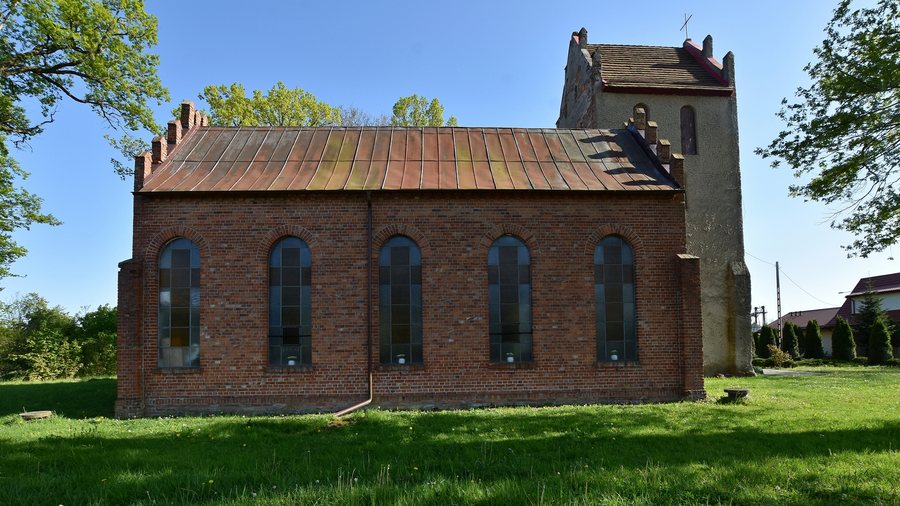 Pieszcz, Church of the Exaltation of the Holy Cross (HB4)
Photo: Henryk Bielamowicz via Source, CC BY-SA 4.0
Pieszcz, Church of the Exaltation of the Holy Cross (HB4)
Photo: Henryk Bielamowicz via Source, CC BY-SA 4.0
Pieszcz at a glance
- The church is an unusual example of a rural church in Western Pomerania: its nave has two aisles, the roof structures are separate, and the roof ridges run parallel to each other.
- The historic village landscape includes, among other features, remnants of a medieval castle complex, a 19th-century manor forge, and traces of the manor estate.
- The former palace park dates from the 19th century and covers 1.5 hectares.
What makes the church in Pieszcz special?
The church brings together several striking features in one building. Its two-aisled nave is unusual for a rural church in Western Pomerania. It also has separate roof structures and parallel roof ridges. These details give the church a distinctive architectural form, unlike a simple nave with a single, unified roof. Visitors interested in church architecture will find specific features here to look out for.
The history of the patron families is also connected with the church. The Below family initially held the right of patronage; from the 17th century, the von Krockow family was associated with it as well. This chronology adds the families connected with the church as patrons to the architectural picture. In Pieszcz, architectural features and a history of patronage spanning several centuries can therefore be seen side by side.
What traces of the manor estate and castle remain?
The manor forge in Pieszcz dates from the 19th century. It was entered in the regional register of historic monuments on 1 August 1989, under number A-300.
A hill and a moat remain from the medieval castle complex of the Below family. These two remnants are distinct from the traces of the manor estate buildings: they point to the castle complex, while ruins of farm buildings remain from the manor estate. The palace at the Pieszcz A manor estate had already been demolished by the mid-1990s. The surviving farm-building ruins should therefore not be confused with the former palace. The manor complex with Park “A” is part of Pieszcz’s cultural heritage.
What green spaces and historic features can be found in the village?
The former palace park dates from the 19th century and covers 1.5 hectares. This figure describes the park itself; it should not be confused with manor park “B,” which is also part of Pieszcz’s cultural heritage. The manor complex with Park “A” is also part of Pieszcz’s cultural heritage.
The former cemetery on the road to Pałowo is another part of the historic village landscape. Mature trees have been preserved there. Together with the historic village layout that can still be discerned, it offers another way to explore the village’s history: as well as individual buildings and remains, you can also look at the inherited layout and its green spaces. The church is in the northeastern part of the village, at the fork between the main road and the road to the former manor estate. Its location connects the church to a specific point in the village layout, without implying a particular sightseeing route.
FAQ
What is unusual about the church in Pieszcz?
It has a two-aisled nave, separate roof structures, and parallel roof ridges.
What remains of the medieval castle complex?
A hill and a moat remain from the castle complex of the Below family.
How large is the former palace park?
The former palace park, dating from the 19th century, covers 1.5 hectares.
What remains of the Pieszcz A manor palace?
The palace had been demolished by the mid-1990s. Ruins of the manor estate’s farm buildings remain.
For the main travel overview: Sławno.

.jpg)