
Homorog between Church Art, Museum and Nature
Accommodation in Homorog
In Homorog, history, art and nature can be explored through several distinct themes. The Orthodox Church of “Nașterea Maicii Domnului” dates from 1836–1837.
 File:RO BH Madaras Homorog Nativity church 12.jpg
Photo: Utilizator:Țetcu Mircea Rareș at ro.wikipedia via Wikimedia Commons, CC BY-SA 2.5
File:RO BH Madaras Homorog Nativity church 12.jpg
Photo: Utilizator:Țetcu Mircea Rareș at ro.wikipedia via Wikimedia Commons, CC BY-SA 2.5
Culture
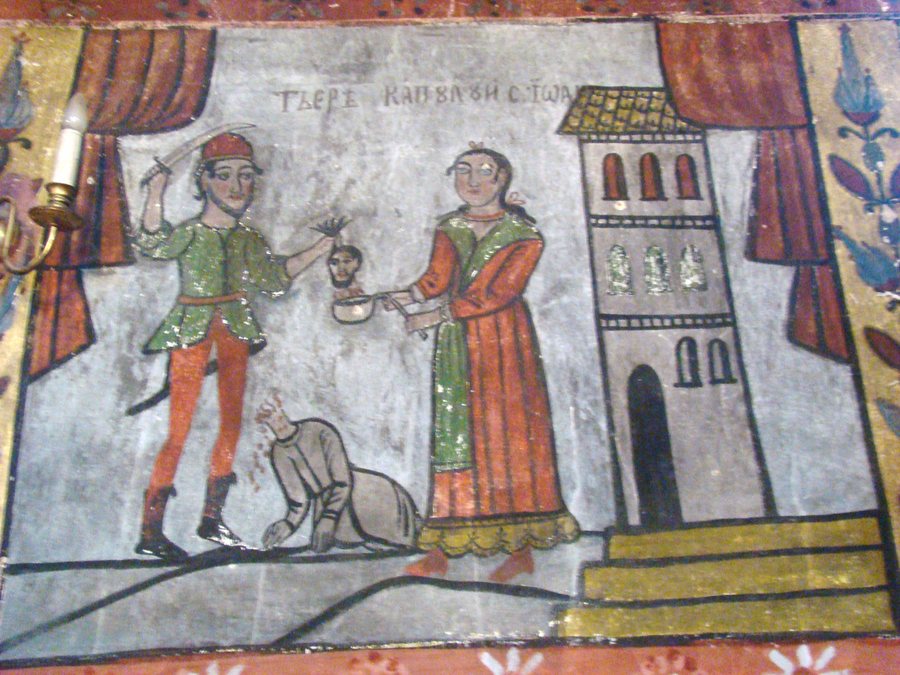
The church is known for its wall paintings by the painter Ioan Lopoșan and is considered an important historical monument. Almost all of its old interior furnishings – from the altar to the entrance to the high tower – have been preserved in their original form.
As another testament to the local culture of remembrance, the Homorog Heroes’ Monument was erected in 1996 from white and black marble. Its artistic design was created by the sculptor Cornel Durgheu.
The Homorog Icon Museum was established after more than 200 objects had been collected between 1970 and 1973. The museum collection was opened to visitors in 1973. The museum building housing the collection was completed in summer 1973 and consists of three rooms and an open corridor.
The church, wall paintings, monument and museum each have their own focus. As a result, sacred design, the culture of remembrance and a collection with a clearly described spatial structure exist side by side. Within the museum as well, the history of the collected objects, the opening to visitors and the structural form of the building differ from one another.
For cultural classification, the sites can be considered separately: the church combines its construction period, wall paintings and preserved interior furnishings, while the monument and museum make other forms of local memory visible. This distinction keeps the individual themes and their respective characteristics clearly separate.
The cultural sites therefore offer different perspectives: at the church, sacred painting and historic building fabric are central, while at the monument, the focus is on material and artistic design. The museum combines the history of its objects with a clearly structured exhibition format. Comparing these focal points makes it possible to understand art, remembrance and collection as distinct themes rather than combining them into a single cultural impression.
Water and Nature
In the area of water and nature, the Corhana River between Homorog and the Hungarian border forms an 8 km-long section for recreational fishing. Lake Homorog is one of the tourist destinations in the surroundings of Salonta.
In the wider regional surroundings of Homorog, on the border with the municipality of Mădăraș, lies the 3-hectare Rădvani bird colony. It is a zoological nature reserve in Cefa Nature Park. There is a visitor and information center at the bird colony.
The river, lake and bird colony represent different connections with nature and leisure activities. An 8 km-long section of river, a lake destination in the surroundings of Salonta and a 3-hectare protected area in the wider regional surroundings stand alongside one another. The visitor and information center adds a separate information site to the classification of the bird colony.
Church art, the culture of remembrance, water and nature therefore form distinct thematic focuses.
The Center for Tourist Information and Promotion in Homorog began operating in 2015 and was open daily.
For the higher-level travel overview: Comuna Mădăraș.

