
Bogdan Vodă: Wood, Water and Cultural History
Accommodation in Bogdan Vodă
Wooden Church and Woodworking Tradition
In the center of Bogdan Vodă, the wooden church “Sfântul Nicolae” stands on the grounds of the old cemetery. The construction of this wooden church is dated to 1718 or 1754. Both possible dates belong to the 18th century; no single year is thereby established.
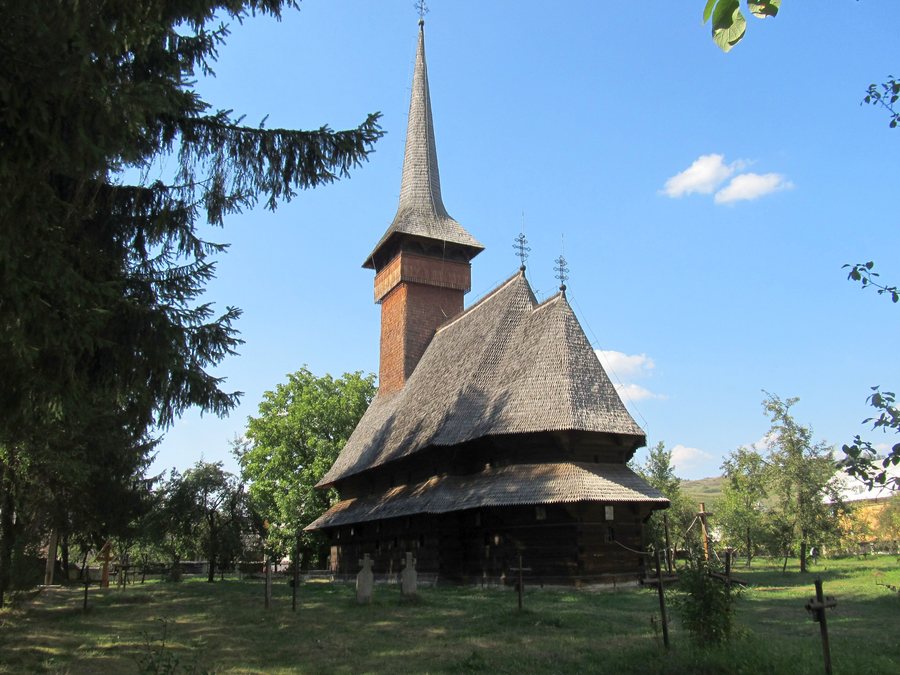 File:Wooden Church Saint Nicholas Bogdan Voda 2012-03.jpg
Photo: Nenea hartia via Wikimedia Commons, CC BY-SA 4.0
File:Wooden Church Saint Nicholas Bogdan Voda 2012-03.jpg
Photo: Nenea hartia via Wikimedia Commons, CC BY-SA 4.0
The traditional households in Bogdan Vodă are historically marked by a “civilization of wood.” Until the end of the 19th century and the beginning of the 20th century, gates and fences, as well as residential and agricultural buildings, were made exclusively of wood in Bogdan Vodă. Religious buildings, wayside crosses and grave markers were also made of wood during this period.
Architectural Forms of Traditional Houses
Traditional houses in Bogdan Vodă generally had hipped roofs. Their wooden roof structures supported a covering made of two-layer fir-wood shingles. Older traditional buildings in Bogdan Vodă were constructed from round logs using log construction with Romanian corner joints. From the 19th century onward, the German corner joint came into use.
For those interested in culture, the wooden church provides a concrete connection to the architectural and local history of Bogdan Vodă.
The Iza and the Surrounding Mountains
The local water network of Bogdan Vodă includes the Iza River and its small tributaries. The Vârful Poienilor peak is located in the immediate vicinity of Bogdan Vodă. The Vârful Poieniţei peak is also located in the immediate vicinity of Bogdan Vodă. Mount Vârful Raşcului is located in the immediate vicinity of Bogdan Vodă. Mount Cetăţelul is located in the surroundings of Bogdan Vodă.
For those interested in nature, the Iza River, its small tributaries and the mountains surrounding Bogdan Vodă are concrete landscape features of interest.
Archaeology and Medieval History
Archaeological excavations in the area of Bogdan Vodă have uncovered settlement remains from the Bronze Age and later from the Iron Age, the Hallstatt period. Bogdan I is described as the founder of Moldavia; he had his voivodal “capital” in Cuhea.
For those interested in history, the settlement remains in the area of Bogdan Vodă and Bogdan I, with his voivodal “capital” in Cuhea, are concrete topics of interest.
Routes and Regional Culture
Thematic tourist routes begin in the area of Bogdan Vodă, showcasing the region’s natural and cultural potential. Visitors to the Bogdan Vodă commune can purchase handicrafts made by local artisans. These items reflect multiethnic cultural influences. Local crafts with multiethnic cultural influences are a specific topic of interest for those interested in culture and a concrete feature of the Bogdan Vodă commune.
Nearby Destinations
The Mânăstirea Dragomireşti Monastery is located in the immediate vicinity of Bogdan Vodă. The Biserica Greco-Catolică Bogdan Vodă church is also located in the immediate vicinity of Bogdan Vodă. The Capela Ortodoxă Dragomireşti chapel is likewise located in the immediate vicinity of Bogdan Vodă. The Bustul lui Mihai Eminescu Săliştea de Sus monument is located in the surroundings of Bogdan Vodă.
For the broader travel overview: Comuna Bogdan Vodă.

