
Lăpușna: wooden church, hunting lodge and resonance spruces
Accommodation in Lăpușna
Culture
The wooden church “Sfântul Nicolae” in Lăpușna was built in 1779 in the village of Comori. In 1937, it was relocated to the Secuieu stream, near the royal hunting lodge.
Inside, there are icons created in 1740 by Vasilașcu, a painter from Moldavia.
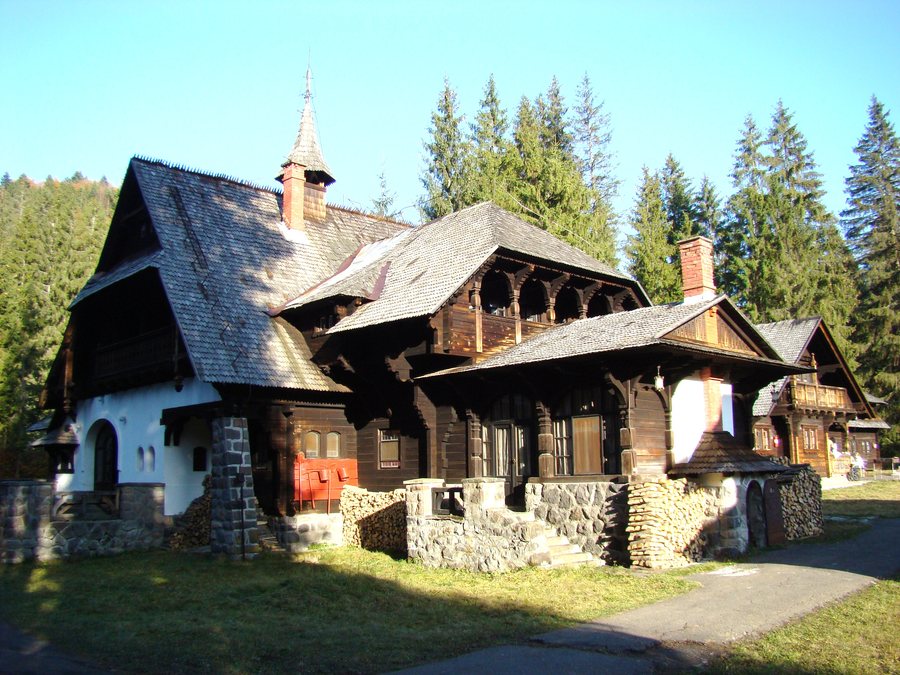 File:RO MS Lapusna hunting mansion.jpg
Photo: Utilizator:Țetcu Mircea Rareș at ro.wikipedia via Wikimedia Commons, CC BY-SA 2.5
File:RO MS Lapusna hunting mansion.jpg
Photo: Utilizator:Țetcu Mircea Rareș at ro.wikipedia via Wikimedia Commons, CC BY-SA 2.5
Lăpușna Hunting Lodge was built between 1925 and 1926 at the request of King Ferdinand. It was completed and decorated in 1933; members of the Romanian royal family used it.
The lodge complex comprises a main lodge with six building sections and 23 rooms, a hunting house with 12 rooms, and more than 4 hectares of woodland. Lăpușna Monastery was founded in 1997.
Several historical points of reference therefore stand side by side in Lăpușna: the older wooden church with its icons, the royal lodge complex and the monastery founded later. Their different dates of origin and building types make the cultural sites legible as separate stations in local history.
Nature
The Lăpușna Resonance Spruces Nature Reserve is a forestry seed reserve for the spruce species. The forest ecosystem of the Lăpușna Resonance Spruces includes very rare resonance spruces about 150 years old, with a diameter of more than 60 centimetres and a height of 36 to 38 metres.
The Lăpușna hunting lodge complex lies amid a fir forest.
The information about nature ranges from the purpose of the reserve to the characteristics of individual trees. The forestry seed reserve, rare resonance spruces and surrounding fir forest describe different aspects of the same landscape without reducing it to a single viewpoint or a specific activity.
Context
The Păstrăvăria de la Lăpușna is located at an altitude of 795 metres, at the confluence of the Gurghiu River and its left tributary, Sebeșul Mare. It lies on the route to the royal hunting lodge and the “Sfântul Nicolae” wooden church.
Getting there
The paved access road ends at Brădețelu. From there, an approximately 11-kilometre forest road leads through the woods towards Lăpușna.
After rain, the forest-road access route can turn into a track passable only by ATVs and motorcycles.
Lăpușna’s royal hunting lodge is usually closed. It opens when larger tourist groups request to rent a pavilion or the entire complex.
In Lăpușna, cultural sites, the forest landscape and access conditions should be considered separately. The wooden church and hunting lodge represent different historical stations, while the resonance spruces and fir forest shape the connection with nature. The approximately 11-kilometre forest road and the possible change in conditions after rain are part of the practical context for getting there.
When booking a hotel in Lăpușna, you can compare travel dates, room categories and cancellation policies on the respective offer page.
On the way
The Ibănești–Lăpușna–Vârful Saca Mare route passes through rugged terrain and an especially wild landscape.
For the overarching travel overview: Ibănești commune.

