
Arbore: Churches, Murals and Acacia Forest
Accommodation in Arbore
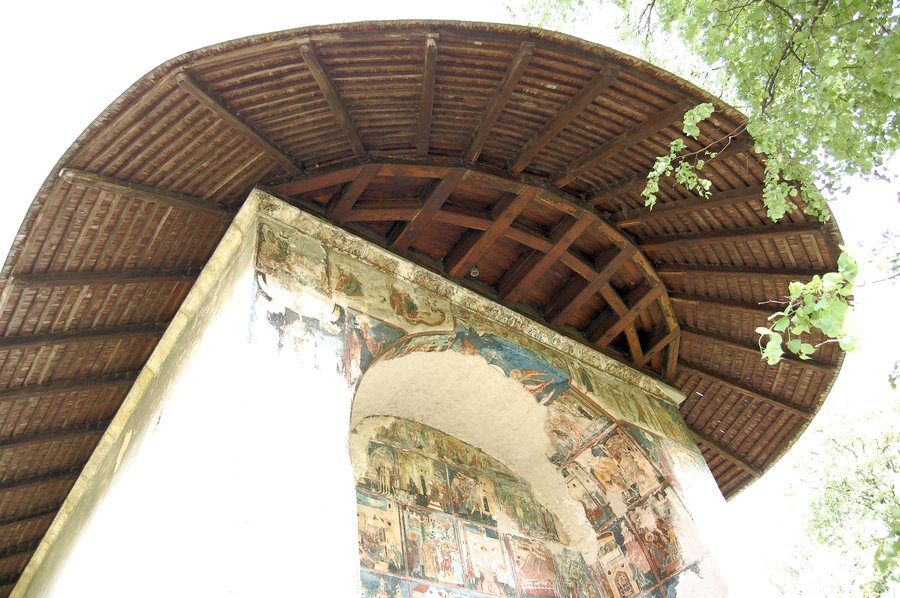
The painted church of Arbore Monastery is inscribed on the UNESCO World Heritage List. Arbore can therefore be explored through a clear cultural starting point that leads to other churches, historical construction periods and named local references. The cultural points of reference differ significantly: exterior wall paintings, ecclesiastical consecration, a medieval boyar court and the history of a local community stand side by side.
Culture and Architectural History
The Church of the Beheading of Saint John the Baptist in Arbore is distinguished by its exterior wall paintings. It was built in 1503 as the residence of the governor of Suceava, Luca Arbore. The medieval boyar court of Arbore–La Saghieni dates from the 15th to the 17th century. Thus, the historic buildings reflect both a specific original purpose and dating spanning several centuries. The dates place the buildings in different historical periods without limiting the impressions to a single era.
A later construction history belongs to Biserica Sfânta Treime: construction began on 10 May 1901, and it was consecrated on 29 August 1912. Sixteen national saints are highlighted in the church. The Church of the Nativity of the Blessed Virgin Mary in Arbore was built in 1902. The Roman Catholic Church in Arbore was also built in 1902 by the village’s German Catholic community. This makes it possible to distinguish different denominational references and chronological classifications within the local church landscape based on specific names and dates.
Landscape and the Course of the Year
The municipality of Arbore contains a 50-hectare forested area covered with acacia trees. The “FLOARE DE SALCÂM” festival takes place during the acacia blossom season. The area and the festival date provide two different points of emphasis: one is a precisely quantified natural area, while the other is a date tied to a particular time of year. Those who take the course of the year into account can therefore consider the natural setting both through the size of the forested area and through the timing of the acacia bloom.
For accommodation in Arbore, travel dates, room category and cancellation conditions can be considered separately. The painted monastery church and the acacia forest area stand side by side as cultural and landscape reference points of the town. The choice remains dependent on your personal dates, preferred room type and individual conditions.
Nearby
In the immediate vicinity of Arbore is Stejar Multisecular a lui Ştefan cel Mare, a monument. Also in the immediate vicinity are Biserica Ortodoxă Veche Arbore, a church, and Biserica Catolică de Nord Arbore, also a church. The three destinations mentioned therefore belong to the immediate vicinity, but differ in their classification as a monument or church.
In the vicinity of Arbore is Monumentul Eroilor Milişăuţi, a monument. Grădina Zoologică Rădăuţi, a zoo, is also located in the vicinity of Arbore. Cacica is a mountain in the vicinity of Arbore, while La Fântâna lui Cioată is a spring. Dealul Bobeica is a hill in the immediate vicinity of Arbore. For spatial orientation, it is important to distinguish between the immediate vicinity and the broader surrounding area; at the same time, historical, landscape and zoological points of reference appear there.
For the overarching travel overview: Arbore Commune.

_(7013721927).jpg)