
Poiana Stampei: Nature, Trails and Local History
Accommodation in Poiana Stampei
Poiana Stampei lies between the Bârgău and Suhard Mountains in a landscape of gentle hills, extensive coniferous forests and broad meadows. This landscape includes Tinovul Mare Poiana Stampei, a Natura 2000 site and Romania’s largest natural peat reserve. When planning a trip, these landscape features can be considered as different nature-related themes alongside one another.
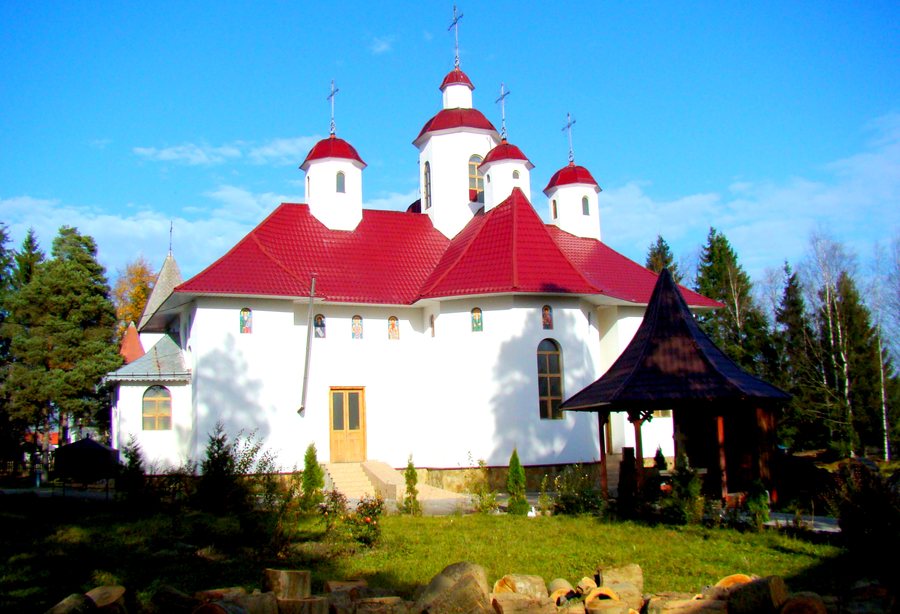 File:Biserica de lemn din Poiana Stampei.jpg
Photo: Țetcu Mircea Rareș via Wikimedia Commons, CC BY-SA 4.0
File:Biserica de lemn din Poiana Stampei.jpg
Photo: Țetcu Mircea Rareș via Wikimedia Commons, CC BY-SA 4.0
The hills, forests, meadows and natural peat reserve do not form a single uniform description of the landscape, but rather represent different natural features brought together in Poiana Stampei. As a result, open areas, wooded sections and the protected peatland stand alongside one another as distinct themes.
Trails through the landscape
In the centre of Poiana Stampei, the Via Transilvanica leaves the DN17 main road in the direction of Teșna and Tătaru. The trail then follows approximately 4 km of asphalt before continuing on a gravel road to the Tătaru hilltop. The approximate route length and the change in surface provide concrete points of reference for incorporating this section into your own plans.
The route thus connects a starting point in the centre, the direction of Teșna and Tătaru, the initially asphalted section and the subsequent gravel road. The Tătaru hilltop is also part of this sequence, supplementing the information about the route and surface with a clearly named endpoint.
Culture and history
The former wooden church “Biserica „Sf. Arh. Mihail și Gavriil“” is part of the local history. It was built with imperial approval between 1883 and 1885 and destroyed by fire in February 2015.
A museum in Poiana Stampei was established to keep the local history alive and document the development of the commune up to the present day. It illustrates traditional rural ways of life and crafts, such as house building and use, weaving and spinning, agriculture, livestock farming, pottery, festive clothing, and the production and preparation of food.
The museum’s themes thus range from housing and crafts through agriculture and livestock farming to clothing and food. House building and use stand alongside weaving, spinning and pottery; the production and preparation of food is an additional part of the documented rural way of life.
Balul Gospodarilor is a traditional cultural festival held annually in Poiana Stampei that promotes local customs, traditional dress and community identity. The festival combines folk music, dancing, socialising and traditional food; the commune presents it as an authentic cultural experience for visitors.
The festival therefore encompasses musical and dance elements as well as socialising and traditional food. Customs and traditional dress stand alongside the community identity emphasised by the commune in this setting.
The Gruiul Mare Heroes’ Monument commemorates Romanian soldiers who died on Gruiul Mare. In spring 2005, a new monument was erected that encloses the older one.
Local history is thus shaped by different forms of remembrance: the former wooden church, the museum documentation of rural ways of life, the annual festival and the Gruiul Mare monument.
Information and regional points of reference
A tourist information office is located in Poiana Stampei at one of the entrances to Călimani National Park.
The Vârful Piatra Dornei mountain and the Oușoru and Tarnița peaks are located in the vicinity of Poiana Stampei. In the wider regional area are the Piatra Fântânele Cross monument and the Fărăoane peak.
For the overarching travel overview: Comuna Poiana Stampei.

