
Putna: Monasteries, Churches and the Via Transilvanica
Accommodation in Putna
The Via Transilvanica begins in Bukovina, more precisely at Mănăstirea Putna; its Bukovina section is 144 kilometres long and heads towards the Sucevița Depression.
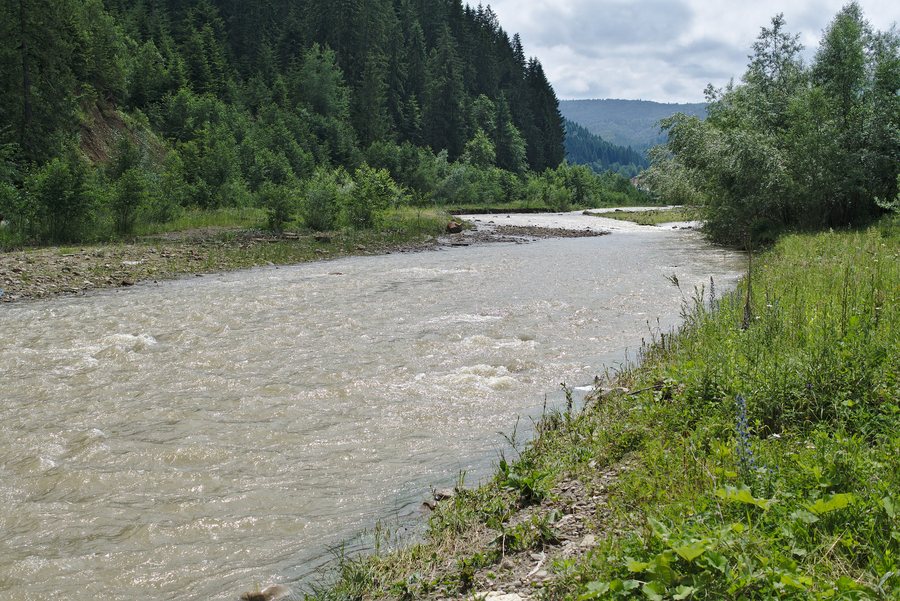 File:Romania Putna Putna River (Moldova) near Putna Village.jpg
Photo: Alexander Klink via Wikimedia Commons, CC BY 4.0
File:Romania Putna Putna River (Moldova) near Putna Village.jpg
Photo: Alexander Klink via Wikimedia Commons, CC BY 4.0
Culture
Mănăstirea Putna is an Orthodox monastery and one of Romania’s most important cultural, religious and artistic centres. Ștefan cel Mare built it between 1466 and 1469. In honour of its founder, a special military ceremony takes place within its walls on 2 July and has already become a tradition.
The medieval museum of Mănăstirea Putna preserves manuscripts, embroideries from the monastery’s workshops, church and school books, ecclesiastical treasures and ceramic objects. Decorating eggs, known as “Închistritul ouălor”, is a tradition that has been known in Putna since ancient times. The female artisans use a simple tool, which each craftswoman makes herself and which is popularly known as a “chișiță”.
The Biserica “Nașterea Maicii Domnului” in Putna was built between 1900 and 1908 by Romanian Orthodox believers from the village, with the support of the Bukovina Ecclesiastical Fund. According to tradition, the wooden church “Intrarea Maicii Domnului în Biserică”, also known as the wooden church “Dragoș Vodă” or Schitul Putna, dates back to the mid-14th century. Today, this wooden church serves as a chapel and museum.
Sacred Places
The original Biserica “Bunavestire” of Mănăstirea Sihăstria Putnei was built between 1754 and 1758. During restoration work, it was completely rebuilt from 1990 to 1996 and consecrated on 29 September 1996. Biserica “Bunavestire” houses a reliquary containing the relics of the venerable abbots Sila, Natan and Paisie.
Mănăstirea Sihăstria Putnei comprises four places of worship: two small chapels dedicated to “Sfântul Ioan Evanghelistul” and “Acoperământul Maicii Domnului”, the Biserica “Buna Vestire” and the large church “Izvorul Tămăduirii”. Pilgrims visit the monastery to attend the services held there.
The Biserica “Acoperământul Maicii Domnului”, also called the “Biserica de la izvor”, is located on the left, 200 metres before the entrance to Mănăstirea Sihăstria Putnei. Next to it is the Izvorul Starețului Sila, which many believers visit to collect blessed water.
Paths and Landscapes
Mănăstirea Putna is located about 1.5 kilometres from Putna railway station. The distance between Mănăstirea Putna and Mănăstirea Sihăstria Putnei is 3.7 kilometres, which can be covered on foot. The different distances help distinguish between short walks and longer plans when making arrangements.
Chilia lui Daniil Sihastrul is a grotto carved into a rock in the valley of the Vițău stream, about 1 kilometre from Mănăstirea Putna. The pronaos, naos and altar of a chapel carved into the rock are still visible inside; beneath it is a cell also carved into the stone. Poiana Sihăstriei is a broad, bright clearing.
For the overarching travel overview: Comuna Putna.

_near_Putna_Village.jpg)