
Municipality of Lišane Ostrovičke
Accommodation in Municipality of Lišane Ostrovičke
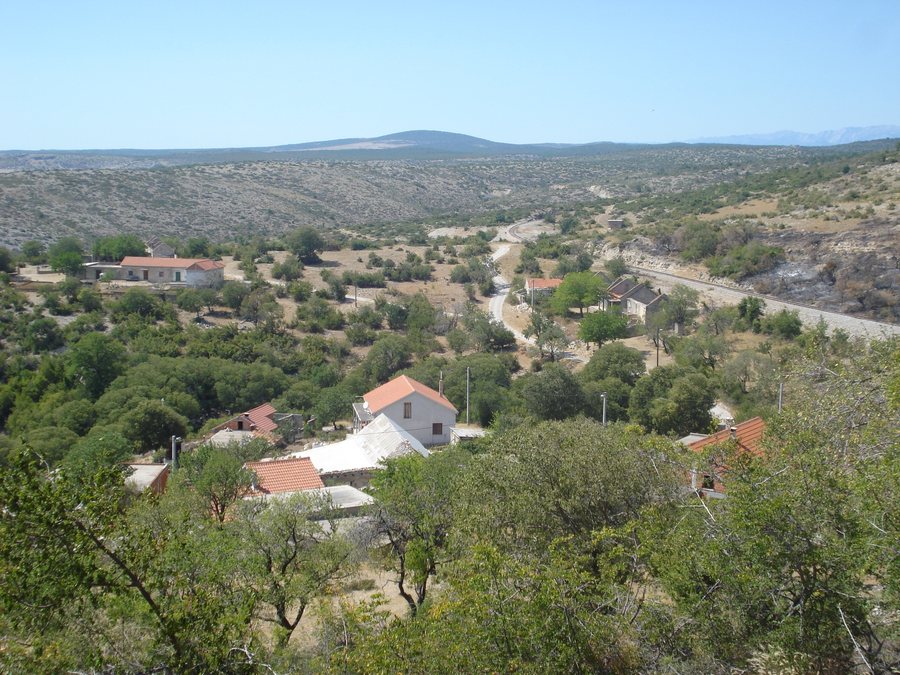
Lišane Ostrovičke lies in the Ravni kotari, on the edge of a field, on a sun-facing slope and beside a drinking-water spring.
Key facts about the Municipality of Lišane Ostrovičke
- The village lies in a semicircle between the Kotari to the south and the karst plateau of Bukovica to the north.
- The Zadar–Benkovac–Kistanje–Knin road and the Zadar–Knin railway line run through the municipality.
- Local cultural themes include the “Lišanska misa,” traditional dances, and several instruments.
What characterizes the landscape and location?
The semicircular village forms a natural boundary between two landscapes: the Kotari to the south and the karst plateau of Bukovica to the north. This location gives the settlement a distinct regional character, without equating the village and the municipal area with a single landscape type. Lišane Ostrovičke is a typical village of the Ravni kotari; it lies on the edge of a field, on a sun-facing slope and beside a drinking-water spring.
Part of Trolokve also lies within the municipality. There, marsh and lake sediments of sand and mud can be found. The area’s marshy character is explained by its impermeable, muddy substrate. Anyone interested in landscape and geology can thus consider another aspect of the municipal area alongside the village’s setting: the sediments and soil conditions of Trolokve.
Which local traditions can you discover?
The “Lišanska misa” is a traditional church singing form related to the secular singing of the area around Lišane. The cultural association KUD “Sv. Nikola Tavelić” works to preserve local traditions, including this form of singing. For travelers interested in regional culture, it offers a concrete way to explore the connection between church and secular singing, without treating them as the same thing.
The circle dance Kukulešće is also characterized by its movements and music: men and women hold hands and dance in a circle, with their feet fully planted and jumping to the rhythm set by a Cvitara player. Cvitare are harmonica-like instruments that were played in Lišane for circle dances. In this tradition, the dance form and musical accompaniment are therefore connected.
Other instruments offer a comparison between different kinds of sound. Diple are traditional wind instruments played with six fingers and made from specially treated goat or sheep skin. Svirale, also called Dvojnice, are wooden shepherd’s instruments with two pipes: the right one is used to finger the melody, while the left provides the accompaniment. These differences make the local instrument culture understandable even to visitors unfamiliar with the names.
Which churches shape the townscape?
The old Baroque parish church of Sv. Mihovil arkanđel in Lišane Ostrovičke dates from 1663. The parish church of Sv. Nikola Tavelić has a different history: it was built between 1975 and 1977 as a votive shrine to plans by architect Vinko Galić and consecrated in 1978. The church, bell tower, and landscaped grounds were completed in 2003. The dates refer to different stages of its construction and completion.
Which transport routes run through the municipality?
The Zadar–Benkovac–Kistanje–Knin road and the Zadar–Knin railway line run through the Municipality of Lišane Ostrovičke. The “Pirovac” motorway interchange on the Adriatic Motorway is also 15 kilometers from the municipality. These details help you place the area in relation to the transport routes mentioned.
If you would like to compare other municipal destinations for your travel plans, you can find Lišane Ostrovičke, the Municipality of Polača, the Municipality of Privlaka, the Municipality of Poličnik, the Municipality of Obrovac, the Municipality of Jasenice, the Municipality of Stankovci and the Municipality of Sukošan here.
FAQ
What is the “Lišanska misa”?
It is a traditional church singing form related to the secular singing of the area around Lišane.
Which instruments are part of the local musical traditions?
Cvitare are harmonica-like instruments. Diple are traditional wind instruments made from specially treated goat or sheep skin; Svirale or Dvojnice are wooden shepherd’s instruments with two pipes.
How far away is the “Pirovac” motorway interchange?
The interchange on the Adriatic Motorway is 15 kilometers from the Municipality of Lišane Ostrovičke.
For the broader travel overview: Zadar County.

,_selo_-_zapad.JPG)