
Discover Dinnyeberki
Accommodation in Dinnyeberki
Dinnyeberki combines a locally protected natural area with a building that was formerly used as both a school and a church. Facts about the landscape and history offer a practical starting point for choosing your destination; find more experiences in the wider destination of Baranya.
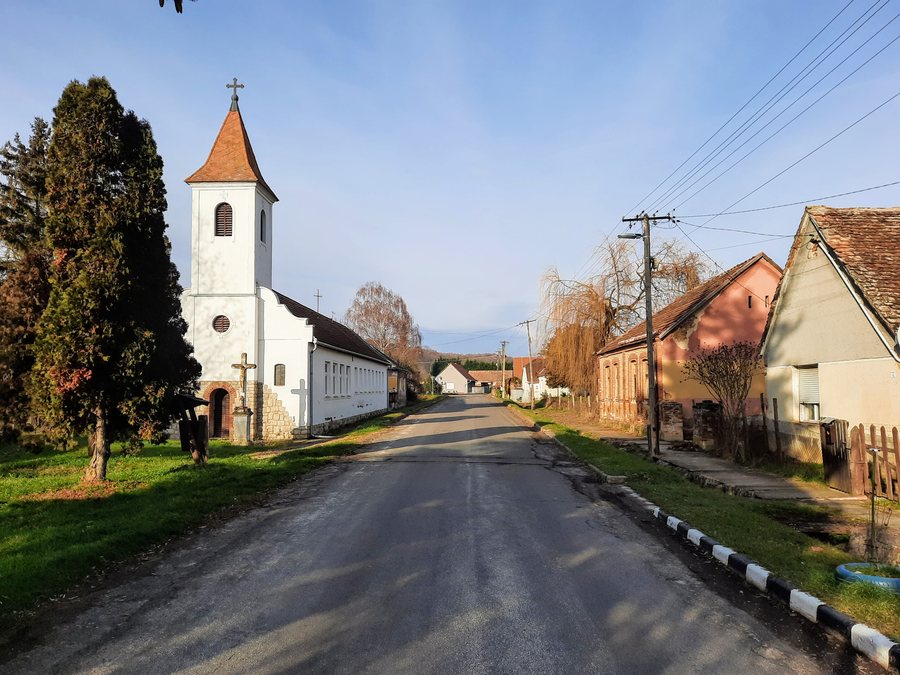 File:Dinnyeberki, Fő utca, iskolakápolna.jpg
Photo: Györkő Zsombor via Wikimedia Commons, CC BY-SA 4.0
File:Dinnyeberki, Fő utca, iskolakápolna.jpg
Photo: Györkő Zsombor via Wikimedia Commons, CC BY-SA 4.0
Quick facts about Dinnyeberki
- The Gyűrűfű TT natural area is located in Dinnyeberki, covers 237.8468 hectares, and was protected in 1996.
- The narrow valley of the Sándor-árok is part of the protected area. A gravel road leads from Dinnyeberki towards Gyűrűfű.
- The Iskolakápolna resembles a bell tower and was formerly used as both a school and a church.
What makes the natural area near Dinnyeberki distinctive?
Gyűrűfű TT is the town’s main natural attraction. Its designated area of 237.8468 hectares and the year it was protected, 1996, provide a clear sense of scale and historical context. The narrow valley of the Sándor-árok is part of the area. This brings both the size of the protected area and a specifically named landscape into focus.
The gravel road leads from Dinnyeberki towards Gyűrűfű. You can therefore include this natural area as a local highlight of Dinnyeberki in your travel plans.
What story does the Iskolakápolna tell?
The Iskolakápolna offers a different perspective on Dinnyeberki from the protected area: the building resembles a bell tower and was formerly used as both a school and a church. Its dual former function makes the name particularly vivid.
The natural area and the Iskolakápolna offer different points of interest: one is a protected landscape, while the other is a building formerly used for educational and religious purposes. If you compare destinations based on your interests in nature and culture, these specific features can help you put Dinnyeberki in context.
What other experiences are available in the wider destination of Baranya?
In the wider destination of Baranya, the Early Christian Necropolis of Sopianae in Pécs features decorated tombs dating from the 4th century. They were built as underground burial chambers with above-ground memorial chapels and embellished with richly decorated Christian wall paintings. Art and cultural history take centre stage in the Zsolnay Cultural Quarter, whose attractions include the “Golden Age of Zsolnay” and “Pink Exhibition” exhibitions, as well as an exhibition on the family and factory history.
The Zsolnay Cultural Quarter also lists several activities for children: outdoor playgrounds, an interactive lab, a planetarium, the Bóbita Puppet Theatre, a ceramics painting workshop, and classes at the Hercules Workshop. The freely accessible outdoor area can be entered and used free of charge during opening hours. The exhibitions and outdoor area are different aspects of the quarter to consider when choosing cultural experiences.
The Ős-Dráva Visitor Centre near Szaporca offers a different combination of exhibitions and nature. It includes an interactive exhibition, a demonstration farm with hands-on farming activities, and three themed nature trails. These provide information about traditional farming, the Ős-Dráva Programme, and wildlife along the Drava. The farm area features, among other animals, Hungarian Grey cattle, Mangalica pigs, Hucul horses, and traditional sheep and poultry breeds. The wilderness trail along the Old Drava adds a birdwatching and bird-ringing station, a lookout point, a photography hide, a covered activity area, and several rest areas.
Culture and landscape can also be given different emphasis in the wider destination of Baranya. Siklós Castle is considered one of Hungary’s best-preserved military structures and one of its most significant Renaissance buildings. Modernisation of the museum wing opened its previously inaccessible Gothic section to visitors. The Kikerics Panorama Trail in Nagyharsány Sculpture Park focuses on safe movement along the cliff edge and protecting plant life from trampling; the “Art in Nature” programme includes a guided tour.
Villány’s row of wine cellars offers a different focus: you can go from cellar to cellar throughout the year to sample wines and food. Nature, historic architecture, exhibitions, and wine tasting offer different thematic ways to explore the wider destination of Baranya, while Dinnyeberki’s local features are its protected area and the Iskolakápolna.
Discover more destinations: Szentlőrinc, Hetvehely, Helesfa and Bükkösd.
FAQ
What is Gyűrűfű TT?
Gyűrűfű TT is a locally protected natural area in Dinnyeberki. It covers 237.8468 hectares and was protected in 1996. The narrow valley of the Sándor-árok is part of it.
What is known about the Iskolakápolna?
The building resembles a bell tower and was formerly used as both a school and a church.
What other experiences does the wider destination of Baranya offer?
The options described include the Necropolis of Sopianae in Pécs, the Zsolnay Cultural Quarter, the Ős-Dráva Visitor Centre near Szaporca, Siklós Castle, Nagyharsány Sculpture Park, and Villány’s row of wine cellars.
Go to the wider travel overview: Szentlőrinci.

