
Kisar: Tisza floodplain, nature trail and cultural heritage
Accommodation in Kisar
Kisar can be explored through three distinct themes: the Tisza floodplain, the Jégmadár Nature Trail and the 15th-century Reformed Church. Together, they give nature and cultural heritage their own distinct emphasis. The visitor centre also offers a separate way to explore the cultural and natural history of the Upper Tisza region; visits are only possible by prior arrangement.
Kisar at a glance
- Kisar lies entirely within the Szatmár-Beregi Landscape Protection Area.
- Kisar’s Tisza floodplain is home to a traditional jungle orchard landscape, with old walnut and plum trees as well as protected old apple varieties.
- The Jégmadár Nature Trail runs between Kisar and Panyola. Its starting point in Kisar is the Ökoház; part of the trail follows the cycle path along the top of the flood-protection embankment.
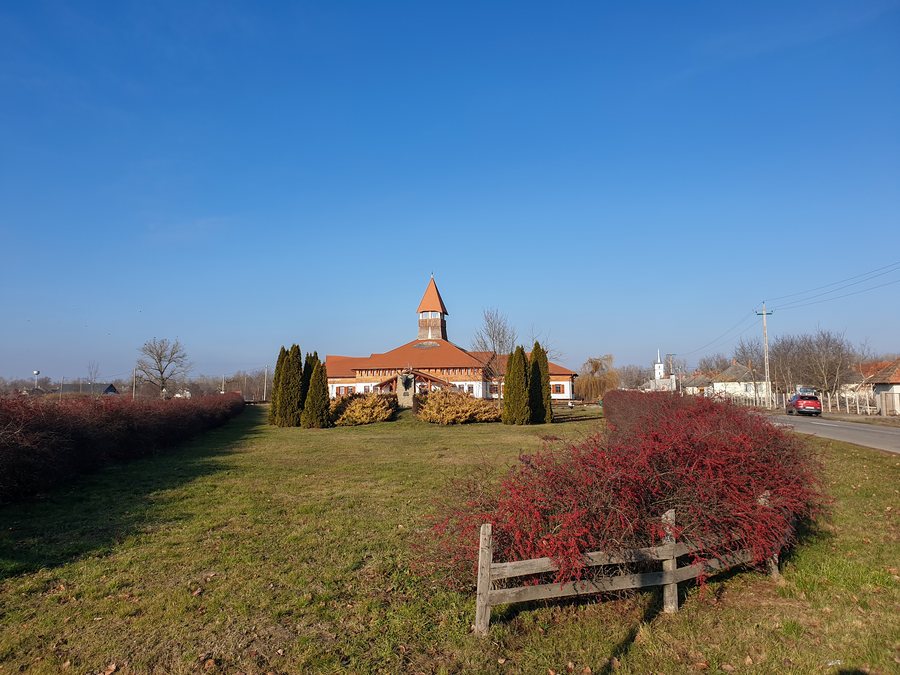
- The visitor centre stands directly beside the Tisza embankment, surrounded by an extensive green area with trees and grass. It features a permanent exhibition arranged by theme.
- Kisar’s Reformed Church was built in the 15th century in the Gothic style.
What defines Kisar’s landscape?
Kisar lies entirely within the Szatmár-Beregi Landscape Protection Area, giving its surroundings a clear connection to nature. The Tisza floodplain also includes a landscape shaped by people: its traditional jungle orchard landscape features old walnut and plum trees as well as protected old apple varieties. Here, the natural environment and the fruit trees are not separate themes; both are part of the floodplain’s character.
For planning your trip, this distinction makes the town’s different highlights easy to understand. You can think of Kisar as a destination for landscapes and natural history, while also seeing its distinctive orchards as part of the local landscape. The trees and apple varieties mentioned offer concrete examples of the nature theme, rather than limiting it to a general description of the floodplain.
What is the route of the Jégmadár Nature Trail?
The Jégmadár Nature Trail runs between Kisar and Panyola, and starts at the Ökoház in Kisar. This identifies both its starting point and the two towns it connects. For orientation, it is also useful to know that part of the route follows the cycle path along the top of the flood-protection embankment.
The route can be understood through several features: it is a nature trail, starts in Kisar and partly follows a path along the embankment. If you want to connect Kisar with Panyola, the route between the two towns is a specific point of reference.
Which cultural sites define Kisar?
The visitor centre of Szatmár-Beregi Nature Park stands directly beside the Tisza embankment and is surrounded by an extensive green area covered with trees and grass. Its permanent exhibition, arranged by theme, presents the cultural and natural heritage of the Upper Tisza region. Visits are only possible by prior arrangement. So plan your visit to the exhibition as a separate activity that requires advance arrangements.
The Reformed Church adds a specific historic building to this theme: it was built in the 15th century in the Gothic style. The nature trail, exhibition and church thus represent different interests—the route, the history of the Upper Tisza region and the architecture of a medieval church. This distinction can help you choose the focus of your stay without treating the themes as interchangeable.
What other contrasts does Szabolcs-Szatmár-Bereg offer?
The wider destination of Szabolcs-Szatmár-Bereg features other distinct nature and cultural themes in different places. The Bátorliget Ancient Swamp, for example, covers around 53 hectares and is strictly protected. It preserves particularly complete examples of different stages in the vegetation and landscape history of the Alföld plain. Near Csaroda, Nyíres-tó and Báb tava are distinctive peat bogs whose history dates back to the Ice Age. These examples offer a different perspective from the orchard landscape of Kisar’s Tisza floodplain.
Cultural themes also vary by place and focus. The Vay-Ádám Museum Collection of the Hungarian National Museum is housed in the Renaissance Vay Castle in Vaja. At the Báthori Castle in Nyírbátor, a permanent exhibition and a panorama exhibit members of the Báthori family in period settings. The wider destination thus offers historic collections and displays alongside the wetlands’ natural features and Kisar’s landscape, nature trail and church.
Discover more destinations: Tunyogmatolcs, Szatmárcseke, Panyola, Tiszabecs, Túristvándi, Fehérgyarmat.
FAQ
Where does the Jégmadár Nature Trail start in Kisar?
The starting point in Kisar is the Ökoház.
How can I visit the visitor centre?
Visits to the visitor centre are only possible by prior arrangement.
When does Kisar’s Reformed Church date from?
It was built in the 15th century in the Gothic style.
Back to the main travel overview: Fehérgyarmat.

