
Discover Lesencetomaj: Church history, nature and a cycling route
Accommodation in Lesencetomaj
Lesencetomaj can be understood through its local history, old trees and a cycling route.
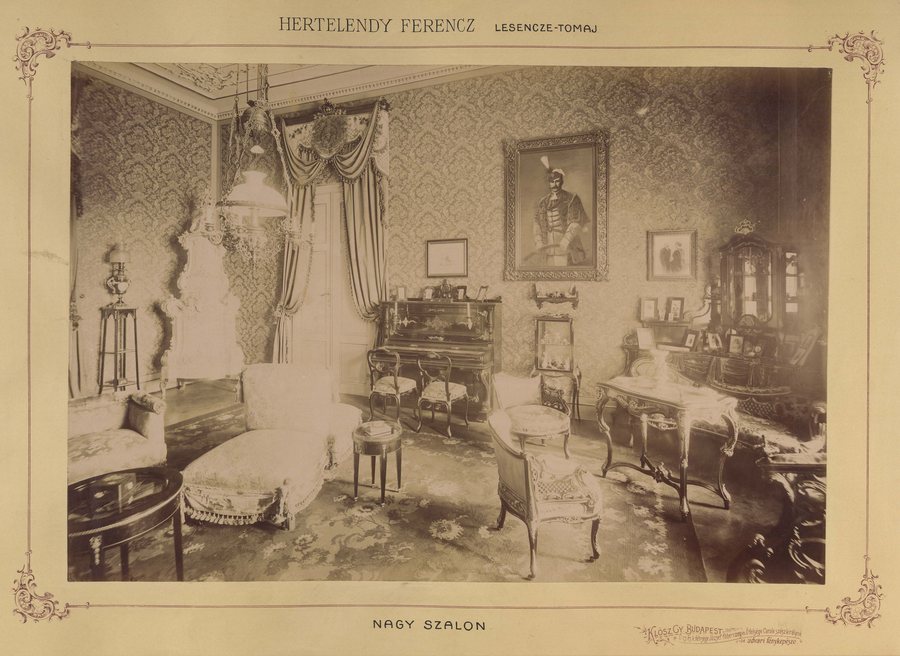 Hertelendy Castle grand salon, Lesencetomaj, 1895–1899
Photo: Photo: Fortepan — ID 83321; donor: Budapest Főváros Levéltára
Hertelendy Castle grand salon, Lesencetomaj, 1895–1899
Photo: Photo: Fortepan — ID 83321; donor: Budapest Főváros Levéltára
Lesencetomaj at a glance
St. Anne’s Church was rebuilt from its ruins in 1754 and consecrated in honour of St. Anne that same year. In 1806, Bishop Nedeczky Károly had it remodelled in the Classical style. The church also contains a Gothic red-marble tombstone dating from 1400. It bears the carved coat of arms of the Tomaj family; according to the inscription, it belonged to Pál, son of Jakab.
Protected plane trees, estimated to be 200 to 250 years old, and a giant sequoia grow in the one-and-a-half-hectare old park of the Lesencetomaj institute. The Lesencetomaji láprét is a habitat for the strictly protected bird’s-eye primrose (Primula farinosa). The 36 km Lesence-kör cycling route starts in Lesencetomaj and runs along the northern edge of the Keszthely Mountains.
What story does St. Anne’s Church tell?
The dates point to two distinct chapters in the church’s history: its reconstruction and consecration in 1754, and its remodelling in the Classical style in 1806. The tombstone adds an earlier historical note. Its date of origin, 1400, its red marble and the coat of arms of the Tomaj family give it its own historical context; the inscription links it to Pál, son of Jakab. Anyone interested in architectural history or historic tombs will find several points of interest in these details, without combining them into a single period.
What nature and cycling themes define the area?
The park and the láprét represent different aspects of nature: in the park, they are the protected plane trees and their estimated age, along with the giant sequoia; on the Lesencetomaji láprét, it is the strictly protected bird’s-eye primrose, a characteristic species of its habitat. The old park of the Lesencetomaj institute covers one and a half hectares, and the plane trees are estimated to be 200 to 250 years old.
Two specific details help put the Lesence-kör cycling route into perspective: it is 36 km long and starts in Lesencetomaj. It runs along the northern edge of the Keszthely Mountains.
What other themes are there in the North Balaton region?
The wider North Balaton destination includes other places with distinct themes. Boat trips are offered in the Tapolcai-tavasbarlang, which also has a guided exhibition called “Csodálatos karszt” (“Wonderful Karst”). The cave is part of a cave system beneath the town that has so far been explored over a length of 14.6 kilometres.
Hegyestű is a 337-metre-high mountain between Zánka and Monoszló. A quarry there exposes the inner face of a basalt volcano that was active about eight million years ago. At the western edge of the quarry grounds, visitors can identify the surrounding hills from a viewpoint using a panorama board; Hegyestű also has a rock garden featuring characteristic rock types of Transdanubia.
At Badacsony, the focus is instead on hiking trails and panoramas, as well as the geological formations known as basalt organ pipes. Special grape varieties are grown on its slopes and used to make Badacsony wine. Thus, geology and landscapes sit alongside viticulture within the wider destination; these should be distinguished from Lesencetomaj’s own features.
How should you approach your accommodation search?
First, consider which local features matter for your trip: the history of St. Anne’s Church, the nature themes around the park and láprét, or the cycling route that starts here. If you are looking for a hotel in Lesencetomaj, you can then compare these priorities with your own accommodation criteria. If you would also like to consider other places in the wider North Balaton destination, their themes can serve as a separate guide for further planning.
Discover more destinations: Nemesgulacs, Taliándörögd, Kisapáti, Balatonrendes, Badacsonyörs, Badacsonytomaj, Gyulakeszi and Badacsonytördemic.
FAQ
What is the history of St. Anne’s Church?
It was rebuilt from its ruins in 1754 and consecrated to St. Anne that same year. It was remodelled in the Classical style in 1806. The church also contains a Gothic red-marble tombstone dating from 1400.
Which cycling route starts in Lesencetomaj?
The 36 km Lesence-kör cycling route starts in the village and runs along the northern edge of the Keszthely Mountains.
What geological themes does the wider North Balaton destination offer?
At Hegyestű, the inner face of a basalt volcano dating back about eight million years is exposed. At Badacsony, there are geological formations known as basalt organ pipes.
For an overview of the wider destination: Tapolcai.
