
Balatongyörök
Accommodation in Balatongyörök
Balatongyörök combines a nature trail designed for children with a beach, sweeping views across Lake Balaton, and special insights into history and craftsmanship. You can choose the focus of your stay according to your interests.
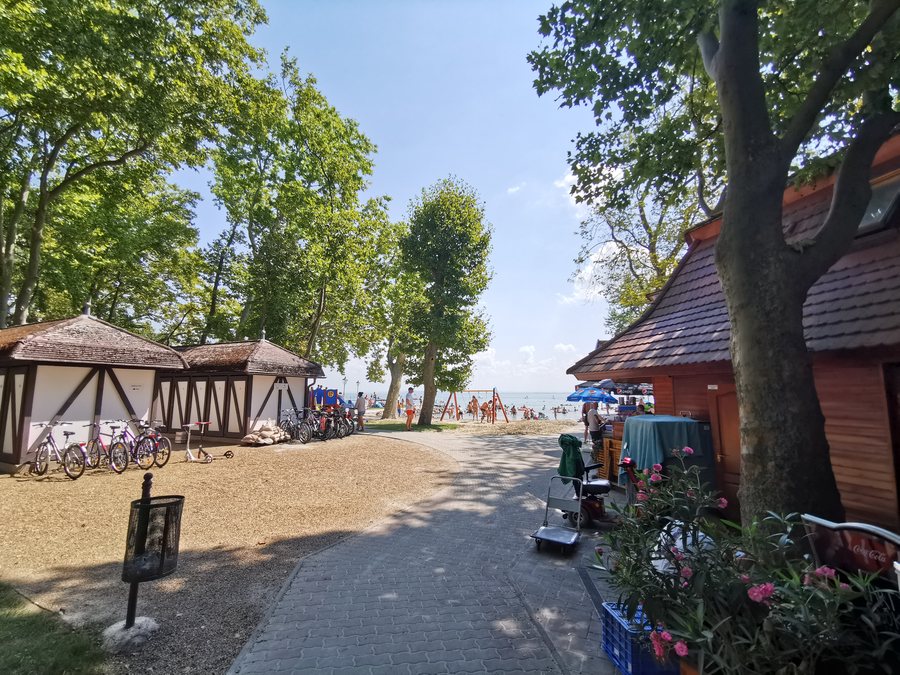
Balatongyörök at a glance
The Pele-apó nature trail in the Keszthely Mountains offers insights into forest habitats, plants, and animals. Balatongyöröki Községi Beach can be reached in several ways; both entrances are accessible. From Szépkilátó, the view extends across Lake Balaton to the witness hills of the Tapolca Basin and Szigliget Bay. The local history includes a Roman villa from the 2nd century and the Church of the Archangel Michael.
What nature experiences does the Pele-apó nature trail offer?
Created by the Balaton Uplands National Park, the Pele-apó nature trail is specially designed for children. It runs near Balatongyörök in the Keszthely Mountains and has 38 stations along a route 8.5 kilometers long. Its focus is on the habitats, plants, and wildlife of the region’s forests. The stations turn the route into a nature discovery experience: families can take both the distance and the trail’s themes into account when planning their visit.
If you enjoy learning about nature while on vacation, this trail offers a clearly defined focus. It is explicitly aimed at children and centers on the region’s forest environment. This sets the experience apart from the historical and craft themes also associated with Balatongyörök.
How are the beach and cycling route positioned in relation to each other?
The Balaton Cycling Route passes through Balatongyörök and runs just a few meters from the entrance to Balatongyöröki Községi Beach. This clearly describes the proximity of the cycling route to the beach entrance, without providing any further details about the route or facilities. The beach itself can be reached on foot, by bicycle, train, boat, or car. You can take these listed travel options into account when planning your day.
Both entrances to Balatongyöröki Községi Beach are accessible. This provides convenient access for people with limited mobility, as well as guests using wheelchairs or strollers. For travelers planning a beach visit in addition to nature and culture, this is useful information about the accessibility of the entrance area.
What can you see at Szépkilátó and Római-forrás?
From Szépkilátó, the view extends across Lake Balaton, the witness hills of the Tapolca Basin, and Szigliget Bay. The viewpoint offers a broad panorama of the lake and surrounding landscape. Római-forrás is located below Szépkilátó. There, the remains of a Roman villa from the 2nd century were excavated in the 1940s, along with the remains of its bath and spring. The viewpoint and the archaeological finds offer different highlights: here, the landscape takes center stage; there, the history of the Roman estate.
What culture and craftsmanship are part of the town?
Balatongyörök’s Roman Catholic church was built in 1715 in honor of the Archangel Michael and rebuilt in 1745. These two dates mark different phases of construction: the original building and its later reconstruction. The church is another point of interest for visitors interested in local history.
At Kajdi Kristály, visitors can watch lead crystal and glass objects being worked. The demonstrated processes include grinding, engraving, sandblasting, etching, and polishing. Those interested in craft techniques can gain a practical insight into different methods of glassworking. Along with the nature trail, viewpoint, and historic sites, these experiences show Balatongyörök as a destination with nature, landscape, history, and craftsmanship at its heart.
If you would like to compare other town guides, you can also find information about Keszthely, Karmacs, Várvölgy, Vindornyalak, Gyenesdias, Zalavár, Esztergályhorváti and Vonyarcvashegy.
FAQ
How long is the Pele-apó nature trail?
The trail has 38 stations and is 8.5 kilometers long.
How can you reach Balatongyöröki Községi Beach?
The beach can be reached on foot, by bicycle, train, boat, or car.
What was excavated at Római-forrás?
In the 1940s, the remains of a Roman villa from the 2nd century, along with its bath and spring, were excavated there.
For the broader travel overview: Keszthelyi.

.jpg)