
Zalavár: Memorial Park and Kis-Balaton House
Accommodation in Zalavár
Zalavár combines memorial sites with exhibitions about the Kis-Balaton landscape. On Zalavár-Vársziget, a historical-archaeological memorial park and the Kis-Balaton House are the main attractions. If you compare hotels in Zalavár, this thematic overview offers an initial impression of whether the place suits your interests in history and nature.
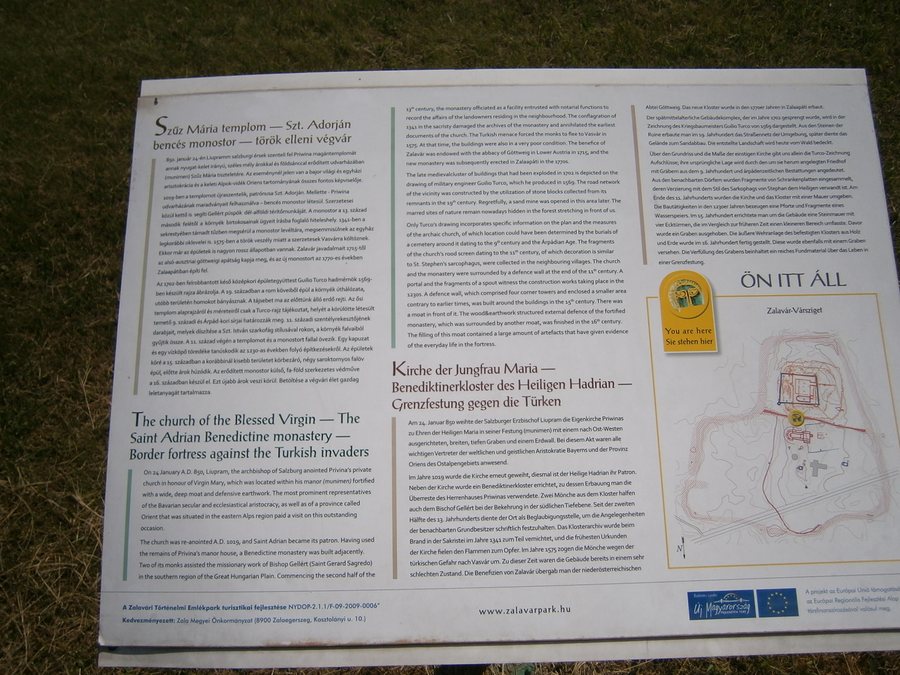 The history of church of the Blessed Virgin in Zalavár - Saint Adrian Benedictine monastery
Photo: Vámos Sándor via Source, CC BY-SA 3.0
The history of church of the Blessed Virgin in Zalavár - Saint Adrian Benedictine monastery
Photo: Vámos Sándor via Source, CC BY-SA 3.0
Zalavár at a glance
- The memorial park on Zalavár-Vársziget features an exhibition about the area’s landscape and history, monuments, and ancient ruins.
- The Kis-Balaton House presents the natural values of the Kis-Balaton Water Protection System and its role in the water quality of Lake Balaton.
- A multi-part water playground introduces children to the water’s course, power, and possible uses through play.
What can you expect on Zalavár-Vársziget?
The historic memorial park combines archaeological remains with several monuments and an exhibition about the area’s landscape and history. Hungarian, Bulgarian, Slovenian, and Austrian monuments give the site an international historical character. Zalavár-Vársziget is also considered Hungary’s most important site of the cult of Saint Adrian.
The arrangement of some of the memorial sites is also easy to make out: the nations’ monuments stand beside the road between the Kis-Balaton House and the Millennium Monument. A tree of life has been on display there since 2011. Its 258 leaves symbolize the municipalities of Zala County. Both the number and its meaning make the monument a point of reference at the regional level.
Which historic buildings define the site?
The Szent-István Chapel is dedicated to Saint King Stephen. It was built in 1996 over the foundation walls of a church dating from the Árpád era. Different periods of history therefore stand side by side here: the foundation walls of an Árpád-era church and the chapel, built much later.
The Szent-Adorján Basilica is also part of the site’s history. From the late 860s, it served as the main church of Methodius’s Pannonian archdiocese for almost a decade. This historical role adds a church-history connection to the monuments and ruins. Visitors interested in the site’s past will find several specific points of connection, rather than just a single memorial.
What topics does the Kis-Balaton House cover?
The Kis-Balaton House explores the natural values of the Kis-Balaton Water Protection System and its importance for protecting the water quality of Lake Balaton. A model shows how the system operates in several modes; a diorama focuses on the underwater world of Kis-Balaton. The exhibition thus combines an overview of a protection system with clear illustrations of how it works and of life underwater.
These topics set the house apart from the historic memorial sites on Zalavár-Vársziget, without requiring you to change the overall focus of your trip: here, the emphasis is on water, protection, and nature, while the memorial park focuses on regional history and its monuments. When planning your interests, you can consider the two themes separately or as different aspects of a stay in Zalavár.
What does the water playground offer children?
A multi-part water playground lies between the Kis-Balaton House and the Szent-István Chapel. In its central water area, children can playfully experience the water’s course, power, and possible uses. It offers another hands-on way to explore the topic of water, alongside the exhibitions at the Kis-Balaton House. For trip planning, it helps to distinguish between the two: the house presents information through exhibits, while the play area explores water in a practical way.
What else can you experience in the Zala destination region?
The wider Zala destination region also offers other thematic highlights. In Zalaszántó, a 390 cm overshot waterwheel mechanism can be seen in operation at the Kotsy Watermill. The Zalai Wine Region developed on the slopes and plateaus of the Zalai Hills and on the northwestern slopes of the Keszthely Mountains; it comprises two wine-growing districts and 38 settlements. These regional examples are part of Zala and are not features of Zalavár itself.
Discover more destinations: Vonyarcvashegy, Zalaszántó, Keszthely, Karmacs, Vindornyalak, Gyenesdias, Balatongyörök, Várvölgy.
FAQ
What is the main focus of the memorial park?
The historical-archaeological memorial park on Zalavár-Vársziget includes an exhibition about the area’s landscape and history, monuments, and ancient ruins.
What can you learn at the Kis-Balaton House?
The house presents the natural values of the Kis-Balaton Water Protection System and its role in protecting the water quality of Lake Balaton. A model shows how it operates in several modes; a diorama focuses on the underwater world of Kis-Balaton.
What can children experience at the water playground?
In the central water area, children can playfully explore the water’s course, power, and possible uses. The multi-part playground is located between the Kis-Balaton House and the Szent-István Chapel.
For the broader travel overview: Keszthelyi.

