
Rososzyca: Church, Manor Park and Cycling Route
Accommodation in Rososzyca
Rososzyca combines historic buildings with a large manor park and a cycling route that passes through several villages and two nature reserves. It also has traces of early settlement and a potato festival that featured regional dishes and competitions. Depending on your interests, you can include culture, history or a longer cycling tour in your travel plans.
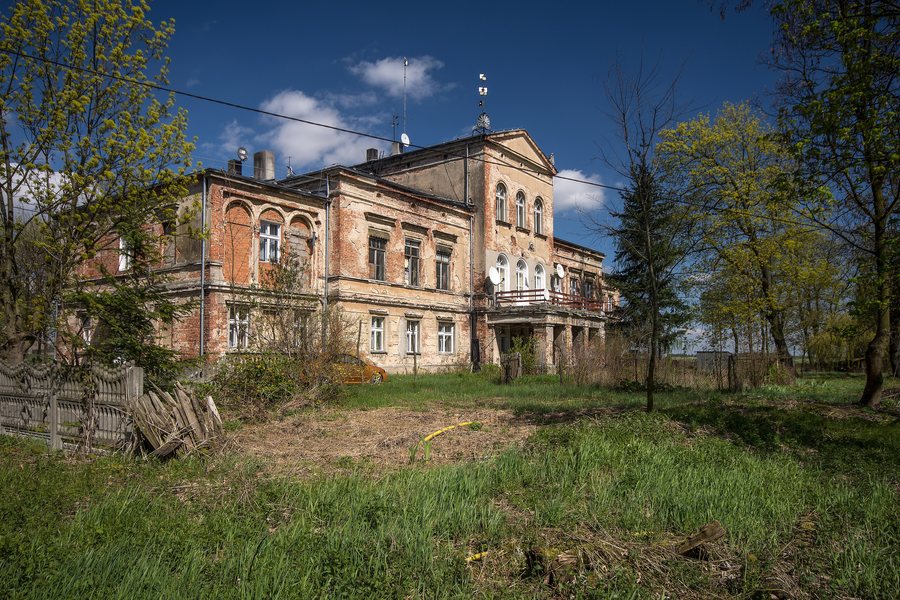 File:SM Rososzyca Pałac (2) ID 653847.jpg
Photo: Sławomir Milejski via Wikimedia Commons, CC BY-SA 4.0
File:SM Rososzyca Pałac (2) ID 653847.jpg
Photo: Sławomir Milejski via Wikimedia Commons, CC BY-SA 4.0
Rososzyca at a glance
Notable buildings include the Church of St. Mark the Evangelist and the Skórzewski Palace, dating from the 1870s. The manor park covers more than five hectares and contains old trees, including oaks designated as natural monuments. Cycling Route No. 1 is around 27 km long and passes through Rososzyca and other nearby villages.
What do the church and palace tell us about Rososzyca’s history?
The Church of St. Mark the Evangelist was built in 1818. It stands on the site of a wooden church endowed by Michał Wierzbowski in 1692. The construction of the present church was commissioned by Paweł Skórzewski, senator and voivode of Kalisz, and by parish priest Bogumił Grodecki.
The building has a single nave. Its presbytery, the part of the church designated for the altar, is slightly narrower than the nave and consists of one bay. It ends in a semicircle.
The Skórzewski Palace dates from the 1870s and is designed in the Neo-Renaissance style, with references to the Italian Renaissance. The palace’s complex structure shows the passage of time, and it is inhabited. The church and palace thus represent different periods and architectural forms; visitors interested in historic buildings will find more than a single glimpse of local history in Rososzyca.
What can you discover in the manor park?
The manor park covers more than five hectares. Its recorded tree cover is characterized by old trees and imposing oaks, which are designated as natural monuments. The park may therefore be of interest to you both for its size and for these specifically protected trees.
The park also contains the remains of an old fortification, dating approximately from the 13th to the 15th century. Together with the church and palace, the park offers several points of historical interest: a medieval fortification, a church with a history dating back to its construction in 1818, and a palace from the 1870s.
What is the route of Cycling Route No. 1?
Cycling Route No. 1 is around 27 km long and passes through Sieroszewice, Rososzyca, Strzyżew, Wydarta, the “Majówka” and “Niwa” nature reserves, Namysłaki, Masanów and Rososzyca Pólko. It then returns to Sieroszewice. The stated distance refers to the entire loop. Consider this when deciding whether to include a cycling tour of this length in your travel plans.
What do the festival and early finds reveal?
At the “Święto Ziemniaka Pyrczok” festival, potato dishes were served as the main fare. The program also included potato competitions for children and adults. The festival was organized by the local Koło Gospodyń Wiejskich (Rural Housewives’ Association) and the village council.
Archaeological finds are also part of the village’s history: a cemetery dating from the Early Iron Age, approximately 700–600 BC, was discovered in Rososzyca. This dating points to a much earlier period than the medieval remains in the manor park. If you choose Rososzyca mainly for its culture and history, you can consider these different time periods without confusing them.
For your travel decision, there are several different options to consider: church architecture, an inhabited palace, a park and castle remains, a cycling route of around 27 km, or the history of the potato festival. Consider which of these themes matters most to you when deciding whether to visit Rososzyca and look for suitable accommodation.
If you’d like to compare other village pages: Korytnica, Skrzebowa, Antonin, Radłów, Sulisław, Przygodziczki, Nowe Skalmierzyce and Odolanów.
FAQ
How long is Cycling Route No. 1?
The loop is around 27 km long and returns to Sieroszewice.
When does the Skórzewski Palace date from?
The palace dates from the 1870s and is designed in the Neo-Renaissance style, with references to the Italian Renaissance.
What was offered at the “Święto Ziemniaka Pyrczok”?
Potato dishes were served as the main fare; there were also potato competitions for children and adults.
For the broader travel overview: Ostrowo.

_ID_653847.jpg)