
Wielka Nieszawka – Olender Culture and Settlement Pattern
Accommodation in Wielka Nieszawka
Wielka Nieszawka is characterized by a distinctive settlement pattern and the Olenderski Park Etnograficzny. Here you can find information about the layout of the village, the open-air museum, and ways to plan your visit.
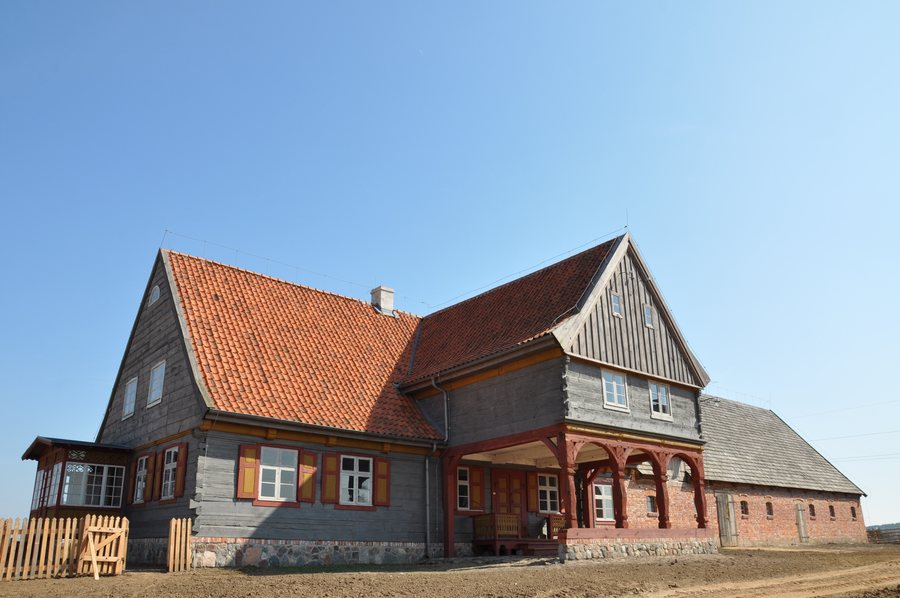 Zagroda z Kaniczek - Olenderski Park Etnograficzny w Wielkiej Nieszawce
Photo: Olebart via Wikimedia Commons, CC BY-SA 4.0
Zagroda z Kaniczek - Olenderski Park Etnograficzny w Wielkiej Nieszawce
Photo: Olebart via Wikimedia Commons, CC BY-SA 4.0
Wielka Nieszawka at a glance
- Wielka Nieszawka and Mała Nieszawka form a single unit with their two-row wetland settlement pattern.
- The Olenderski Park Etnograficzny is Poland’s first open-air museum dedicated entirely to Olender settlements.
- A village from the turn of the 19th and 20th centuries has been reconstructed there across more than five hectares.
- The visit includes audio guide options; the park can be reached on MZK bus lines 151 and 152.
What characterizes the settlement pattern?
The characteristic wetland settlement pattern links Wielka Nieszawka with nearby Mała Nieszawka. The homesteads stand in a row along the road. Field strips run perpendicular to it, separated from one another by drainage ditches. This arrangement gives the settlement its two-row form: the road and homesteads on one side, and the narrow fields on the other.
Those interested in the spatial layout of the village will find more here than a description of individual buildings. The orientation of the fields and the ditches are also part of the traditional pattern. This makes it possible to view the structure as a unified landscape and settlement pattern, without separating the two named places.
What does the Olenderski Park Etnograficzny show?
The Olenderski Park Etnograficzny is devoted entirely to Olender settlements. A village from the turn of the 19th and 20th centuries has been reconstructed across more than five hectares. Its linear settlement pattern is characteristic of floodplains. The park thus offers a tangible insight into a settlement pattern that is also reflected in descriptions of Wielka Nieszawka and Mała Nieszawka.
Buildings from the Lower Vistula Valley stand in the park among fields, orchards, and gardens. They illustrate the Olenders’ way of life and living conditions. The grounds also include a cemetery with more than 150 marked graves. The earliest surviving date on a gravestone is 1847.
What visitor information is available on site?
For your tour, you can use an audio guide on your own smartphone or borrow a device. The loan devices offer texts in Polish, English, and German, as well as audio description; borrowing one is free. Tactile maps are also available at the ticket office. Ramps to the homesteads can be provided on request. These options are especially useful if you want to consider in advance which type of orientation suits your needs.
If you need a specific option, check this information with the museum again before your visit.
How do you get to the museum, and what might interest cyclists?
The Olenderski Park Etnograficzny can be reached on MZK bus lines 151 and 152. From the “Wielka Nieszawka Wiślana” stop, a footpath leads to the open-air museum in five minutes. As routes and directions can change, it is advisable to check your connection before setting off.
An older route description mentions a green cycle route that passes hillforts in Wielka Nieszawka. If you’re planning to cycle there today, check the route in advance.
Discover more destinations: Stary Toruń, Czarne Błoto, Łysomice, Steklin, Ostaszewo, Cierpice, Papowo Toruńskie, Czernikowo.
FAQ
What is the Olenderski Park Etnograficzny known for?
The open-air museum is devoted entirely to Olender settlements and features a reconstructed village from the turn of the 19th and 20th centuries.
What audio guides does the park offer?
You can use your own smartphone or borrow a device free of charge with texts in Polish, English, and German, as well as audio description.
How do you get from the bus stop to the museum?
From the “Wielka Nieszawka Wiślana” stop, a footpath leads to the open-air museum in five minutes. Check the bus connection and directions before setting off.
Go to the higher-level travel overview: Toruński.

