
Lipinki: Churches, History and a Hiking Trail
Accommodation in Lipinki
Churches, memorial sites and the history of oil give Lipinki a clear cultural focus. There is also a blue-marked hiking trail, with a stated walking time of five hours for the full route. As you plan your trip, you can first decide whether to focus on historic buildings or a longer hike.
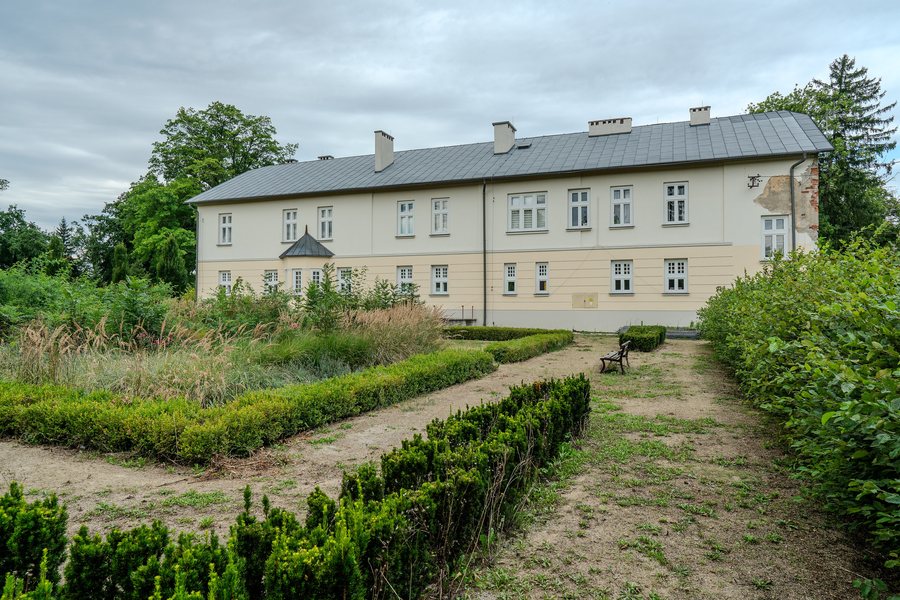 File:Lipinki gm. Lipinki. Zespól dworsko parkowy A103M (4).jpg
Photo: Januszk57 via Wikimedia Commons, CC BY-SA 4.0
File:Lipinki gm. Lipinki. Zespól dworsko parkowy A103M (4).jpg
Photo: Januszk57 via Wikimedia Commons, CC BY-SA 4.0
Lipinki at a glance
- Four war cemeteries are located in Rozdziele, Pagorzyn, Wójtowa and Bednarka.
- The wooden Church of St. Bartholomew in Wójtowa dates from the 16th century and is classified as a Class III monument.
- The historic Byszewski manor house and its park have been preserved in Lipinki.
- The blue-marked hiking trail runs through Biecz, Lipinki, Rozdziele and Ferdel.
Which historic sites shape the municipality?
The four war cemeteries in Rozdziele, Pagorzyn, Wójtowa and Bednarka are the final resting places of those killed in the Battle of Gorlice in early May 1915. Their distribution across several villages in the municipality makes these memorial sites a distinct theme if you want to explore Lipinki’s cultural history.
The churches can also be distinguished by their period, construction and dedication. Wójtowa is home to the wooden Church of St. Bartholomew, which dates from the 16th century and is classified as a Class III monument. In Rozdziele, a church is dedicated to the Protection of the Mother of God (Pokrow). Another church, built from dressed sandstone in 1927, is dedicated to the Nativity of the Blessed Virgin Mary. These details give you specific points of comparison for the municipality’s history of sacred architecture.
The historic Byszewski manor house and its park have been preserved in Lipinki. Numerous historic chapels also add to the local landscape. One chapel was built on the site of the main altar of the first Catholic church. Together, the manor house, park, churches and chapels represent different aspects of local history.
What connects Lipinki with the history of oil?
Oil is another part of Lipinki’s history. The oil wells known as kopanki associated with Lipinki date from the late 19th century. Oil is still extracted in Kryg and Lipinki, though this operating status may change. The historic link to the kopanki and ongoing extraction in both villages thus represent different periods.
If you are interested in regional cultural history, this topic offers a different perspective from churches and memorial sites. When planning your trip, you can consider the combination of historic wells and ongoing extraction as a focus in its own right, alongside sacred and architectural heritage.
What should you know about the hiking route?
The blue-marked hiking trail passes through Biecz, Lipinki and Rozdziele on its way to Ferdel, and extends as far as the northern built-up areas of Lipinki. The stated walking time of five hours applies to the entire route, not just the section in Lipinki. This helps you gauge the time required without mistaking the full-route estimate for the walking time within the village itself.
The route description refers to a 2003 hiking guide; trail conditions may change. Check the current situation before your hike if you plan to follow the route.
Discover more destinations: Gładyszów, Kunkowa, Hańczowa, Bystra, Nowica, Klimkówka, Biecz and Strzeszyn.
FAQ
How long does the hiking trail through Lipinki take?
The entire blue-marked Biecz–Lipinki–Rozdziele–Ferdel route has a stated walking time of five hours. It reaches the northern built-up areas of Lipinki; the five hours do not apply only to this section.
Which churches are described in the municipality of Lipinki?
Wójtowa is home to the wooden Church of St. Bartholomew, which dates from the 16th century and is classified as a Class III monument. In Rozdziele, one church is dedicated to the Protection of the Mother of God (Pokrow); another, built from dressed sandstone in 1927, is dedicated to the Nativity of the Blessed Virgin Mary.
What recalls Lipinki’s oil history?
Oil wells known as kopanki are dated to the late 19th century. Oil is still extracted in Kryg and Lipinki, although this operating status may change.
For the broader travel overview: Gorlice.

.jpg)