
Discover Gładyszów
Accommodation in Gładyszów
Two specific points of interest help place Gładyszów in its cultural context: the Orthodox Church of the Nativity of St. John the Baptist and World War I Cemetery No. 55. The building’s history, interior and wooden features offer different ways to explore the area.
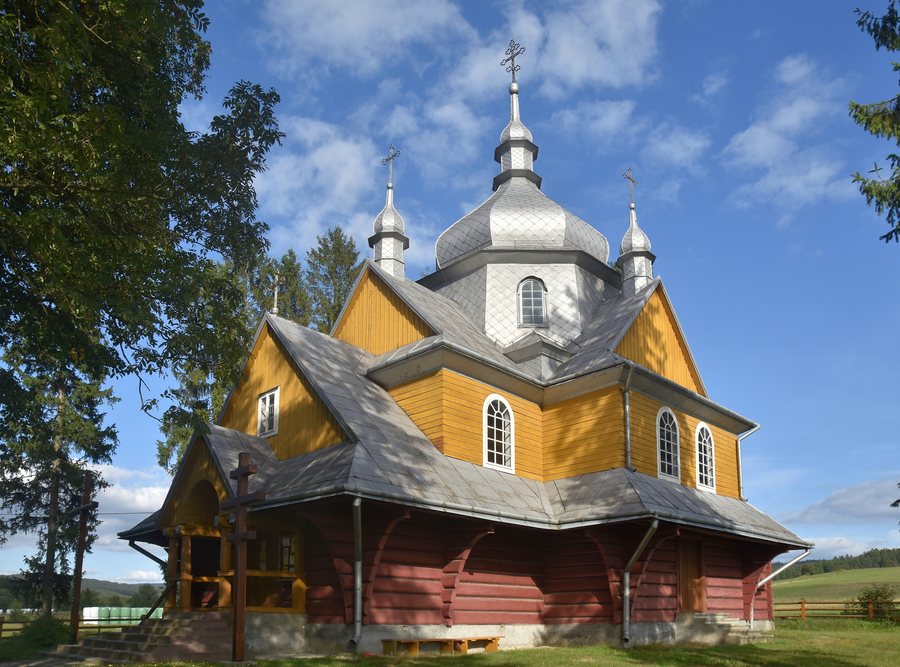 File:Gładyszów, cerkiew Wniebowstąpienia Pańskiego (HB6).jpg
Photo: Henryk Bielamowicz via Wikimedia Commons, CC BY-SA 4.0
Gładyszów at a glance
- The Orthodox Church of the Nativity of St. John the Baptist is part of the Wooden Architecture Route in Małopolska.
- It was built in 1857 and extended in 1914, after the previous church burned down.
- An iconostasis dating from the 20th century separates the nave from the enclosed, three-sided sanctuary.
- The central feature of Cemetery No. 55 is a restored, tall wooden tower on a stone base.
Which historical events shaped the church?
The building’s history comprises two distinct stages: the Orthodox parish church was built in 1857, followed by an extension in 1914. The new building was needed because the previous church had burned down. The dates therefore mark not a single construction event, but the original building and a later extension. If you include Gładyszów in your travel plans for its cultural history, you can consider these two building phases separately.
The church’s use also changed over time. It was used by Greek Catholics until the Lemkos were expelled in 1947. It was later converted into a stable and handed over to the Orthodox Church in 1967. The building’s construction history and its history of use are therefore two distinct aspects: the first traces its construction and extension, while the second reflects its changing functions.
The local history also includes the return of some residents after the postwar expulsions. Some residents resettled in Gładyszów after 1957.
What are the distinguishing features of the church’s architecture?
Inside, an iconostasis dating from the 20th century separates the nave from the enclosed, three-sided sanctuary. Put simply, the wall divides the church interior into the nave and the sanctuary. The shape of the sanctuary and its separation by the iconostasis are two specific features that help describe the interior.
The walls and ceiling of the sanctuary are decorated with folk paintings depicting the Holy Trinity. The subject of the paintings is clearly identified, and the decoration covers both the walls and the ceiling. There is also a wooden bell tower with a square ground plan and a tented roof next to the church.
How is Cemetery No. 55 different from the church?
At World War I Cemetery No. 55 in Gładyszów, the focus is on a restored, tall wooden tower. It stands on a stone base and is topped by a wooden cross. By contrast, the church’s described features span its building phases, interior and neighboring bell tower. At the cemetery, the striking description centers on the tower, base and cross.
Wood is present in both places, but in different forms: at the church, in the bell tower; at the cemetery, in the tall tower. When planning your trip around your cultural interests, the church offers ways to explore architecture and changing uses, while the cemetery is distinguished by its striking tower monument. This makes it possible to identify two different aspects of Gładyszów without combining them into a single visit topic.
Discover more destinations: Szymbark, Klimkówka, Kunkowa, Nowica, Czarne, Bystra, Ropa, Krzywa.
FAQ
Which church in Gładyszów is part of the Wooden Architecture Route in Małopolska?
The Orthodox Church of the Nativity of St. John the Baptist is part of this route.
When was the church built and extended?
It was built in 1857 and extended in 1914, after the previous church burned down.
What are the distinguishing features of the church’s interior?
An iconostasis dating from the 20th century separates the nave from the enclosed, three-sided sanctuary. The walls and ceiling of the sanctuary are decorated with folk paintings depicting the Holy Trinity.
What is the central feature of Cemetery No. 55?
A restored, tall wooden tower on a stone base, topped by a wooden cross.
For the broader travel overview: Gorlice.

