
Rożnowice: Discover the Church and Its History
Accommodation in Rożnowice
Rożnowice can be explored through two distinct cultural and historical themes: the architectural and artistic history of St. Andrew’s Church, and the history of the First World War military cemetery. This information can help you decide which aspect interests you most.
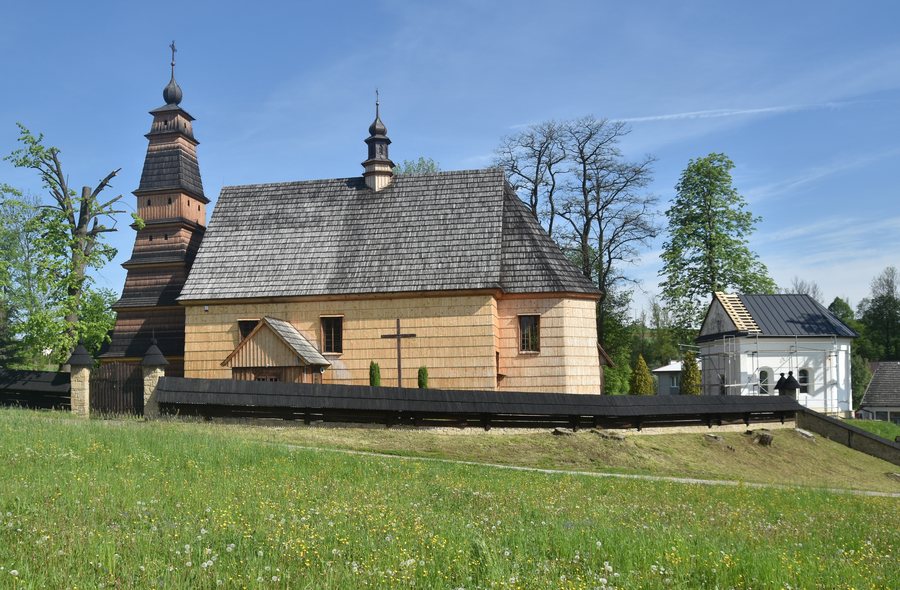 Rożnowice, kościół św. Andrzeja Apostoła (HB15)
Photo: Henryk Bielamowicz via Wikimedia Commons, CC BY-SA 4.0
Rożnowice, kościół św. Andrzeja Apostoła (HB15)
Photo: Henryk Bielamowicz via Wikimedia Commons, CC BY-SA 4.0
Rożnowice at a glance
- St. Andrew the Apostle Church was built between 1756 and 1764 on the site of an earlier place of worship.
- Its interior is late Baroque in character; J. Kozicki painted the polychrome decoration in 1787. The three Rococo altars date from the 18th century.
- First World War military cemetery No. 112 has a rectangular layout and covers 570 m². It lies among fields used for agriculture.
- The municipal description lists 256 soldiers buried there, including 133 unidentified soldiers.
Which historical themes can you explore in Rożnowice?
The church and cemetery offer different ways to engage with the town’s history. At the church, you can distinguish its period of construction, its predecessor, and its later artistic decoration. The cemetery draws attention to those buried there during the First World War and to a specific memorial site in the landscape. This lets you decide while planning whether you are more interested in religious architecture and art or in historical remembrance.
You can also consider the two themes together without treating them as the same: the church’s history concerns its construction and design, while the cemetery is described in terms of its layout, area, and burial figures. These differences give you a clear point of reference when choosing Rożnowice for its cultural history or deciding how to prioritise these themes on your trip.
What do the church’s construction date and furnishings tell us?
St. Andrew the Apostle Church was built between 1756 and 1764 on the site of an earlier place of worship. This gives us both a specific period of construction and a record of a predecessor building. The polychrome decoration is important for dating the furnishings: J. Kozicki created it in 1787, after the church was built. The building’s history and its artistic design can therefore be considered as distinct, successive aspects.
The church also has three Rococo altars dating from the 18th century. Their date places them in the same century as the church’s construction, while the decoration is more precisely dated to 1787. Those interested in historic interiors will find several specific points of reference, rather than just a general description of the style. The late Baroque character describes the interior; the painter, date, and altars add identifiable details to this picture.
How can the military cemetery be understood in context?
At military cemetery No. 112, a clearly described layout and a modest area are connected with the history of those buried there. The municipal description lists 256 soldiers, including 133 unidentified soldiers. These figures indicate the recorded scale of the burial site without going into the individual stories. The information that it lies among fields used for agriculture adds a description of its landscape setting to the historical context.
The church and cemetery also differ in the kinds of details you can explore based on your interests: the church is defined by its construction period and furnishings, while the cemetery is described by its burial figures, rectangular layout, and area of 570 m². This comparison helps you explore Rożnowice’s cultural themes with purpose, rather than treating both sites as interchangeable historical stops.
Which accommodation search suits your travel plans?
If you are considering Rożnowice for its architectural history and memorial heritage, you can choose a hotel separately from deciding what to explore.
Discover more destinations: Bystra, Ropa, Klimkówka, Krzywa, Wysowa-Zdrój, Korczyna, Sękowa, Lipinki.
FAQ
When was St. Andrew’s Church built?
It was built between 1756 and 1764 on the site of an earlier place of worship. The polychrome decoration by J. Kozicki dates to 1787.
How many soldiers are buried at cemetery No. 112?
The municipal description lists 256 soldiers buried there, including 133 unidentified soldiers.
What are the physical details of the military cemetery?
The cemetery has a rectangular layout, covers 570 m², and lies among fields used for agriculture.
For the broader travel overview: Gorlice.

.jpg)