
Bienkówka: Valley, Church and Places of Remembrance
Accommodation in Bienkówka
Bienkówka lies in the Kamienna Valley, on the slopes of wooded hill ranges. Its church, chapel and places of remembrance give the village a distinct cultural character. Here you can learn about the landscape, history and routes described.
Bienkówka at a glance
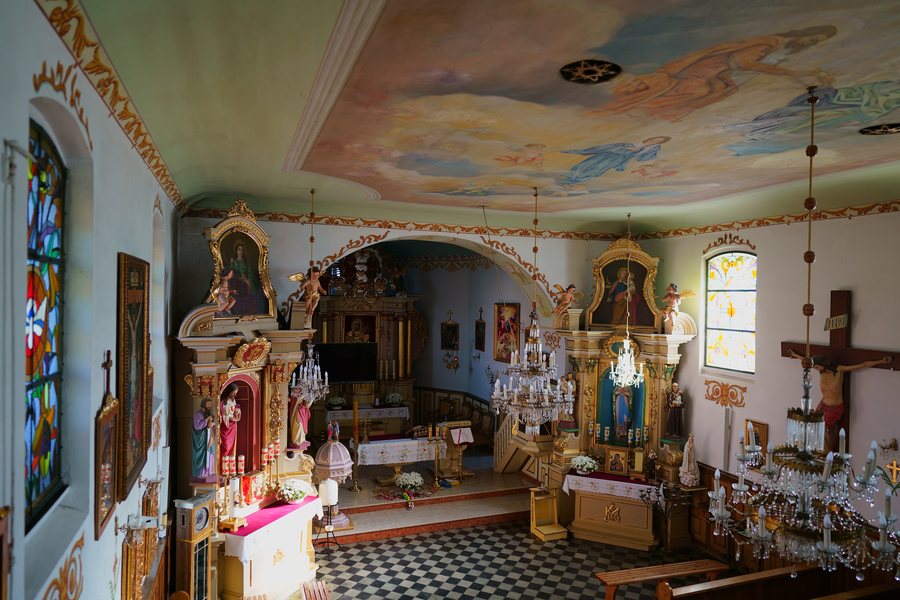
Residents call the Kamienna the Skorutówka. Hill ranges surround Bienkówka to the north and south; their wooded slopes are covered mostly with spruce and fir. Notable buildings include the Parish Church of the Most Holy Trinity, a stone Baroque building with a massive four-sided tower. The Freedom Oak stands next to the church.
What characterizes the valley and hills?
The setting combines two distinct landscape features: Bienkówka lies in the Kamienna Valley and also on the slopes of two hill ranges that surround the village to the north and south. Residents call the Kamienna the Skorutówka.
Several tree species grow on the wooded hills: spruce and fir predominate, while beech, juniper and larch grow in smaller numbers. These trees are not just a backdrop to the landscape; they also characterize it through their variety. This helps you understand the village’s landscape when planning your trip, without associating it with a particular route or a single viewpoint.
What buildings and places of remembrance are there?
The Parish Church of the Most Holy Trinity is a stone Baroque building. Its massive four-sided tower continues the line of the nave. The church’s history also includes the fact that residents began building their own church in 1793. Another historic building in Bienkówka is a three-storey stone chapel dating from 1876.
The Freedom Oak stands next to the church. Young people planted it in 1923 to commemorate the restoration of Polish independence. Another place of remembrance is an obelisk erected in 2001 and dedicated to the victims of the Second World War from Bienkówka. The two sites thus commemorate different events: the oak represents the restoration of Poland’s independence, while the obelisk commemorates the village’s war victims.
What routes are described?
A 2016 municipal description mentions a marked blue hiking trail running north from Bienkówka towards Lanckorona and south via Koskowa Góra towards Jordanów.
A nature trail to Babica was also established in Bienkówka and equipped with markers and information boards. Their different focus can help you distinguish between the routes: the blue hiking trail has named directions and destinations, while the nature trail focuses on Babica and its information boards. This may help you decide whether you would prefer to follow a route with named directions or a trail with interpretive information.
If you would like to compare other destinations as you plan your trip, also discover Budzów, Maków Podhalański, Juszczyn, Tarnawa Dolna, Białka, Grzechynia, Jordanów and Lachy.
FAQ
What characterizes the Parish Church of the Most Holy Trinity?
It is a stone Baroque building. Its massive four-sided tower continues the line of the nave.
What do the Freedom Oak and the obelisk commemorate?
The oak, planted by young people in 1923, commemorates the restoration of Polish independence. The obelisk, erected in 2001, is dedicated to the victims of the Second World War from Bienkówka.
How do the routes described differ?
The 2016 municipal description names Lanckorona and Jordanów as directions for the blue hiking trail. For the nature trail to Babica, it describes the trail itself, its markers and its information boards.
For the broader travel overview: Sucha.

