
Accommodation in Tarnów: Old Town and Culture
Accommodation in Tarnów
Tarnów combines a Renaissance street plan with historic buildings and museums that explore different chapters of the city and region. When planning your trip, you can consider architecture, collections and a themed trail of figures as distinct points of interest.
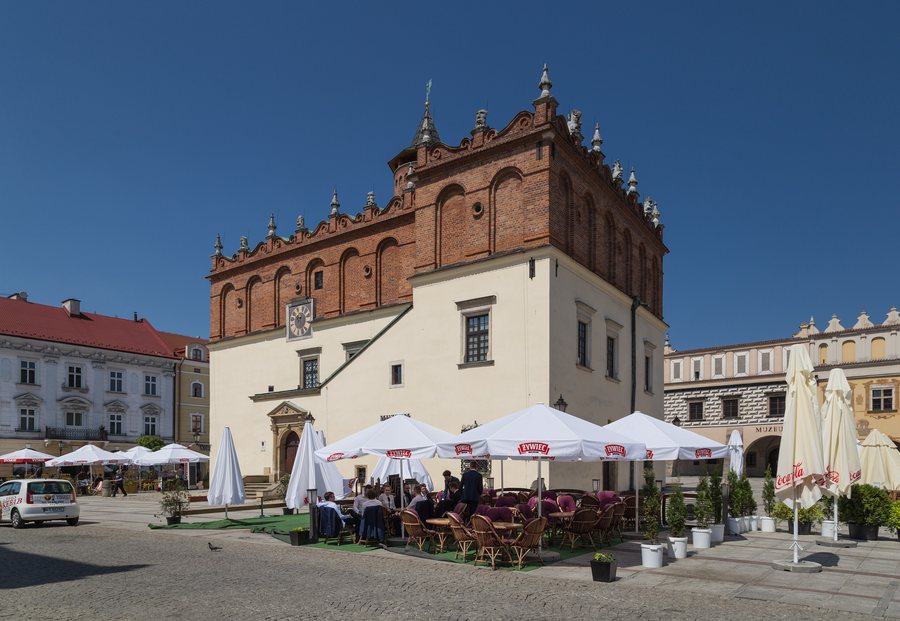
Tarnów at a glance
- The market square was laid out in 1330 when the city was founded; it is lined mainly with townhouses dating from the 16th to 18th centuries.
- The Ethnographic Museum houses more than 5,000 objects, including exhibits on regional folk culture and works by women painters from Zalipie.
- The Szlak Maszkaronów was created in spring 2024 and connects twenty figures at important locations around the city; their number may change.
- “‘Tarnowski Smak’ includes ‘Tarninówka’, a tea made from sloe berries.”
How does Tarnów’s history come to life in the Old Town?
Different periods meet in the market square: it was created in 1330 when the city was founded, and the townhouses that mostly line it date from the 16th to 18th centuries. Together with the Renaissance street plan, they give a tangible impression of the historic layout of the city centre.
The Town Hall is also part of this picture of the city’s history. Its origins date back to the mid-15th century. Tarnów is also the birthplace of Polish-Hungarian General Józef Bem—a biographical connection that adds a well-known figure to the city’s history.
What architectural history do the churches tell?
The Cathedral Basilica was built in the 14th century in the Gothic style. It acquired its present-day Neo-Gothic appearance following an extensive renovation and partial rebuilding between 1889 and 1900. The cathedral contains Renaissance tombs of members of the Tarnowski family, as well as a Mannerist tomb of the Ostrogski family. The building’s history and its tombs offer different ways to understand the interior and the development of the structure.
Another historic church is the wooden church of Matki Bożej Szkaplerznej, near the market square. It was consecrated in 1440. Compared with the Cathedral Basilica, the focus here is on its timber construction and earlier consecration date; together, the two sites reveal different aspects of Tarnów’s religious heritage.
What can you discover in the museums?
The Museum of the History of Tarnów and the Region takes visitors through prehistory, a guild tavern, a tram, the Second World War and the period of the People’s Republic of Poland. A figure of a barrel organ player also guides visitors through the city’s history. The Armoury displays medieval swords. Alongside historical periods, individual objects and a storytelling figure are also in focus.
The Ethnographic Museum offers a different perspective. Its collection comprises more than 5,000 objects, including exhibits on the traditional folk culture of the Tarnów region and works by women painters from Zalipie. The world’s first permanent exhibition on the Roma opened there in 1990. It includes, among other things, handicrafts made by various Roma groups living in Europe, magical objects used in fortune-telling, and works by contemporary Roma artists. In Tarnów, you can therefore explore city history as well as folk culture and Roma art.
What other themes can add to your stay?
The Szlak Maszkaronów is a tourist attraction in Tarnów. Created in spring 2024, the trail connects twenty Maszkaron figures at locations important to the city. Since the number of figures may change, it should be understood as a changing feature of the trail. The figure trail offers a different focus from the museums and historic buildings: it links the Maszkaron figures with important places around the city.
Local flavours have a name of their own, too: “‘Tarnowski Smak’ includes ‘Tarninówka’, a tea made from sloe berries.” If you are looking for a hotel in Tarnów, you can start planning by considering whether you are more interested in the buildings, the different museum collections or the Szlak Maszkaronów. These topics offer distinct points of focus for your cultural trip.
Discover more destinations: Jamna, Janowice, Wierzchosławice, Świebodzin, Ryglice, Zabawa, Wał-Ruda, Zbylitowska Góra.
FAQ
How many figures does the Szlak Maszkaronów connect?
Created in spring 2024, the trail connects twenty Maszkaron figures at important locations in Tarnów. The number may change.
What does the permanent exhibition on the Roma cover?
The exhibition, which opened in 1990, includes, among other things, handicrafts made by various Roma groups living in Europe, magical objects used in fortune-telling, and works by contemporary Roma artists.
Which tombs are in the cathedral?
It contains Renaissance tombs of members of the Tarnowski family and a Mannerist tomb of the Ostrogski family.
To the main travel overview: Tarnów.

