
Smardzewice: Sanctuary, Promenade and Pier
Accommodation in Smardzewice
Smardzewice brings together different highlights to consider when planning your trip: the Franciscan monastery complex with the Sanctuary of Saint Anne, activities at the Sulejowski Reservoir, and a hiking trail that passes through the town. This lets you give culture, time by the water and hiking the emphasis that suits your interests.
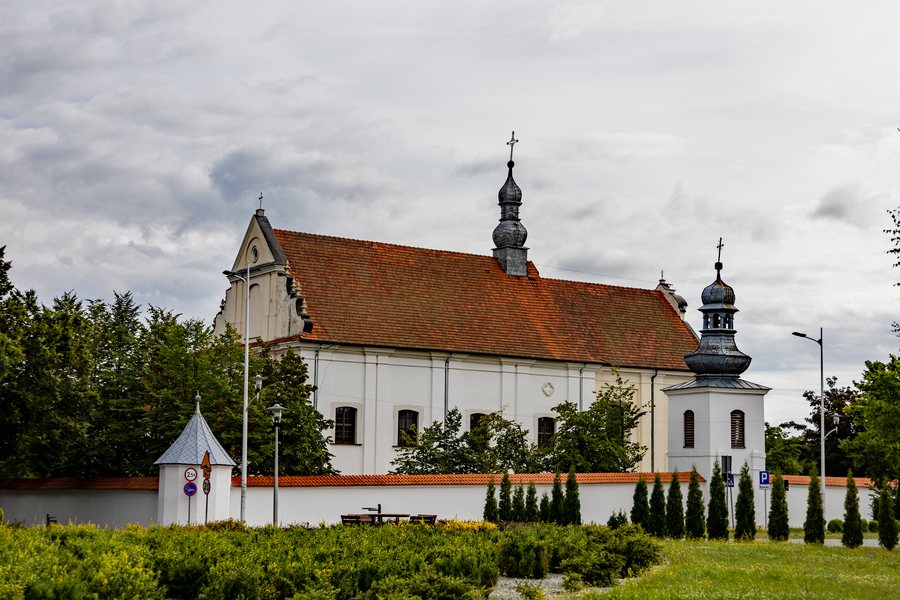
Smardzewice at a glance
- The Sanctuary of Saint Anne is housed in a fine example of sacred Baroque architecture.
- The main altar of Saint Anne dates from around 1700; access to the sanctuary is through a renovated park.
- The recreation area at the Sulejowski Reservoir has a promenade, two playgrounds and a beach volleyball court. It can be reached via Klonowa Street.
- A pier around 0.3 km long extends into the reservoir. The blue Ignacy Mościcki hiking trail is about 21.5 km long and passes through Smardzewice.
- The bison breeding centre was established between 1934 and 1936; the “Smardzewianie” ensemble preserves regional folklore traditions.
What does the sanctuary tell us about Smardzewice?
The Franciscan monastery complex with the Sanctuary of Saint Anne is a fine example of sacred Baroque architecture. The sanctuary’s origins are linked to a religious tradition: according to the account, Saint Anne, the mother of the Virgin Mary, appeared to local resident Wojciech Głowa in the 17th century. The beginnings of the sanctuary date back to this event. This means you can consider the town’s history and the complex’s architecture from two different perspectives.
Individual parts of the complex also provide a sense of its history. The main altar of Saint Anne in the sanctuary church dates from around 1700. Access to the sanctuary is through a renovated park. These details help you distinguish the religious tradition, the historic furnishing and the described approach to the complex, rather than treating them as a single attraction.
What does the recreation area at the Sulejowski Reservoir offer?
In Smardzewice, the recreation area at the Sulejowski Reservoir has a promenade running alongside a sandy, grassy beach. Facilities include two playgrounds, one of them a water playground, as well as a beach volleyball court. The area thus combines play and sports facilities in a recreational setting. The access point is also clearly specified: the area can be reached via Klonowa Street.
A pier around 0.3 km long in Smardzewice extends into the reservoir. Its length gives a concrete sense of the scale of this waterside attraction. If you are weighing up different options, you can compare the beach promenade, playgrounds and volleyball court with access via the pier. These facilities are distinct aspects of spending time by the water, not interchangeable descriptions of the same offering.
How do the pier and hiking trail differ?
The blue Ignacy Mościcki hiking trail is about 21.5 km long. It runs from Spała through Ciebłowice Duże, Jeleń and Wąwał, passing through Smardzewice before reaching Tomaszów Mazowiecki. The sequence of towns makes clear that Smardzewice lies on a longer route, whereas the pier extends about 0.3 km into the Sulejowski Reservoir. The two lengths can be compared as different scales: a short pier by the water and a hiking trail connecting several of the places mentioned.
For planning purposes, it is more useful to distinguish between them than to describe them as one route: the pier and hiking trail have different courses and scales. If you are mainly interested in the lake, the promenade, beach and pier provide specific points of reference. If you want to understand the longer hiking route, its length and the course of the blue trail are the relevant details.
What other cultural and historical themes are there?
The “Smardzewianie” folk ensemble preserves regional folklore traditions. Smardzewice is also associated with Sobótki celebrations in June. These cultural themes complement the sacred architecture with folklore and a celebration associated with June.
The bison breeding centre in Smardzewice is another of the historical points of interest mentioned; it was established between 1934 and 1936. By comparison, the tradition about the sanctuary’s origins dates back to the 17th century, and the main altar dates from around 1700. This gives you several different historical reference points without equating the religious tradition, the work of art and the founding of the centre.
Discover more destinations: Józefów Stary, Kanice, Inowłódz, Spała, Ujazd, Czerniewice, Tomaszów Mazowiecki.
FAQ
How is the sanctuary’s origin described?
According to the account, Saint Anne appeared to local resident Wojciech Głowa in the 17th century. The beginnings of the sanctuary date back to this event.
What facilities are available in the recreation area by the reservoir?
There is a promenade alongside a sandy, grassy beach, two playgrounds including a water playground, and a beach volleyball court. The area can be reached via Klonowa Street.
What is the route of the blue Ignacy Mościcki hiking trail?
The trail is about 21.5 km long and runs from Spała through Ciebłowice Duże, Jeleń and Wąwał, passing through Smardzewice before reaching Tomaszów Mazowiecki.
Go to the broader travel overview: Tomaszowski.

